
For many founders, marketing feels like a treadmill that only moves when they run. You have a decent website, useful expertise, and enough content to help buyers, yet marketing support for small business still feels harder than it should be when client work gets busy and marketing slips. When leads slow down, marketing becomes urgent again. That cycle is exhausting.
The real problem is not usually a lack of ideas. It is the lack of steady follow-through. Service businesses often do not need another brainstorm, another campaign theme, or another batch of disconnected posts. They need a calmer way to keep useful work moving without adding more coordination burden to the founder.
Marketing Support for Small Business is the practical, ongoing execution that keeps a service business’s website, content, and visibility moving forward consistently, without relying on the founder to drive every task personally.
That definition matters because many founders buy “marketing help” and get more noise instead of more progress. Sustainable growth comes from small, useful improvements repeated over time. Clear ownership. Lower friction. Visible movement. In practice, that is what marketing support for small business should deliver.
Key Takeaways
- Steady over Sporadic: Sustainable growth is built on weekly marketing movement rather than inconsistent, high-pressure campaigns.
- Operational Clarity: Effective marketing support for small business owners prioritizes execution over abstract strategy.
- Asset Leverage: Use what you already have: refreshing and connecting existing content is often more valuable than creating new material from scratch.
- Compound Interest: Small website improvements, such as internal linking and FAQ updates, yield significant long-term results when applied consistently.
- Ownership Matters: Moving marketing from your “memory and motivation” to a structured partner-led system reduces burnout and friction.
The Founder-Led Marketing Paradox
Most founder-led service businesses are built on expertise, trust, and direct client relationships. That is a strength. It is also the source of the bottleneck. The founder knows the work best, hears the buyer’s questions first, and understands the nuance behind every service. But that same knowledge often means marketing waits for the founder’s time, memory, and energy.
When you manage your own marketing support for small business growth, the work usually happens in bursts. You publish a strong article on a Saturday. You update a service page after a good sales call. You finally sent a newsletter because you felt behind. Then client delivery takes over again, and the marketing backlog grows quietly in the background.
In our experience, this is where the treadmill feeling gets real. One founder we helped had a strong website, years of useful insight, and clear client results, but everything depended on her finding “a free afternoon” to move marketing forward. She kept rewriting the same ideas in different places, had half-finished drafts in Google Docs, and felt guilty every time she looked at her site. What changed was not a big strategy reveal. We helped her move from scattered effort to a weekly operating rhythm. A few service page updates. A content refresh. Better internal links. A simpler review loop. Within a few cycles, the work stopped living in her head. That relief mattered as much as the marketing gains.
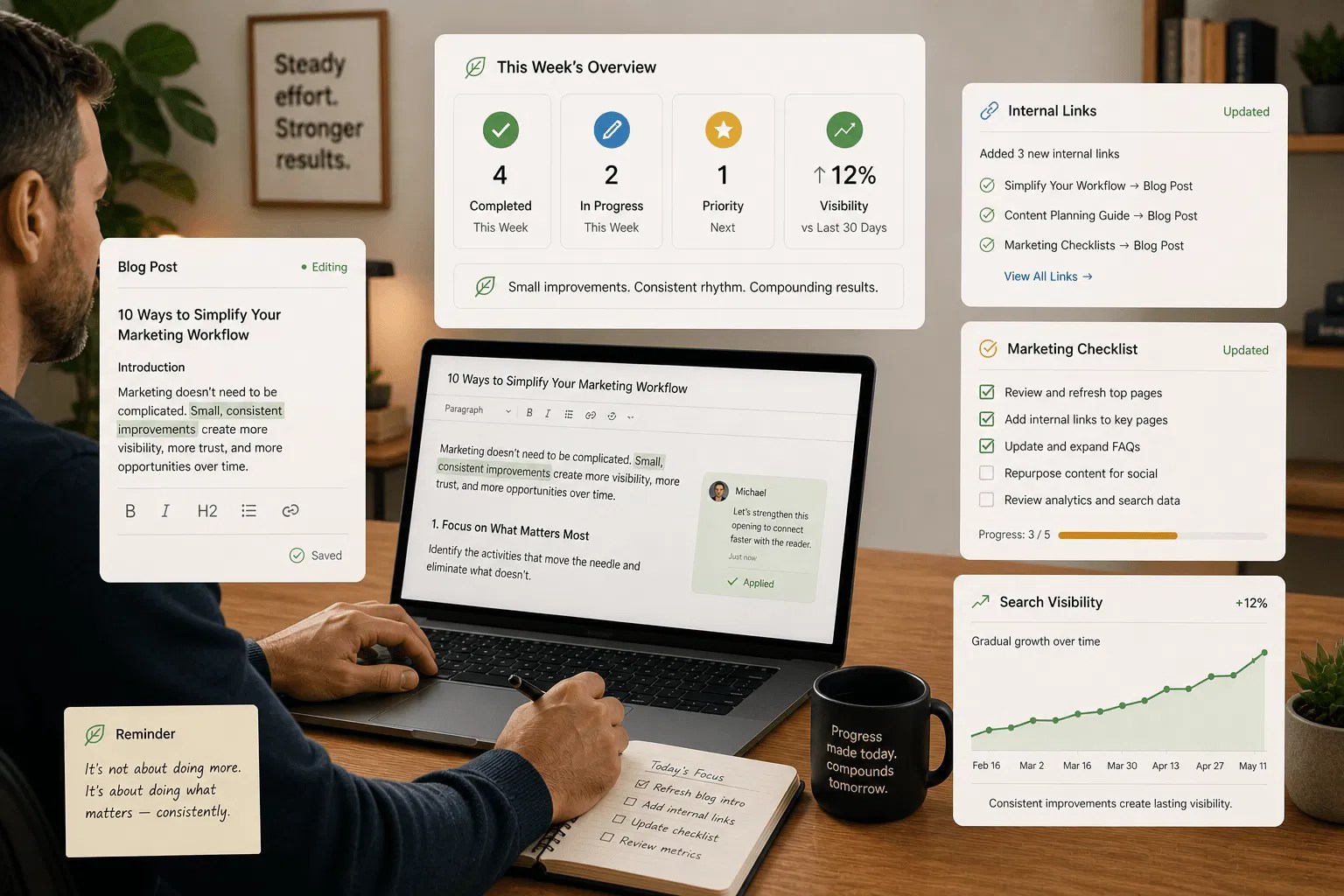
To break this cycle, you have to stop treating marketing as an event and start treating it as a function. It should not depend on spare time at the end of the week. It should move in the background, quietly and reliably, even when client work gets busy. That shift from founder-driven effort to system-driven progress is what protects growth and reduces burnout. For a deeper look at that pressure, see Marketing Operations for Founders: Prevent Burnout and Keep Moving.
Why Inconsistent Campaigning Fails Service Businesses
The traditional agency model often pushes a campaign mindset. Launch something big. Publish more content. Redesign the site. Run a sprint. For a lean service business, those bursts can create more friction than value because they demand intense coordination, repeated approvals, and founder attention that is already stretched.
When the campaign ends, the movement often ends with it. Pages start aging. Leads flatten. The backlog returns. What looked like momentum was really a temporary spike atop an unchanged operating problem. That is a big reason many founders become skeptical of outsourced marketing. They paid for the activity, but they did not get a steadier system.
Contrarian Take: More Content Is Often the Wrong First Move
For many service businesses, “we need more content” is not the smartest diagnosis. It is a distraction. The better question is whether your current website and existing content are doing their job.
In a lot of cases, the real problems are more basic:
- Service pages are vague or outdated.
- Older articles are no longer aligned with current offers.
- Internal links are weak.
- FAQs from real sales calls never made it onto the site.
- Good ideas were published once and then forgotten.
That is why we often push back on volume-first advice. Even strong industry sources point to consistency, audience usefulness, and process as the foundation. The Content Marketing Institute’s ongoing research consistently shows that successful marketers rely on documented processes and clear priorities, not just output volume (CMI). HubSpot’s marketing reporting also regularly reinforces that content performs better when it is aligned with buyer intent and distribution, rather than produced for production’s sake (HubSpot).
In contrast, sustainable marketing support for small businesses focuses on low-noise improvements that make your website more useful right now:
- Updating a service page to answer a question you heard in a sales call.
- Fixing a broken or outdated link.
- Adding internal links so search engines and visitors can move through your expertise more easily.
- Refreshing an old article to keep it relevant for another year.
These actions do not require a launch. They require a rhythm. That is where marketing support for small business becomes practical instead of theoretical.
The Shift to SMB Marketing Operations
The term “marketing operations” can sound bigger than it is. For a small service business, SMB marketing operations simply means the practical system that gets useful marketing work done. It is the bridge between a good idea and a finished task. Not just “we should update that page,” but “the page was revised, reviewed, published, linked, and folded into the next cycle.”
That is why this is such a useful form of marketing support for small business. It is not centered on inspiration. It is centered on execution. A marketing operations partner helps move tasks through a clear pipeline, takes ownership of the logistics, and reduces the friction that usually causes good work to stall.
Instead of asking, “What should I do for marketing today?” you start asking, “What moved this week, and what is next?” That shift matters. It moves the founder from being the doer of every task to the reviewer of progress. It also creates breathing room. Marketing starts to feel less like a side job and more like a maintained business function.
The Three Pillars of Sustainable Support
To achieve sustainable growth, your marketing support for small business needs to be built on three specific pillars. These aren’t about the latest social media trends; they are about the fundamentals of a healthy service-based brand.
1. Practical Website Movement
Your website is your most important digital asset. It is your 24/7 salesperson. However, most service business sites are static. Sustainable support ensures that your site is constantly evolving. This includes weekly website improvements such as refining calls to action, improving page clarity, and ensuring that every service page accurately reflects your current offering.
2. Content Continuity
Founders often think they need “more content.” In reality, they usually need to make better use of what they already have. Sustainable marketing support focuses on content refreshes and internal linking. By connecting your existing articles and case studies, you build a “web of authority” that helps visitors stay longer and helps search engines rank you higher. This kind of marketing support for small business keeps good assets from fading into the background.
If you want a broader look at this mindset, our post on maximizing existing content explains why reusing, refining, and redistributing content usually beats starting from scratch every month.
3. Reliable Distribution
Creating a great article is only half the work. The other half is making sure the right people see it. But few founders have the time to format a newsletter, pull out LinkedIn snippets, and update their email signatures. A structured support system handles these distribution tasks as a natural byproduct of the creation process. It’s about creating “useful movement” without the noise of “social media management.” Good marketing support for small business owners should help content move after it is published, not stop at draft delivery.

Defining the Marketing Operations Partner Role
Many small businesses make the mistake of hiring a “social media manager” or a “content writer” when what they actually need is a marketing operations partner. A writer will give you words. A social media manager will give you posts. A marketing operations partner gives you follow-through.
A partner in this capacity acts as a steward of your marketing engine. Their job is to:
- Identify gaps in your current website structure.
- Keep a prioritized backlog of improvements so nothing is forgotten.
- Manage the “coordination burden” so the founder only has to make high-level decisions.
- Ensure that every piece of content is fully leveraged (refreshed, linked, and distributed).
- Provide simple, clear reporting so you can see the progress without getting buried in data.
This role is about reducing the founder’s mental load. It’s about having someone who says, “I noticed this service page is a bit outdated. I’ve drafted some updates for you to review,” rather than waiting for the founder to realize it six months later. This proactive, operational approach is what makes marketing operations support beat pure strategy every time. It is also why this model works as real marketing support for small business teams can stick with over time.
The Rhythm Marketing Engine: A Framework for Progress
At InteniThrive Consulting, we built the Rhythm Marketing Engine specifically for founder-led service businesses. We saw too many talented professionals getting stuck in the “stop-start” cycle of marketing. The RME is designed to provide the steady marketing support that small business owners need to keep things moving without adding to their workload.
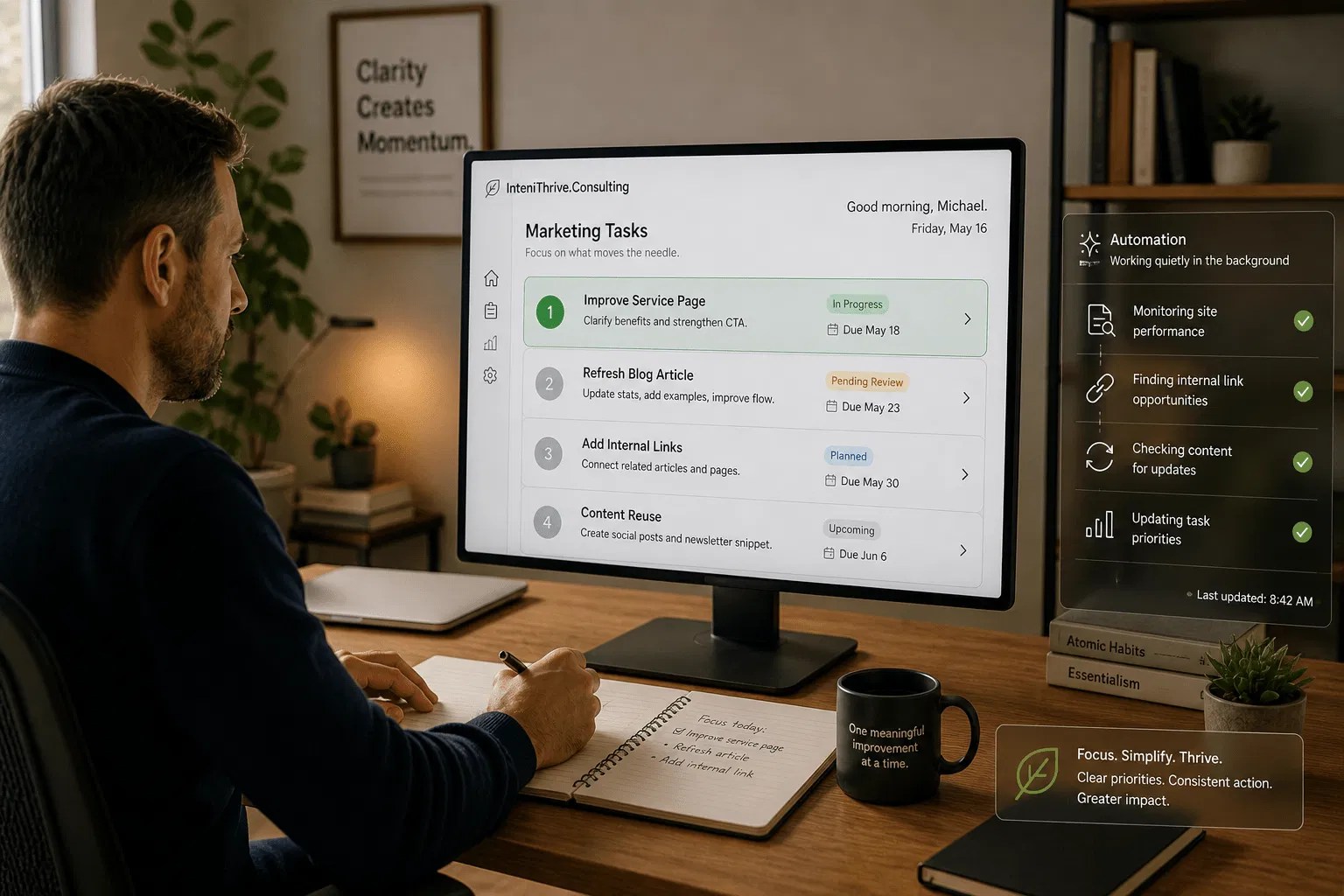
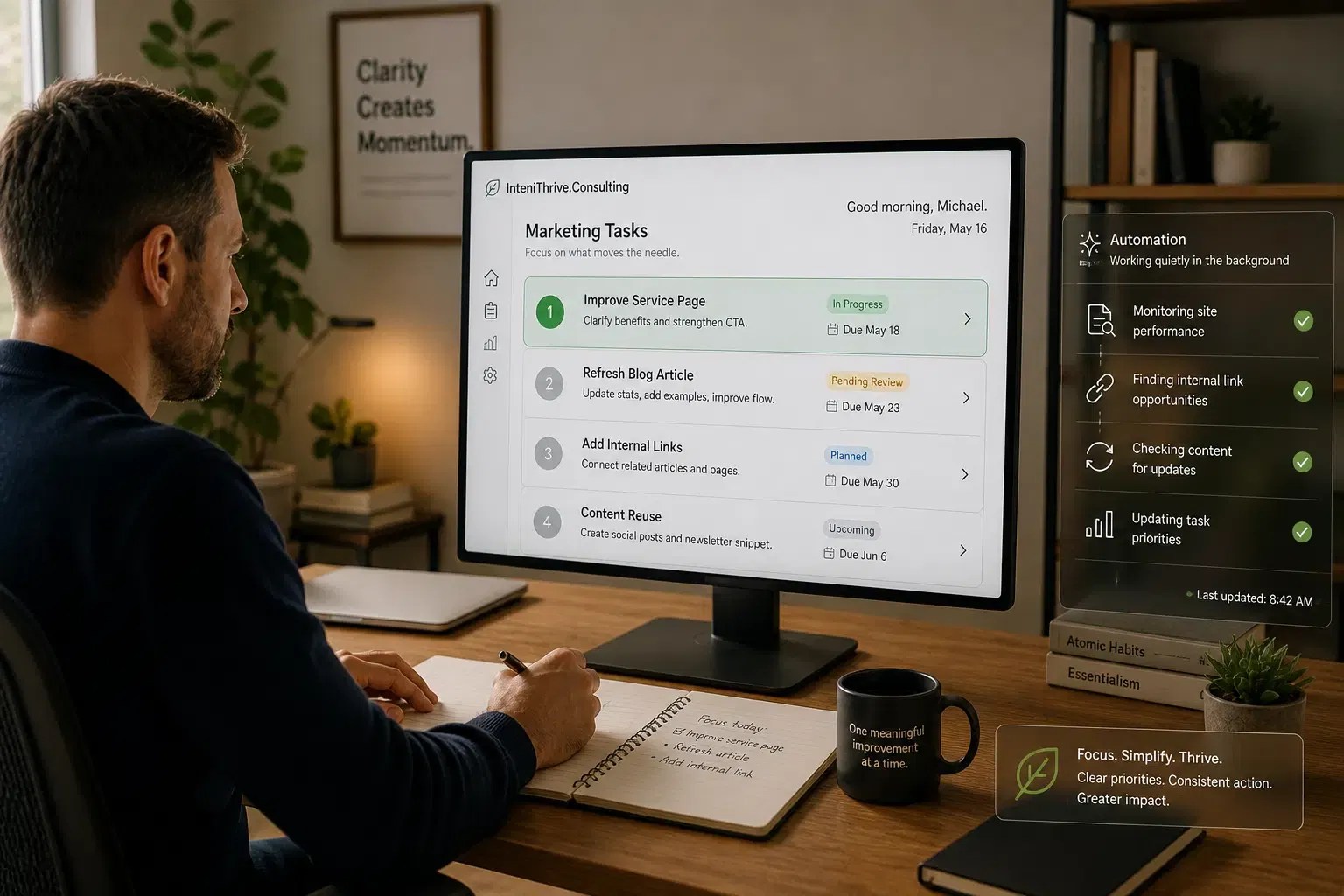
The engine works through a simple, repeatable weekly cycle. We don’t ask you for big campaign ideas. Instead, we identify the next most useful improvement for your website or content, and we move it forward. This might be a marketing follow-through task, such as adding internal links to a new blog post or refreshing an old FAQ page. That steady execution is what makes marketing support for small business feel manageable instead of overwhelming.
The goal is to create “momentum through sequence.” By doing two useful things every week, we ensure that your marketing never stalls. Over months, these small updates compound into a significantly more professional, more visible, and more effective digital presence. It is the “tortoise” approach to marketing, and in the world of busy service businesses, the tortoise always wins. For many firms, that is the difference between patchy effort and real marketing support for small business growth.
How the RME Handles the Work:
- The Baseline Setup: We start by identifying exactly where your site stands and what needs to move first. No more guessing.
- Weekly Improvements: Each week, we advance specific tasks that improve your search visibility and user experience.
- Simplified Reviews: We send you a short update. You spend 10 minutes reviewing it. The work keeps moving.
- Visibility Reporting: You see exactly what was done and what is coming next. Clarity over complexity.
How Small Improvements Compound Over Time
It can be hard to see the value of a single internal link or a refreshed FAQ. However, when you look at the impact of these tasks over a 6 to 12-month period, the results are undeniable. This is the “interest” on your marketing investment.
In 30 Days, a working rhythm is established. You stop feeling guilty about your “forgotten” website because updates are finally moving again. You have a clear priority list, and the most urgent issues are being handled.
By 90 Days, your website starts to feel different. Several service pages have been improved. Your internal linking is stronger, which means visitors (and search engines) can navigate your expertise more easily. You are seeing consistent improvements in search visibility because you are sending steady “activity signals” to the web.
At 6 Months, the compounding effect is in full swing. You have a library of refreshed, high-performing content. Your service pages are robust and answer the actual questions your buyers are asking. Most importantly, you have saved hundreds of hours of coordination time. The marketing is no longer “your” problem: it’s a system that just works. That is the long-term value that dependable marketing support for small business owners can count on.
Moving from “Memory and Motivation” to “Systems and Rhythm”
The biggest risk to your growth is relying on founder motivation. Motivation rises and falls. Client work expands. Life gets busy. If marketing depends on whether you have energy left on Friday afternoon, it will remain inconsistent.
Sustainable marketing support for small business replaces motivation with rhythm. A rhythm keeps moving even when the week is messy. It protects useful work from slipping. It lowers the chance that key updates stay buried in a backlog for months.
This transition is often the most rewarding part for clients. There is real relief in knowing the work is no longer sitting in your head. You can step back into the role of owner and expert rather than acting as the part-time marketing coordinator, editor, and web admin. That relief is not soft value. It is an operational value. Less friction. Better ownership. More consistent progress.
Choosing the Right Path for Your Business
If you are a founder-led service business, you have a choice. You can continue the “stop-start” cycle, hoping that next month you’ll finally find the time to “fix the marketing.” Or, you can invest in a system designed for sustainability.
Providing marketing support for small business isn’t about doing the most work; it’s about doing the right work consistently. It’s about building a foundation that supports your sales process, boosts your visibility, and reflects the true quality of your expertise.
Whether you choose to build these systems internally or work with a marketing operations partner, the goal is the same: steady movement. Don’t let your best ideas sit in a backlog. Give them the rhythm they need to reach your audience and grow your business. The best marketing support for small business is rarely flashy. It is steady, useful, and easy to keep going.
Frequently Asked Questions
What is marketing support for a small business?
It is the ongoing help that keeps your website, content, and visibility moving forward without requiring the founder to manage every detail. Good marketing support for small business reduces friction, clarifies priorities, and turns useful ideas into completed work.
What is the difference between a marketing agency and a marketing operations partner?
A traditional agency often focuses on campaigns, launches, and high-volume deliverables. A marketing operations partner focuses on steady execution, practical improvements, and follow-through, which makes it a better fit for marketing support for small business needs.
How much time does the founder need to spend on marketing each week?
With a system like the Rhythm Marketing Engine, the founder typically spends less than 30 minutes a week reviewing updates. Our goal is to handle the coordination, editing, and technical execution so you can focus on your clients.
Why focus on refreshing old content instead of writing new posts?
Most service businesses already have useful content that is underperforming because it is outdated, disconnected, or unsupported. Refreshing and linking existing assets is often faster and more effective than constantly starting from zero.
What is a Baseline Setup?
The Baseline Setup is a one-time project ($1,499) in which we review your website, content, and search visibility to determine what should move first. It gives the work a practical starting point and a clearer backlog.
Does this service include social media management?
We handle content distribution and reuse, but we do not manage daily social media interaction or trend-chasing. The focus is on evergreen assets, useful updates, and sustainable progress.

Leave a Reply