
Most service business websites do not have a traffic problem first. They have a connection problem. Useful pages exist, but they do not support each other. A strong article does not point to the right service page. A service page does not point to proof. A helpful FAQ sits on its own. That is where internal linking services matter.
When those connections are weak, visitors stall. Search engines get a thinner picture of your site. AI systems also have less context for understanding what your business actually does. What looks like a content problem is often a structure problem.
Internal linking services are the ongoing work of auditing, adding, improving, and maintaining links between relevant pages on your website so that visitors, search engines, and AI discovery systems can navigate your content with less friction.
At InteniThrive Consulting, we treat this as practical website operations, not SEO theater. In our experience, service businesses rarely need a dramatic rebuild. They usually need someone to keep the useful pages connected, the priorities clear, and the next step moving each week.
Key Takeaways
- Connective Tissue: Internal links guide visitors to the next helpful page and help search engines understand your site’s hierarchy.
- Authority Distribution: Links pass “ranking power” from high-traffic pages (like your homepage) to specific service pages.
- Reduced Friction: A clear linking structure makes content discoverability easy, reducing the effort a prospect needs to make a decision.
- Steady Execution: The Rhythm Marketing Engine handles the repetitive work of updating links so your marketing never stalls.
- SEO Foundation: Internal linking for SEO is a primary factor in how quickly your new content is crawled and indexed.
What Are Internal Linking Services?
Internal linking services help a business find, plan, and maintain useful links between its own pages. That includes blog posts, service pages, FAQs, case studies, contact pages, and pillar content. The goal is simple: make it easier for people to find the next answer and the next action.
Unlike a one-time SEO document, good internal linking services are operational. They involve repeated review, judgment, and follow-through. New pages get linked. older pages get refreshed. Important pages get more support. Weak paths get fixed before they become dead ends.
For a service business, this usually means connecting three practical layers:
- Educational content to service pages: A blog post about a buyer problem links naturally to the service that solves it.
- Service pages to prove and trust assets: A service page links to case studies, FAQs, reviews, or process pages.
- Core hubs to supporting content: Pillar pages and high-level pages link to detailed supporting articles, and those supporting articles link back.
That sounds straightforward. In practice, it slips.
A founder publishes something useful, then moves on. A contractor uploads the page, but does not connect it to the rest of the site. A team member refreshes the copy, but no one checks where the page should link next. Over time, the website grows, but the pathways do not.
That is why internal linking deserves more respect than it usually gets.
Google’s own guidance makes the basics clear: search engines discover pages through links and rely on descriptive anchor text and crawlable site structure to understand what matters on a site (Google Search Central, link best practices). Good internal linking services turn that guidance into weekly execution.
For a service business, the practical outcomes are easier to see:
- Fewer orphan pages
- Clearer topic relationships
- Stronger paths to service pages
- Better support for search visibility
- Better support for AI visibility
- Less friction for buyers who are trying to decide
That last point matters most. Internal links are not just for crawlers. They are for real people trying to answer the questions, “What should I read next?” and “Can this company help me?”
The SEO Impact: Internal Linking for SEO
Search engines still rely heavily on links to discover, crawl, and interpret pages. That makes internal linking for SEO one of the simplest high-value improvements a service business can make without producing a huge volume of new content.
A page that sits alone is harder to find, harder to prioritize, and harder to understand. A page that is linked from relevant articles, navigation paths, and topic hubs sends stronger signals.
Crawlability and Indexing
If a page is not linked well, it can sit unnoticed for longer than you expect. Google explains that links help crawlers discover pages and understand site structure. That applies to new pages and older pages that were published and then forgotten.
A steady internal linking process helps by:
- Giving crawlers clear paths to new content
- Reducing the chance that useful pages become isolated
- Making high-priority URLs easier to discover
- Supporting faster recognition of refreshed content
This is especially useful for small businesses that publish slowly. If you only add one or two pages a month, each page needs support.
Distributing Attention to the Pages That Matter
Not every page on your site carries the same weight. Your homepage, core service pages, and better-known resources often attract more visits and more external attention. Internal links help distribute that value to deeper pages.
That matters because many service business websites have this problem:
- Informative blog content gets traffic
- Service pages need more visibility
- Proof pages exist, but stay buried
Internal linking helps connect those layers. A useful article can support a service page. A service page can support a case study. A case study can support a consultation page. The site starts to behave more like a system rather than a stack of unrelated URLs.
Topical Clarity and Semantic Support
Internal links also help search engines understand what your site is about. If several related articles point to one strong hub or service page, you are creating a clear topical pattern.
This is where entity density helps naturally. When a post about internal linking also addresses concepts such as site architecture, anchor text, crawlability, orphan pages, topic clusters, service pages, content refreshes, and buyer journeys, the page becomes easier for search systems to interpret. But the point is not to stuff terms into the article. The point is to make the relationships between pages and ideas easier to follow.
A helpful contrarian point here: many businesses think they need more keyword targets before they need better structure. Often the opposite is true. A better structure lets your existing content perform more clearly before you chase another round of content production.
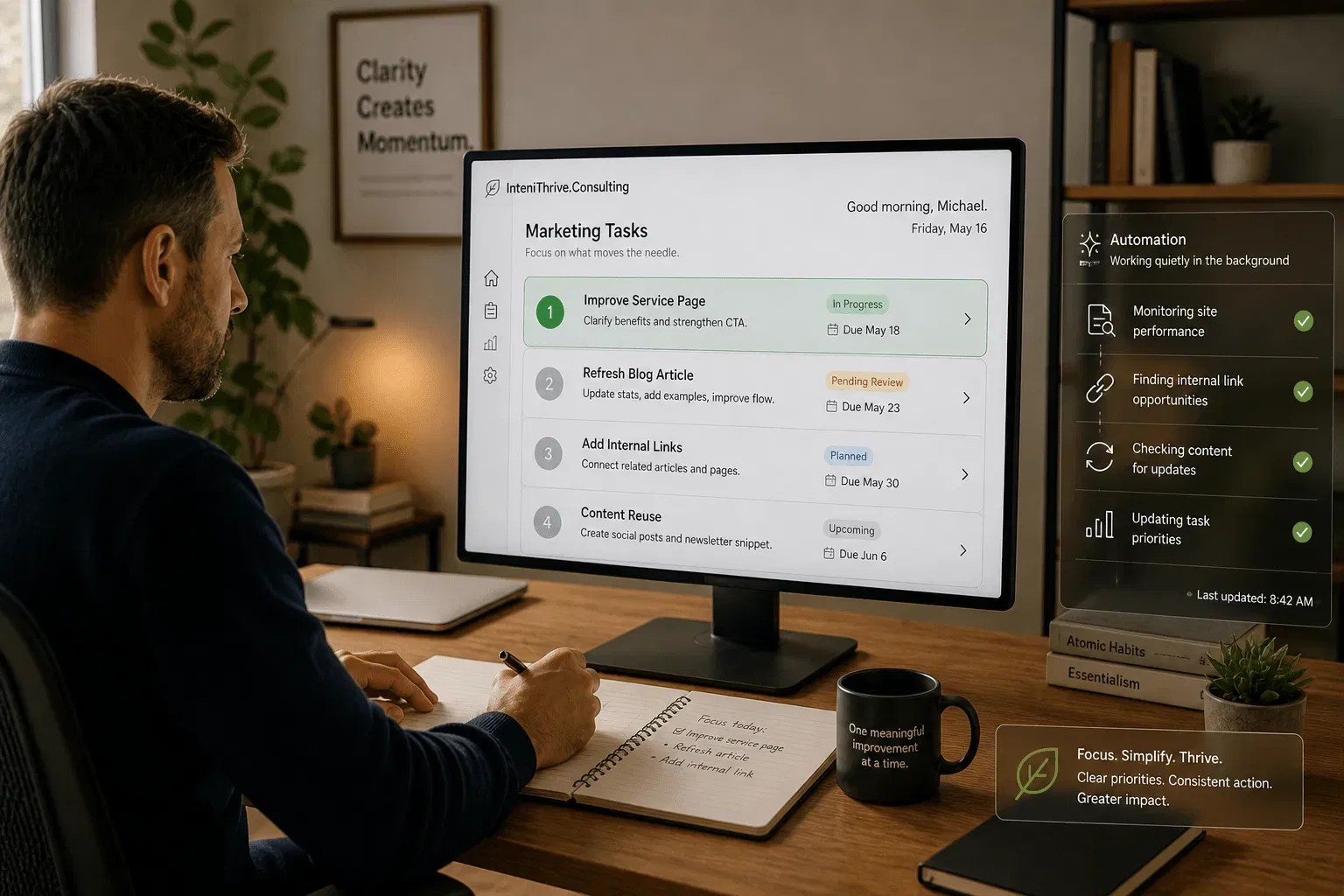
Content Discoverability: Helping Buyers Find Answers
Content discoverability is how easily a person can find the next relevant answer, proof point, or action page on your website without getting lost or having to do extra work.
That sounds obvious. It is also where many service websites quietly fail.
A visitor lands on a useful article from Google. They get part of the answer. Then they have to scan the menu, hunt through categories, or leave the site to figure out what to do next. That gap is friction.
Good internal linking services reduce that friction.
Instead of asking the visitor to assemble the journey themselves, you guide them from one useful page to the next. That approach aligns with how people actually navigate. Nielsen Norman Group’s work on information scent shows that users decide where to go next based on the clarity of labels, surrounding context, and perceived value of the click (NN/g). In plain terms, people click when the next step feels obvious and useful.
That means link choices should reflect buyer intent, not just SEO opportunity.
A few simple examples:
- If someone reads about pricing, the next link might be your service scope, process, or consultation page.
- If someone reads a case study, the next link might be a service page or FAQ that explains how the work is done.
- If someone reads a foundational guide, the next link might be a more specific supporting article or a relevant pillar page.
- If someone reads an article about consistency, the next link might be a page titled “Marketing Operations for Founders: Prevent Burnout and Keep Moving.”
In our experience, this is where small businesses get the fastest practical win. Not because internal links are flashy. Because they make good content easier to use.
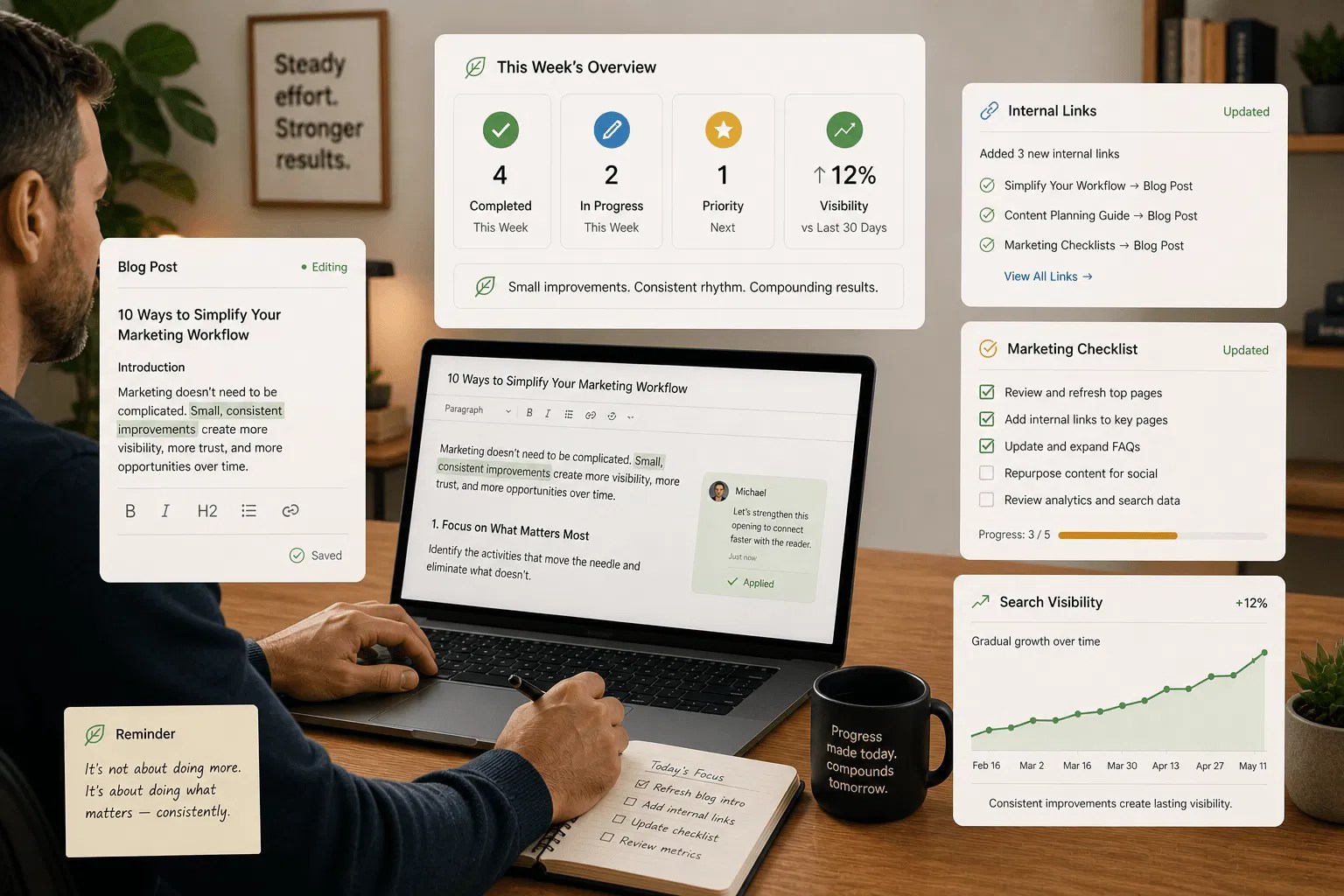
Each week, when links improve, buyers do less searching on your site. They move with less effort. Over time, that creates:
- More pages viewed per session
- Better engagement with service pages
- Stronger trust through clearer pathways
- More qualified inquiries because buyers reach a better context before contacting you
Internal linking does not replace good messaging. It helps good messaging get found.
The Problem: Why Internal Linking Usually Fails
Most service businesses do not ignore internal linking because they think it is useless. They ignore it because it is easy to postpone.
The work is rarely urgent today. It is just important over time.
Internal linking usually breaks down for a few practical reasons:
- Set-and-forget behavior: Links get added once, then no one revisits them as the site changes.
- Fragmented ownership: The writer, developer, assistant, or founder each handles one part, but no one owns the full structure.
- Coordination burden: Finding good link opportunities across older content takes time and attention.
- Weak prioritization: Teams do not know which pages deserve more internal support first.
- Generic linking habits: People use vague anchors like “click here” or drop random related posts without thinking through the next step.
This is exactly why internal linking services are useful. They turn a vague best practice into owned work.
At InteniThrive, we often see this pattern: a business already has enough material to improve results, but the useful content is disconnected. The problem is not a blank page. The problem is follow-through. That is also why our work tends to overlap with weekly website improvements and ongoing content refreshes rather than isolated SEO projects.
When internal linking has clear ownership, it becomes easier to maintain:
- a backlog of pages that need links
- a list of priority service pages
- a process for linking new content to older content
- a habit of checking whether each page has a useful next step
That is not glamorous. It is dependable. And dependable usually wins.
Website Structure: Building a Stable Foundation
A strong website structure makes your business easier to understand. That matters for visitors, search engines, and AI systems trying to interpret relationships between your pages.
Think of structure as the operating layout behind your content. If it is loose and inconsistent, people have to work harder. If it is clear, useful pages support each other.
A practical structure usually includes:
- Hub pages or pillar pages: broad pages that explain a core topic
- Supporting articles: more focused pages that answer related sub-questions
- Action pages: service, contact, booking, or consultation pages
- Trust pages: case studies, FAQs, process pages, review pages, and about pages
The goal is not rigid silos for SEO’s sake. The goal is clearer pathways.
Google has long emphasized the importance of crawlable link architecture and making important pages easy to reach. At the same time, users benefit from clear wayfinding and links. So a good structure should support both.
Here is what that can look like in practice:
- Your homepage links clearly to core services
- Core services link to related FAQs and proof
- Pillar pages link to relevant supporting articles
- Supporting articles link back to pillar pages and onward to service pages
- Older articles get refreshed to point to newer or more strategic resources
This is also where internal linking helps reduce keyword confusion. When two or three pages cover similar ground, a better structure can clarify which page is the main destination and which pages are supporting it.
If you want a broader view of how this fits into practical visibility work, our post on maximizing existing content covers why better use of existing assets often outperforms rushing into endless new content production.
A stable structure does not need to be complicated. It needs to be understandable, maintained, and connected.

How the Rhythm Marketing Engine Solves Internal Linking
At InteniThrive Consulting, we do not treat internal linking as cleanup work you do once and forget. We treat it as part of steady marketing operations.
That is the role of the Rhythm Marketing Engine. It gives internal linking a place inside a repeatable weekly cycle, alongside content refreshes, search visibility support, reuse, and practical website improvements.
The Baseline Setup
Before ongoing work begins, we establish a baseline. This helps us see:
- Which pages matter most commercially
- Which pages already attract attention
- Which pages are isolated or underlinked
- Which content clusters are incomplete
- Which next steps are missing
From there, we build a practical backlog. That backlog matters because it reduces noise. Instead of wondering what to do next, we already know which pages need support and why.
If a reader wants to understand that process more clearly, the Rhythm Marketing Engine page explains how the service is designed to keep useful work moving without adding heavy coordination.
Weekly Improvements
Each week, we move one set of useful improvements forward. Internal linking work may include:
- Adding contextual links from older articles to priority service pages
- Linking service pages to FAQs, proof, or process content
- Tightening links inside a topic cluster
- Fixing broken internal links or redirect issues
- Updating anchor text so the destination is clearer
- Improving discoverability for newer pages
This matters because internal linking decays quietly. New content gets added. Service offers a shift. URLs change. Priorities move. Without a rhythm, the structure falls behind.
Simple Reporting and Visible Progress
We keep reporting simple. Clients do not need a pile of abstract SEO language. They need to know what changed, why it mattered, and what should move next.
That reporting discipline also practically supports EEAT. It shows there is real work, real judgment, and real review behind the website improvements. Not vague promises. Not inflated dashboards. Just visible progress.
A small but important point: internal linking works best when it is connected to the rest of the system. If you refresh a page, you should also review its links. If you publish something new, you should also connect it to older assets. If you improve a service page, you should also ask what proof or FAQs should support it.
That is why we do not isolate this as a narrow SEO chore. We fold it into the broader operating rhythm.
Case Study: Internal Linking for a Consulting Firm
Consider a small consulting firm with 50 blog posts published over three years. The content is decent. Some pages get search traffic. But very few visitors reach the “Work With Us” page, and the rest of the site barely supports several service pages.
This is a common pattern.
When we approach internal linking in a case like this, we do not add links randomly. We review intent. We look at which articles already earn attention, which pages support trust, and which service pages should be more discoverable.
For example, a post about “management best practices” may bring in steady traffic. But if it does not link to the consulting offer, a related case study, or an FAQ about the engagement scope, it is not doing enough.
A better linking path might look like this:
- The article links contextually to the relevant consulting service
- The service page links to a case study or process page
- The article also links to a closely related supporting resource
- The pillar page for that topic links back to the article
That kind of structure does two things at once. It helps readers keep moving. It helps search engines understand the relationship between the pages.
In our experience, the first gains are usually not dramatic ranking spikes. They are signs of reduced friction:
- More visits to service pages from blog content
- Longer engagement across related pages
- Fewer isolated pages
- Better pathways from education to action
- Clearer support for the site’s main commercial pages
That is a more grounded way to think about internal linking. It is not magic. It is accumulated clarity.
Common Internal Linking Mistakes to Avoid
Even if you manage your own website, a few patterns are worth avoiding.
Using weak anchor text
Generic phrases like “click here” or “learn more” provide very little context. Descriptive anchor text helps readers and search engines understand what sits on the other side of the link.
A better example would be linking naturally to marketing operations support when that is the actual destination.
Over-linking inside the body copy
Too many links create visual noise. They also weaken the sense of priority. Every sentence does not need a destination.
A calmer standard works better:
- Link when the next page genuinely adds context
- Link when the next page helps the reader act
- Link when the relationship between pages is clear
Repeating the same destination without purpose
Multiple navigation links to the same page are usually fine. Google has said repeated navigational links are normal. But inside body copy, repeated links to the same page often add little. Use them intentionally.
Sending everything to the homepage
Your homepage already has plenty of visibility. The pages that usually need help are deeper:
- Service pages
- Pillar pages
- Case studies
- FAQs
- Contact or consultation pages
Ignoring orphan pages
An orphan page is a page with no meaningful internal links pointing to it. That is bad for discovery and bad for usability. Orphan pages are one of the clearest signs that content follow-through has slipped.
Forgetting the next step
Not every page needs a hard sell. But every page should help the reader move on to something useful next. That may be another article, a service page, a proof asset, or a contact page.
If you are updating older content, this is one of the easiest wins. Add the next logical step. Then make sure the anchor text accurately reflects where the link goes.
The Rhythm of Content Reuse and Distribution
Internal linking does not sit on its own. It works better when it is connected to content refreshes, distribution, and reuse.
When a page gets refreshed, that is often the right moment to ask:
- Should this page link to a newer service page?
- Should it reference a better FAQ?
- Should it connect to a pillar post?
- Is there a section worth reusing off-site?
That is one reason we connect internal linking with broader content operations. A refreshed article can support search visibility, user engagement, and reuse simultaneously. A paragraph may become a LinkedIn post. A FAQ may become a newsletter section. A short insight may become a Google Business Profile update. But the website remains the anchor.
This is also why “just publish more” is often poor advice. More content without stronger linking can create more clutter, not more clarity.
If this idea is familiar, it connects closely with the practical case for using what you already have and with the broader role of a consistent marketing operations partner. The real value is not volume. It is a useful movement across the assets you already own.
Internal linking supports that movement. It helps each piece do more than sit alone.
Conclusion: Steady Movement for Sustainable Growth
Internal linking is not a side task. It is part of how a working website stays useful.
When pages are connected well, visitors find answers faster. Service pages get more support. Search engines understand your structure more clearly. AI systems have a better context for summarizing your business. And your existing content starts working more like a coordinated system.
That is why internal linking services matter for service businesses. Not because they are trendy. Because they reduce friction.
A calm, practical approach usually works best:
- Identify the pages that matter most
- Connect them to related educational content
- Link to proof and FAQs where buyers need reassurance
- Refresh older content so it supports current priorities
- Review the structure each week instead of once a year
If your website feels disconnected, the fix is rarely “create twenty more pages.” More often, it is to improve the relationships between the pages you already have.
That is the kind of steady work we build into the Rhythm Marketing Engine. Clear ownership. Visible progress. Useful next steps.
FAQs
How long does it take to see results from internal linking?
While SEO is a long-term game, internal linking is one of the faster levers. You often see improvements in crawling and indexing within 2–4 weeks, and ranking shifts typically follow within 4–8 weeks as search engines re-evaluate your site structure.
Do internal links help with AI-driven search (like ChatGPT or Perplexity)?
Yes. AI discovery systems use the structure and links of your website to understand the context and relationship between your ideas. A well-linked site is much easier for AI models to “summarize” and recommend as an authoritative source.
What is an “orphan page”?
An orphan page is a page on your website that is not linked to by any other page on your site. This makes it almost impossible for search engines to find and very difficult for visitors to discover, unless they have the direct URL.
Is it better to link from the navigation menu or within the text?
Both are important. Navigation links help with overall site structure, but “contextual links” (links inside the body of your content) carry more SEO weight and are more likely to be clicked by readers who are engaged with your topic.
How many internal links should a blog post have?
There is no hard rule, but a good standard for service businesses is 2–5 relevant internal links per article. The focus should always be on usefulness: only link to pages that provide genuine additional context or help the reader take the next step.
Can internal linking replace the need for backlinks?
Not entirely, but it makes your existing backlinks much more effective. Internal linking distributes the authority you already have from external sources to the pages that actually generate revenue, like your service pages.

Leave a Reply