
Most small service businesses do not have a content problem. They have a follow-through problem. Useful articles, service pages, FAQs, case studies, and sales emails already exist, but they sit untouched while the pressure to create something new keeps growing. That pressure creates friction. It also creates waste.
Content refresh and reuse give founder-led teams a more practical path. Instead of treating every week like a blank page, you improve what already exists, strengthen what is slipping, and reuse strong ideas across more channels. That keeps marketing moving without adding unnecessary coordination.
Content refresh and reuse means systematically updating existing content to improve accuracy, usefulness, search performance, and distribution value, and then repurposing it into multiple supporting assets. For small service businesses, this is often the most reliable way to build visible progress without the burden of constant new production.
In our experience, this shift is often a relief for founders. Once they realize they do not need to invent a fresh campaign every week, the backlog becomes less intimidating. It becomes a working library. That single mindset change can lower the coordination burden almost immediately.
Key Takeaways
- Higher ROI: Refreshing and reusing existing content is usually faster, lower-friction, and more cost-effective than starting from scratch.
- Better Search and AI Visibility: Updated, well-structured content is easier for search engines and AI systems to understand, trust, and surface.
- Less Founder Drag: A repeatable refresh process reduces the coordination tax that slows down marketing follow-through.
- Stronger Content Lifecycle Management: Content works better when it is intentionally maintained, improved, reused, merged, or retired.
- Practical Content Atomization: One strong pillar post can become 10 or more useful assets across email, LinkedIn, sales follow-up, FAQs, and local visibility channels.
- Steady Movement: Small weekly improvements compound. Each refresh strengthens your site, your message, and your ability to stay visible over time.
Why Content Refresh Services Often Beat Starting From Scratch
When we think about marketing, we often think about the “launch.” We focus on the thrill of a new campaign or the first time a post goes live. However, for a service-based business, the true value lies in the long-term utility of your information. Constantly producing new content requires significant mental energy, coordination, and time. If you are a founder-led team, every hour spent brainstorming a new topic is an hour taken away from client work or high-level strategy.
Existing content refreshes offer a different path. When you update an existing page, you are working with a foundation that already exists. The research is done. The core message is established. Search engines already index the URL. By choosing to refresh rather than replace, you eliminate the “blank page” problem that causes so many marketing plans to slip.
Research suggests that it can be significantly more expensive to acquire a new ranking for a new keyword than to improve a ranking you already have. If a blog post is currently sitting on page two of search results, it is providing almost no value. However, a strategic refresh: adding updated data, clearer headings, and better internal links, can often push that page to the first page. This simple move can result in a significant increase in traffic for a fraction of the effort required to write a brand-new 2,000-word guide.
Understanding Content Lifecycle Management
Content is not a “one and done” task; it is a living part of your business operations. Effective content lifecycle management involves tracking an asset from its initial creation through its various stages of usefulness. Most businesses treat content like a disposable product: publish it once and never look at it again. This approach creates a “ghost town” effect, in which old blog posts contain broken links, outdated service descriptions, and references to tools that no longer exist.
A healthy content lifecycle includes four main phases:
- Creation: Developing the initial asset based on customer needs or common questions.
- Maintenance: Periodically checking for accuracy, broken links, and relevance.
- Optimization: Using search data to improve the asset’s visibility and performance.
- Rebirth or Retirement: Deciding whether to refresh the content, merge it with another piece, or remove it entirely.
By adopting this mindset, you turn your website into a well-oiled engine. You are no longer just “writing blogs”; you are managing an intellectual property inventory. This shift in perspective provides clarity and ownership over your marketing work. It allows you to move away from the pressure of “what’s next?” and focus on “what’s working?”
For small service businesses, this needs to be practical. You do not need enterprise content governance. You need a simple review rhythm that helps you decide what to fix next.
A useful operating model looks like this:
- Each month: Review your core service pages, top blog posts, and buyer-question content.
- Each quarter: Check for ranking slips, outdated references, broken links, weak calls to action, and missing internal links.
- Twice a year: Review overlap between posts and decide whether certain pieces should be merged, expanded, or retired.
- As offers evolve: Update service descriptions, positioning language, examples, pricing context, and next steps so your site still reflects how you actually work.
For founder-led firms, the tactical side matters. A content lifecycle process should answer a few plain questions:
- Is this page still accurate?
- Does it still match how we sell?
- Does it answer current buyer questions?
- Is it connected to other relevant pages?
- Is it earning attention, or quietly slipping?
If the answer is “not really,” the next step is not always a rewrite. Often, a focused refresh is enough.
Here is a practical refresh checklist for small teams:
- Update dates, statistics, screenshots, examples, and service references.
- Tighten the opening so the problem is clear in the first 100 words.
- Improve headings so readers and search engines can scan the page.
- Add missing internal links to service pages, FAQs, and related articles.
- Remove filler, duplicated paragraphs, or vague claims.
- Expand sections that answer high-intent buyer questions.
- Add a short FAQ if the topic supports it.
- Check whether the call to action still fits your current offer.
That may sound simple, but simple is the point. The goal is not content perfection. The goal is steady maintenance that prevents useful assets from slipping into irrelevance.
There is also a contrarian point worth making here: not every content problem is a content creation problem. Often, it is a content maintenance problem. Businesses assume they need more articles when what they really need is a cleaner operating rhythm around the pages they already have. That is less exciting than launching something brand new. It is also usually more effective.
This is one reason we often point businesses toward practical systems instead of endless ideation. Our article on weekly website improvements explains how small, repeated changes create visible progress over time. The same principle applies to content lifecycle management. Each week, one useful improvement moves. Over time, the site becomes clearer, stronger, and easier to trust.
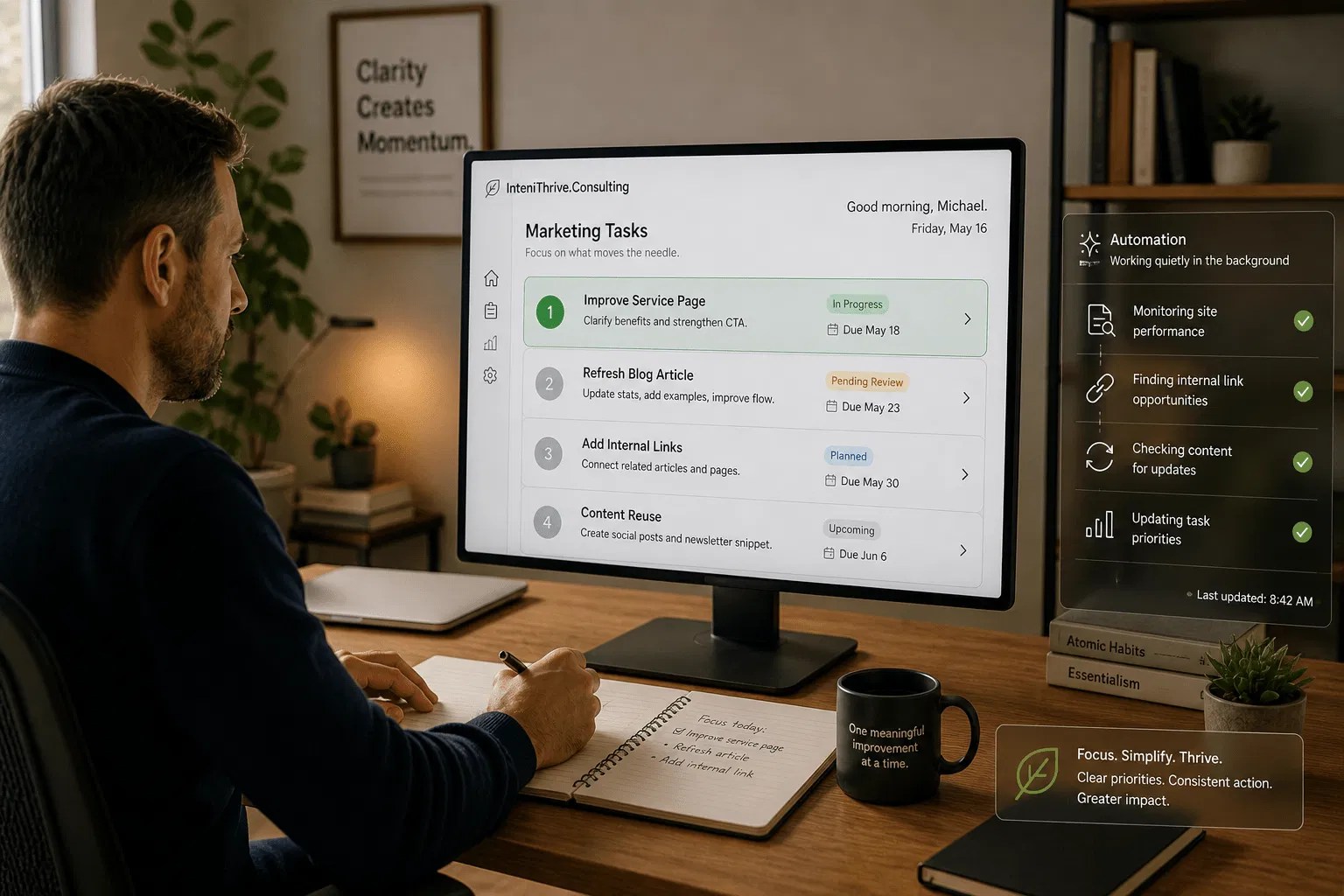
How to Identify Content Worth Refreshing
Not every old post is worth saving. To keep your marketing rhythm moving, you need to be selective about where you invest your energy. The goal of an evergreen content refresh is to double down on pieces that can drive results for years to come.
Look for these three types of candidates in your backlog:
- The “Slipping” Successes: These are pages that used to get a lot of traffic but have slowly declined. This “decay” is natural as competitors publish newer content. A refresh signals to search engines that your information is still the most current and authoritative.
- The “Almost” Winners: Use tools like Google Search Console to find pages that rank in positions 11 through 20. These pages are so close to the front page that even minor content optimization services: like improving the meta description or adding a few relevant subheaders, can tip them into high-visibility territory.
- The “Foundational” FAQs: Every service business gets asked those 5-10 questions on every sales call. If you have existing content that answers these questions but the tone feels outdated, or the examples are old, these should be high-priority refreshes. They directly support your sales process.
By focusing on these specific assets, you ensure that your marketing movement remains practical and grounded in real business needs.
The Process of Content Consolidation Services
Sometimes, the best way to move forward is to merge. Over time, many businesses end up with multiple short posts about the same topic. This creates “content cannibalization,” where your own pages compete against each other in search results. It also creates friction for the user, who has to click through several thin pages to get a complete answer.
Content consolidation services involve taking these smaller, related pieces and combining them into one “super-post” or pillar page. This process does three things:
- Strengthens Authority: One comprehensive 2,500-word guide is almost always more powerful than five 500-word posts.
- Cleans Up the Site: It reduces the number of low-quality pages on your site, which improves your overall “site health” in the eyes of search engines.
- Simplifies Navigation: It makes it easier for potential clients to find the definitive answer to their problem.
When we consolidate, we aren’t just deleting old work; we are recycling the best parts into a stronger, more resilient asset. This is a key part of sustainable content marketing. It acknowledges that your past work has value, even if it needs to be reorganized to meet modern standards.
Using Content Refresh and Reuse to Support Sales and Search
Once an asset is refreshed, its job is only beginning. The real power of a content refresh and reuse approach is found in structured distribution. You should not have to write a new LinkedIn post from scratch every morning. Instead, you can take a refreshed article and break it down. This is often called content atomization.
At a basic level, atomization means taking one substantial asset and turning it into smaller, channel-specific pieces. But for a small service business, the point is not volume for its own sake. The point is reducing friction. One strong idea should support search, sales, email, and social without requiring separate strategy meetings for each format.
A single well-researched pillar post can be turned into:
- Three to five LinkedIn updates focusing on different sub-points.
- A series of Google Business Profile updates to keep your local presence active.
- Snippet-sized answers for your email newsletter.
- A “cheat sheet” or PDF download for sales follow-ups.
That is the starting point. In practice, one pillar post can often become 10 or more assets without stretching the idea too thin. For example, imagine you publish a detailed article on “How to Improve a Service Business Website Without a Full Redesign.” That one piece could become:
- The original pillar post on your website.
- A short email introducing the main idea to your list.
- A second email focused on one common mistake mentioned in the article.
- Three LinkedIn posts were built from three distinct sections or insights.
- A FAQ answer has been added to a service page.
- A Google Business Profile post highlighting one practical tip.
- A sales follow-up email snippet is sent after discovery calls.
- A one-page checklist PDF summarizing the steps.
- A short script for video or audio if you like speaking more than writing.
- An internal talking-points doc your team can use in sales conversations.
- A quote, graphic, or pull-quote post if you already use simple social visuals.
- A supporting micro-article that expands one subtopic from the original post.
That is not content multiplication for show. It is structured reuse.
A simple atomization workflow looks like this:
- Start with the refreshed pillar post.
- Highlight 5 to 7 strong sub-points, claims, examples, or questions.
- Match each one to a channel: LinkedIn, email, sales follow-up, FAQ, Google Business Profile, or short-form video.
- Rewrite each asset for its format instead of copy-pasting the same paragraph everywhere.
- Publish over time so one article supports several weeks of movement.
In our experience, this is where many small teams finally feel some relief. They stop treating content distribution as a separate creative burden. They start seeing it as a packaging step.
A good rule is this: extract, adapt, distribute.
There is also an important quality filter. Not every paragraph deserves to become a standalone post. Look for parts of the article that do one of these jobs well:
- Answer a buyer’s question clearly.
- Offer a practical step or checklist.
- Reframe a common mistake.
- Share a first-hand observation or example.
- Clarify a decision your prospect is already trying to make.
This approach also helps sales. If a prospect asks a recurring question, you do not need to reinvent the answer each time. You can send a short, relevant asset built from a stronger source piece. That creates consistency without sounding robotic.
For more on keeping this work organized, the Rhythm Marketing Engine is built around exactly this kind of steady movement. The work is not about flooding channels. It is about selecting the next most useful asset, adapting it well, and keeping the backlog moving without creating more founder drag.

The Role of a Marketing Operations Partner
Maintaining this rhythm is often where small businesses struggle. It is easy to start an audit, but it is hard to finish the tenth refresh when client work gets busy. This is where a marketing operations partner becomes essential.
Instead of hiring a high-priced strategist to give you more ideas you don’t have time to execute, a partner like InteniThrive Consulting focuses on the steady movement of the work. We provide the “engine” that keeps your content refreshes, internal linking, and distribution moving every single week.
Our core service, the Rhythm Marketing Engine, is built for this exact purpose. We don’t require you to produce massive amounts of new content. Instead, we look at your existing backlog and identify the next most useful improvement. Whether it’s updating a service page, fixing a broken internal link, or repurposing a blog post for LinkedIn, we ensure that marketing fundamentals don’t slip through the cracks.
If you want a practical starting point for this kind of work, review our guide to weekly website improvements. It shows how small, repeated updates create visible progress over time without forcing your team into a constant cycle of new campaigns.
By having a dedicated partner handle the execution, you gain clarity and ownership over your digital presence. You no longer have to worry about whether your website is “getting old” or if you’ve posted to your Google Business Profile lately. The rhythm is already established, and the progress is visible every month.
What founders often feel most is not just the work itself, but the coordination tax around the work. That tax shows up in small, repeated ways:
- Deciding what should be updated first.
- Finding the old draft or source material.
- Asking who owns the change.
- Waiting for feedback from a busy subject-matter expert.
- Remember to publish the adapted version in other channels.
- Tracking what was already updated and what is still slipping.
None of those tasks looks dramatic on their own. Together, they stall momentum.
A marketing operations partner reduces that coordination tax by creating structure around the recurring work. Instead of the founder acting as traffic controller, editor, reviewer, approver, and reminder system, the process becomes simpler:
- There is a prioritized backlog.
- There is a current next step.
- There is someone responsible for moving it.
- There is a review rhythm.
- There is visible reporting on what changed and what comes next.
This is one place where operational support is often more valuable than a more strategic approach. Founders usually do not need another brainstorming session about “content opportunities.” They need someone to take the scattered tasks that already matter and turn them into a calm, repeatable workflow.
That difference matters because the coordination burden has a real cost. It drains attention from client work. It delays simple improvements. It causes useful assets to sit half-finished. And over time, it makes marketing feel heavier than it needs to be.
In our experience, once the operating rhythm is clear, most businesses already have plenty to work with. The issue is not a lack of raw material. The issue is a lack of organized follow-through. That is why a practical partner can be more useful than a campaign-heavy agency model for this kind of work.
If you want a broader view of that operating role, our guidance around marketing operations support and steady website improvement follows the same principle: reduce noise, clarify ownership, and keep one useful step moving at a time.
Sustainable Content Marketing: A Long-Term View
Marketing is not a sprint; it is the ongoing process of building trust with your audience. When you prioritize small-business content support focused on refreshes and reuse, you are building a more sustainable business. You are creating a library of assets that work for you 24/7, even when you aren’t actively “doing marketing.”
This approach respects your time and your budget. It acknowledges that as a service provider, your expertise is your most valuable asset. Your website should reflect that expertise clearly and consistently. By moving away from the noise of the content treadmill and toward a steady rhythm of improvement, you ensure that your business remains visible, professional, and ready for the next step.
If your website has stalled or your useful content is sitting untouched, it might be time to stop starting over. Focus on what you have. Improve it. Reuse it. Let the engine do the heavy lifting so you can get back to the work only you can do.
A big part of this long-term value now includes AI Visibility. Search engines and large language models both rely on signals of clarity, consistency, and usefulness. Updated content helps on all three fronts.
When an article is refreshed, a few things happen:
- Facts, service details, and examples become more current.
- Headings and structure often become clearer.
- Internal links create a stronger context across the site.
- Repeated buyer language appears more naturally across related pages.
- Outdated claims and conflicting information get removed.
That matters because both search systems and AI systems work better when your site is easier to interpret. Google’s guidance continues to emphasize helpful, reliable, people-first content rather than content made mainly to game rankings (Google Search Central). Updated content can support that standard when the refresh genuinely improves usefulness rather than just changing the date.
There is an important distinction here. Refreshing content does not help because an algorithm is impressed that you touched the page. It helps when the page becomes more complete, more accurate, more connected, and easier to trust. That is true for search visibility, and it increasingly matters for AI-assisted discovery as well.
AI tools that summarize the web, answer buyer questions, or recommend sources tend to favor content that is:
- Clearly structured.
- Topically complete.
- Internally connected to related concepts.
- Consistent with the rest of the site.
- Written in language that matches real user questions.
That is why refreshing work often has a multiplier effect. You are not just polishing old copy. You are making the site easier for both humans and machines to understand.
A simple example: if an older article mentions outdated services, has vague headings, and links nowhere, it gives weak context signals. But if you refresh that same article with clearer definitions, updated examples, FAQ-style subheads, and internal links to related service pages, it becomes far more usable. That helps a human reader. It also helps search engines interpret relevance and helps AI systems pull cleaner context from the page.
This is also where internal linking matters more than many teams realize. A refreshed article should not sit alone. It should point readers toward your service pages, related guides, and supporting resources. That connected structure strengthens understanding of the topic across the site. It also gives crawlers and AI systems more evidence that you have depth on the topic, not just a one-off post.
For example, a post like this can naturally connect to supporting InteniThrive content about weekly website improvements, the Rhythm Marketing Engine, and broader guidance on how to stop the new-content treadmill and use what you already have. Those links do more than move users around the site. They reinforce the content cluster and make the site’s knowledge more coherent.
According to Google’s core update guidance, creators should focus on meaningful content improvements instead of quick cosmetic fixes (Google Search Central core updates). That is very aligned with a refresh-and-reuse model. Improve the page to make it more useful. Then connect it, distribute it, and let that improved quality compound over time.
According to HubSpot’s 2024 State of Marketing report, marketers continue to prioritize content that drives traffic, engagement, and leads over time rather than relying on one-off bursts of publishing. That matters for small service businesses. A steady refresh process helps you protect past work, improve search visibility, and reduce the friction that stalls follow-through.

FAQ: Content Refresh and Reuse
What is the difference between a content refresh and a rewrite?
A content refresh updates and improves an existing piece. A rewrite starts much closer to zero. Most service-business pages do not need a full rewrite. They need clearer structure, better examples, updated details, and stronger links.
How often should I review content for refresh and reuse?
For most small service businesses, review core service pages and key articles at least quarterly. High-value pages can be checked monthly. The goal is not constant editing. It is catching slippage before it becomes a bigger problem.
Does refreshing content help with AI Visibility?
Yes, when the update makes the page more useful. Clearer structure, stronger internal linking, better definitions, and current examples make content easier for search engines and AI systems to interpret and cite.
How do I know which pages to refresh first?
Start with pages that already matter: service pages, high-traffic posts, slipping rankings, and articles that address common sales questions. Focus first on content closest to revenue and buyer trust.
How many assets can one pillar post become?
Usually 10 or more, if the source piece is strong. A single pillar post can support LinkedIn posts, emails, FAQ entries, Google Business Profile updates, sales snippets, checklists, short videos, and supporting articles.
What does a marketing operations partner actually do here?
A marketing operations partner helps prioritize the backlog, manage the refresh process, handle reuse and distribution, maintain the review rhythm, and reduce the coordination tax on the founder. In short, they help keep useful work moving.

Leave a Reply