
Weekly website improvements are small, practical updates made to your website and content on a consistent schedule. They help your site stay clear, up to date, useful, and easier for buyers to trust.
Most marketing advice tells you to go big.
Launch the campaign. Rebuild the website. Create more content. Try every new platform. Move faster.
For many small service businesses, that advice creates more pressure than progress. Big projects need budget, time, attention, approvals, and follow-through. When client work gets busy, the project slows down. Then it stalls.
There is a better way. It is quieter. It is steadier. It is more useful.
We call it the Rhythm Marketing Engine.
Key Takeaways
- Weekly website improvements reduce friction: Small, steady changes are easier to sustain than large campaign bursts.
- Website content improvements support buyer clarity: Better service pages, FAQs, and internal links help visitors understand what you do.
- Website content maintenance keeps useful assets working: Older articles, service pages, and FAQs should not sit untouched.
- Ongoing website optimization protects visibility: Search visibility changes as buyers, competitors, and search systems change.
- Website support for service businesses should stay practical: The work should strengthen trust, clarity, visibility, and sales conversations.
Weekly Website Improvements Are A Practical Growth Rhythm
Weekly website improvements are the habit of making focused updates that keep your website improving without requiring a full rebuild.
That may sound modest. Good. Modest work is often what keeps moving.
A website that improves every week can become more useful than a “perfect” site that sits untouched for years. The point is not constant reinvention. The point is steady progress.
Weekly website improvements are small, useful changes that make a website clearer, better connected, easier to maintain, and more supportive of buyer decisions.
For a service business, weekly improvements might include:
- Refreshing an older article
- Improving a service page
- Adding a buyer-question FAQ
- Fixing confusing calls to action
- Updating outdated examples
- Improving internal links
- Preparing one useful content asset for structured distribution
This rhythm works because it reduces the size of the work. Instead of asking, “How do we fix the whole website?” you ask, “What is the next useful improvement?”
That question is much easier to answer.
Stop Chasing Innovation
Your marketing does not need to be revolutionary. It needs to be dependable.
Many founders feel constant pressure to produce. They think they need ten new blog posts a month. They think they need daily social posts. They think they need to master every new platform.
That pressure creates noise. Noise leads to delay.
The Content Marketing Institute’s 2025 B2B Content Marketing Benchmarks, Budgets, and Trends report found that 56% of B2B marketers struggle to attribute ROI to content efforts and track customer journeys. It also found that 45% lack a scalable content creation model. That is a useful warning for small teams: more content activity does not automatically lead to greater clarity. (Content Marketing Institute)
Instead of looking for the next big thing, look at what you already have.
You likely have a website with useful content. You have service pages that explain what you do. You may have articles, FAQs, case studies, sales explanations, or newsletter material. You also have real buyer questions that come up repeatedly.
Improve. Maintain. Repeat.
Focusing on the basics is not boring. It is strategic. It helps your existing assets work harder before you create more.
Friction Is The Enemy
In marketing, friction refers to anything that stops useful progress.
It is the blank page when you try to write. It is the technical issue nobody owns. It is the outdated service page that keeps getting pushed back. It is the “I’ll get to that next week” that quietly becomes next quarter.
Small service businesses are lean. You probably do not have a large marketing operations role waiting to handle every update. When marketing feels heavy, it drops behind client work.
That does not mean marketing is unimportant. It means the system is too hard to maintain.
At InteniThrive Consulting, the goal is to reduce that weight. Rhythm Marketing Engine helps keep practical website, content, visibility, and distribution improvements moving without adding more coordination work to the owner’s plate.
The work stays grounded:
- What is unclear?
- What is outdated?
- What should improve first?
- What can wait?
- What useful content can be refreshed, reused, connected, or distributed?
Small movements still count, especially when they happen consistently.
Website Content Improvements Should Help Buyers Decide
Website content improvements are updates that make your website clearer, more useful, and better aligned with buyer decisions.
This can include clearer service-page copy, stronger FAQs, better examples, improved calls to action, cleaner page structure, and stronger internal links.
Website content improvements are practical changes that help visitors understand what you do, who you help, why it matters, and what to do next.
For a service business, the website is not just a brochure. It supports trust before the first call.
Good website content should answer:
- Who is this service for?
- What problem does it solve?
- What outcome does it support?
- What is included?
- What is not included?
- What questions should buyers understand before contacting you?
- What is the next step?
Google’s guidance on helpful, reliable, people-first content reinforces this direction. Google says its automated ranking systems are designed to prioritize helpful information created to benefit people, not content created primarily to manipulate rankings. (Google Search Central)
That matters because buyer clarity and search quality are not separate jobs. The same content that helps people understand your service often helps search systems understand your site.
The Rhythm Marketing Engine

Consistency is a practical advantage.
The Rhythm Marketing Engine is built on steady, visible improvement. It is not a campaign service, a bulk content production service, or a reactive social media management service.
It is practical marketing operations support for founder-led service businesses with a working website, useful content, and inconsistent follow-through.
Here is what that looks like in practice:
- Content refreshes: Update older posts, improve structure, add current examples, and remove outdated claims.
- Internal linking: Connect related pages so visitors and search engines can follow the right paths.
- Search visibility support: Improve titles, descriptions, FAQs, topic coverage, and useful page signals.
- Content reuse: Turn useful ideas into social-ready posts, email snippets, FAQs, or sales follow-up material.
- Simple reporting: Show what changed, why it mattered, and what should move next.
HubSpot’s 2026 marketing statistics page cites data from the Content Marketing Institute showing that 74% of marketers say content marketing helped generate demand or leads, while 49% say it helped generate sales or revenue. That does not mean content works automatically. It means useful content can support business outcomes when it is maintained and connected. (HubSpot)
Simplify. Automate. Thrive.
Refresh Before You Create
You probably do not need a new blog post today. You may need to improve the one you wrote two years ago.
Content refresh services update older content so it remains accurate, useful, and aligned with current buyer questions.
Old content can still have value. It may already have search history, backlinks, internal links, or buyer relevance. But if the information is outdated, thin, disconnected, or unclear, it may no longer support trust.
Content refresh services are a practical form of website content maintenance because they improve assets the business already owns.
Refreshing older content can include:
- Updating statistics and sources
- Adding better examples
- Clarifying the opening section
- Improving headings
- Strengthening the call to action
- Linking the article to a related service page
- Turning useful sections into FAQs or social-ready posts
This is lower-friction growth. It gets more value from the work you already did.
It also helps avoid unnecessary content production. A useful article that has been refreshed, linked, and reused may do more for the business than another disconnected post.
Link The Dots
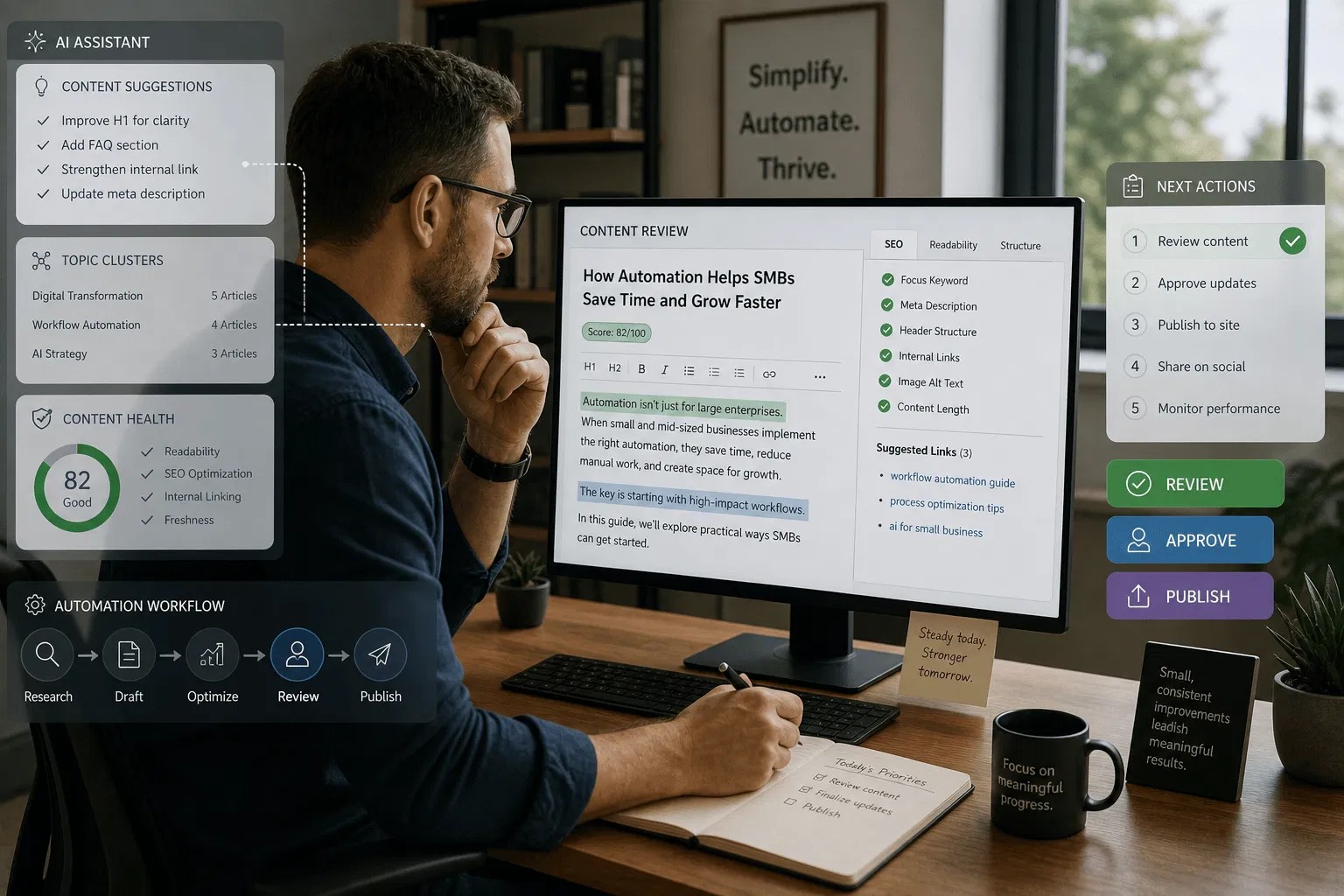
Your website is a map. If the roads are broken, visitors get lost.
Internal linking is the practice of linking one page on your website to another related page. It helps visitors find the next useful step and helps search engines understand how your content fits together.
Google’s SEO Starter Guide says links help Google discover pages and understand what linked pages are about. Google also advises using clear anchor text so people and search engines understand the destination page. (Google Search Central)
Good internal linking helps visitors:
- Move from an article to a relevant service page
- Find an FAQ before booking a call
- Understand related problems and solutions
- See that your business has useful depth
- Find the next step without guessing
Internal links are especially useful for small service businesses because many sites already have disconnected assets. An article explains a buyer’s problem. A service page offers the solution. But if the two are not connected, the path breaks.
Every week, look for a simple connection.
One link from an article to a service page. One FAQ is connected to a deeper guide. One older post connected to a newer explanation.
Organize. Connect. Grow.
Website Content Maintenance Keeps Useful Assets Working
Website content maintenance is the ongoing work of keeping website content accurate, clear, up to date, and useful.
It is not only technical upkeep. It includes the words, structure, links, examples, FAQs, and next steps that shape how visitors understand the business.
Website content maintenance is the practice of keeping existing website assets useful rather than letting them become stale, disconnected, or misleading.
This matters because websites decay quietly.
A service page may still mention an old offer. A blog post may cite outdated numbers. A case study may not link to the service it supports. An FAQ may answer a question your buyers no longer ask.
None of these issues feels urgent on its own. Together, they create friction.
Practical website content maintenance may include:
- Reviewing priority service pages each quarter
- Updating old statistics and source links
- Removing outdated service claims
- Checking calls to action
- Improving internal links
- Adding missing buyer questions
- Reusing useful sections in newsletters or sales follow-up
- Checking whether key pages still match current business priorities
Maintenance protects the work you already paid for. It also helps visitors trust that the business is active, attentive, and clear.
Ongoing Website Optimization Should Stay Manageable
Ongoing website optimization refers to regular improvements that strengthen website clarity, visibility, trust, and usefulness over time.
It does not need to become a huge SEO program. For many small service businesses, practical ongoing website optimization is enough.
That may include:
- Improving page titles and descriptions
- Updating outdated content
- Adding missing buyer questions
- Strengthening internal links
- Checking mobile usability
- Clarifying service-page structure
- Reviewing Google Search Console data
- Reusing high-value content across relevant channels
Search visibility is not a one-time setup.
Your services change. Competitors update their pages. Buyer questions shift. Search systems keep refining how they evaluate content.
BrightLocal’s 2025 Local Consumer Review Survey found that 74% of consumers use two or more websites when deciding whether to use a local business. That means your website works alongside reviews, business listings, social profiles, and other trust signals. (BrightLocal)
A clearer website helps buyers connect those signals.
It gives them a place to understand what you do, who you help, and what to do next.
Website Support For Service Businesses Should Match How Service Businesses Work
Website support for service businesses is practical help that keeps a service business website clear, useful, maintained, and aligned with buyer needs.
It should not assume the business has unlimited review time. It should not require constant content production. It should not create a bigger coordination problem than the one it solves.
Website support for service businesses should reduce recurring friction while keeping human judgment in the right places.
Service businesses depend on trust. Your website needs to reflect your expertise, standards, boundaries, and way of working. That requires judgment.
Tools can identify broken links, search gaps, missing metadata, and content opportunities. They can also help with drafting, summarizing, repurposing, and organizing.
But tools should not replace ownership.
At InteniThrive, automation supports the work. People still make the decisions. Final review matters for client-facing claims, tone, service details, and sensitive examples.
That balance keeps the work useful and safe.
Compounding Progress
Why work weekly?
Because small improvements compound.
One week, you refresh an older article. Next week, you will improve a service page. The week after that, you connect related pages and expand an FAQ.
None of those changes needs to overwhelm the business. Together, they make the website clearer, better connected, and more useful.
By the end of a year, weekly movement can produce meaningful change:
- 12 service-page or FAQ improvements
- 12 content refreshes
- 12 internal linking updates
- 12 content reuse assets
- 12 site clarity or trust improvements
That is a stronger website without a stressful rebuild.
More importantly, the business gains a rhythm. Marketing stops depending only on memory, motivation, or last-minute effort.
Listen. Improve. Repeat.
Start With Clarity
A baseline is a starting point that shows where your website stands today.
Do not start with a massive project. Start with a baseline.
The Baseline Setup from InteniThrive Consulting is designed to clear the fog. It identifies what is already working, what is unclear or outdated, what should improve first, and what can wait.
The Baseline Setup reviews the practical parts of your website and content foundation:
- Service-page clarity
- Existing content usefulness
- Internal linking gaps
- Search visibility signals
- FAQ and buyer-question coverage
- Content reuse opportunities
- Site clarity and trust issues
The output is not a bloated report that creates more work.
It is a practical starting map.
Once the gaps are identified, the Rhythm Marketing Engine can begin. Each week, practical improvements move. Each month, progress becomes visible.
No guessing. No pressure to fix everything at once. No need to pretend another big project is the only path forward.
Let’s Move Forward
Marketing should not be the hardest part of your week.
You have built a useful business. You have knowledge to share. Your website should reflect that in a clear, current, and practical way.
That usually does not require a rebuild.
It requires steady improvement.
The Rhythm Marketing Engine helps keep website content improvements, maintenance, ongoing optimization, and structured content reuse on track when client work gets busy.
Steady. Clear. Useful.
Contact InteniThrive today to see whether Rhythm Marketing Engine is the right fit for your business.
FAQs
What Are Weekly Website Improvements?
Weekly website improvements are small, practical updates made to a website on a consistent rhythm. They may include refreshing content, improving internal links, clarifying service pages, adding FAQs, updating calls to action, or fixing small clarity issues.
Why Do Weekly Website Improvements Matter For Service Businesses?
Weekly website improvements matter because service business websites need to stay clear, current, and useful. Small updates help buyers understand services, answer common questions, and support trust before a sales conversation.
What Are Website Content Improvements?
Website content improvements are updates that make website pages more useful for visitors. They can include clearer service descriptions, stronger headings, better examples, updated sources, improved FAQs, and clearer next steps.
What Is Website Content Maintenance?
Website content maintenance is the ongoing work of keeping website content accurate, relevant, connected, and useful. It helps prevent older pages, articles, links, and service descriptions from becoming outdated or confusing.
What Is Ongoing Website Optimization?
Ongoing website optimization is the regular improvement of website clarity, visibility, structure, and usefulness. For small service businesses, it often includes content refreshes, internal linking, page updates, search visibility support, and buyer-question coverage.
What Kind Of Website Support For Service Businesses Is Most Useful?
The most useful website support for service businesses focuses on practical improvements that support trust and buyer decisions. This usually includes service page clarity, content refreshes, internal linking, FAQs, search visibility support, and simple reporting.
Do I Need A Full Website Redesign First?
Not always. Many service businesses do not need a full redesign first. They need to improve the website they already have by clarifying service pages, updating content, improving links, and answering buyer questions more directly.
How Does Rhythm Marketing Engine Help?
Rhythm Marketing Engine keeps making practical improvements to the website, content, visibility, and distribution, moving each week. It helps founder-led service businesses maintain steady progress without turning marketing into another management burden.

Leave a Reply