
Most small business owners treat SEO like a game of Scrabble: fit the right high-value words onto the page, and you win.
That is no longer enough.
Today, Google and AI-driven answer engines look for clear, useful, well-supported answers to specific user problems. A content gap analysis for small business helps you find the questions your website does not answer yet, especially on service pages, older articles, FAQ sections, and sales-support content.
If a potential client asks, “How long does a renovation take?” and your website only says, “We do renovations,” the gap is not a missing keyword. The gap is a missing answer.
At InteniThrive, we believe most small service businesses do not need more random marketing ideas. They need a steadier way to keep the right improvements moving. That starts by identifying what buyers actually ask, then making sure your website answers those questions clearly.
Key Takeaways
- Content gap analysis for small business means finding missing answers, not just missing keywords.
- Answer engine optimization refers to making content clear enough for search engines and AI systems to understand, summarize, and cite.
- Small business SEO works better when service pages answer real buyer questions directly.
- A website content audit should review clarity, usefulness, internal links, FAQs, trust signals, and next steps.
- Service page optimization should help buyers understand fit before they contact you.
- Search visibility support is strongest when useful content is specific, structured, and easy to maintain.
What Is An Answer Gap?
An answer gap is a missing, vague, buried, or incomplete answer to a question your buyer already cares about.
When we talk about a content gap analysis for small business, we are not only looking for topics you have never written about. We are looking for the missing information in the existing pages.
A law firm may have a page about estate planning, but never answer, “Do I need a lawyer for a simple will?”
A roofing company may mention repairs, but never explain, “How urgent is a small roof leak?”
A consultant may describe strategy support, but never clarify, “What happens in the first month?”
Those are answer gaps.
They matter because buyers use search to reduce uncertainty. Google’s own SEO Starter Guide defines SEO as helping search engines understand content and helping users decide whether to visit a site through search. Google also says its ranking systems aim to prioritize helpful, reliable, people-first content created to benefit people, not content created mainly to manipulate rankings. Google SEO Starter Guide, Google’s helpful content guidance
Why Keywords Alone Are No Longer Enough
Keywords show what people type. Answer gaps show what people still need to know before they trust you.
Traditional small business SEO often starts with phrases like “roofing services in [City Name]” or “business consultant near me.” Those still matter, but they are only part of the picture.
Modern searches are more specific. People ask questions like:
- How much does a minor roof repair usually cost?
- Do I need a lawyer before signing a lease?
- What should I prepare before a first consultation?
- How long does onboarding take?
- Is this service right for a very small team?
That is where answer engine optimization becomes useful.
Answer engine optimization means structuring content so search engines, AI summaries, and buyers can quickly understand the answer, source, context, and next step.
This matters because search behavior is changing. Pew Research Center found that 58% of U.S. adults in its March 2025 browsing study encountered at least one Google search with an AI-generated summary, and users were less likely to click links to results when an AI summary appeared. Pew Research Center
SparkToro’s 2024 zero-click search study also found that 58.5% of U.S. Google searches ended without a click to another website. SparkToro
The practical takeaway is simple: your content needs to be useful even before someone clicks. Clear answers help your website improve search and AI visibility and build buyer confidence.
How To Conduct A Practical Content Gap Analysis For Small Business
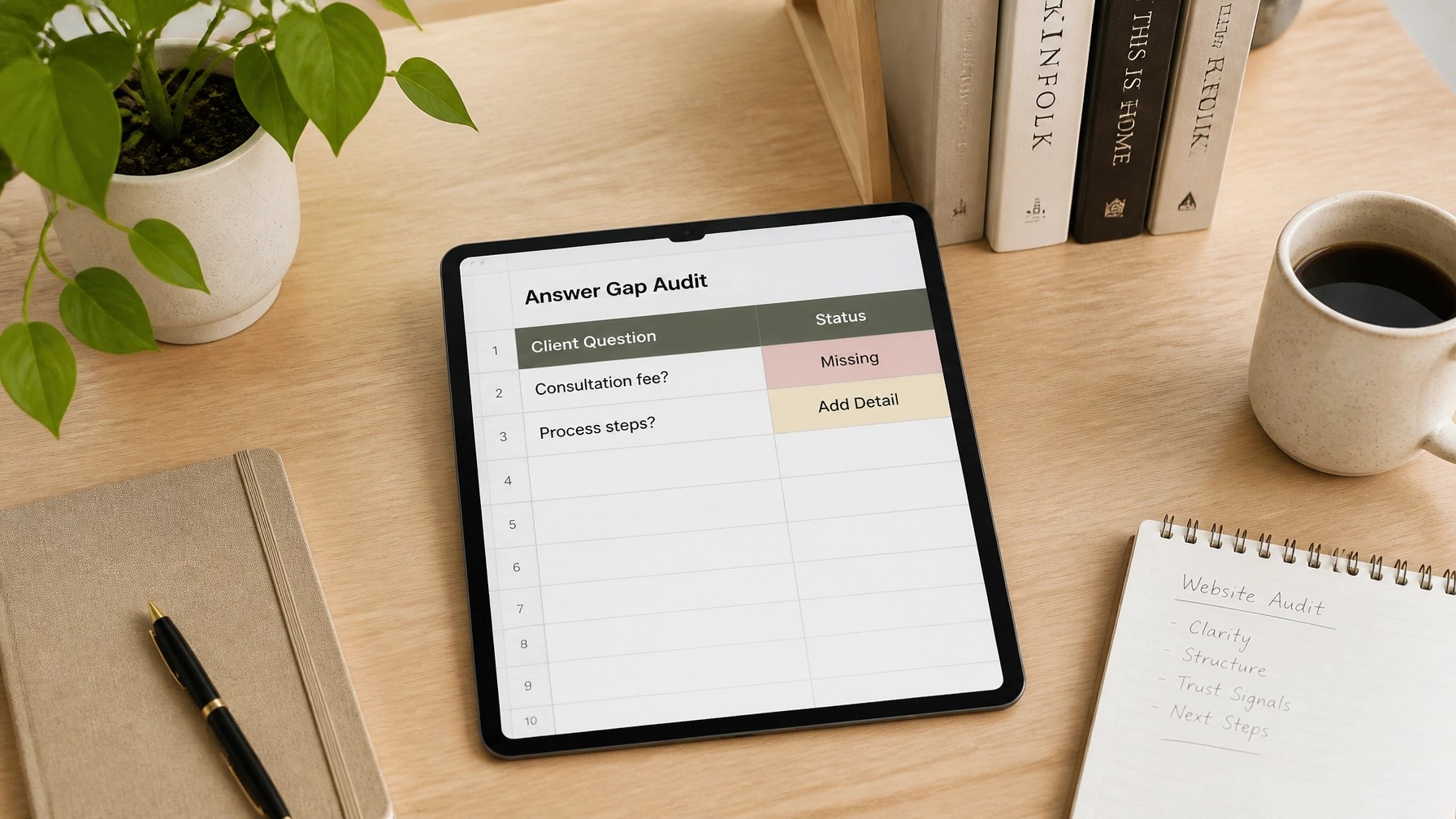
A practical content gap analysis compares real buyer questions against your current website content, then identifies where answers are missing, weak, outdated, or hard to find.
You do not need expensive software to begin. Start with what your buyers already ask.
1. Inventory: The Questions Buyers Already Ask
List 10 to 20 real questions from:
- Sales calls
- Inquiry emails
- Contact forms
- Proposal discussions
- Customer onboarding
- Support conversations
- Reviews or testimonials
- Google Business Profile questions
- Internal team explanations
Useful questions often start with:
- How much does it cost?
- How long does it take?
- What happens first?
- Who is this for?
- What do I need to prepare?
- What makes this different?
- Can this work for my situation?
- What happens if I am not ready yet?
These are not just SEO ideas. They are trust signals.
2. Map Each Question To A Current Page
Open your homepage, primary service pages, FAQs, and top articles. For each buyer question, ask:
- Does this page answer the question directly?
- Is the answer easy to find?
- Is the answer specific enough to be useful?
- Does the answer reflect how we actually work?
- Is the answer connected to the next useful step?
If the answer exists only in your head, inbox, proposal, or sales call notes, it is not yet helping your website.
3. Review Service Pages First
For most small service businesses, optimizing the service page matters more than creating more blog content.
A useful service page should explain:
- Who the service is for
- What problem does it solve
- What outcome does it support
- What is included
- What is not included
- What the process looks like
- What common questions do you ask
- What proof supports trust
- What is the next step that makes sense
If a service page only describes what you do, it is probably thin. If it helps a buyer understand whether the service fits their situation, it is doing more useful work.
4. Use A Website Content Audit To Find Weak Spots
A website content audit is a structured review of existing pages to see what should be kept, improved, connected, reused, merged, or retired.
For this kind of work, keep the review practical. You are not trying to diagnose every technical SEO issue. You are looking for content that should help buyers, but does not yet do enough.
Review each priority page for:
- Missing buyer questions
- Outdated service details
- Vague claims
- Weak examples
- Missing internal links
- Thin FAQs
- Unclear next steps
- Unsupported proof
- Content that could be reused elsewhere
A simple spreadsheet is enough. Use columns for Page, Buyer Question, Current Answer, Gap, Priority, and Next Step.
5. Check Search Results For Related Questions
Type your main service into Google and review:
- People Also Ask results
- Related searches
- Competitor FAQ sections
- Review language
- Forum or community questions
- YouTube titles
- Local search results
Do not copy competitor content. Look for patterns.
If five competitors answer pricing, timing, scope, or readiness questions and your website avoids them, that is a practical visibility gap.
The 60-Word Answer Test
The 60-word answer test means every important section should give a clear answer within the first 60 words.
This helps humans, search engines, and AI systems.
For example, instead of writing:
“Website strategy is an important part of digital growth for modern businesses that want to improve their online presence.”
Write:
“Website strategy means deciding what your website should help buyers understand, which pages matter most, and what content should guide people toward the next step. For a small service business, it usually starts with service-page clarity, buyer questions, internal links, and trust signals.”
The second version is easier to understand, cite, summarize, and reuse.
A Simple Example: The Family Law Page
A boutique law firm had a family law page that explained the practice area, listed services, and included a contact form. Traffic was steady, but inquiries were weak.
The page missed several practical buyer questions:
- Do you offer an initial consultation?
- What should I bring to the first meeting?
- Do you handle uncontested matters?
- How long does the process usually take?
- What happens if both parties already agree?
- What information should I not send before becoming a client?
The fix did not require a full rewrite.
The next step was to add a short “Common First Questions” section, improve the opening paragraph, add internal links to related services, and clarify the consultation process.
That is content gap work. Small page improvements can make a service easier to understand without requiring a full redesign.
What To Improve First
Not every gap deserves immediate attention.
Prioritize gaps that affect:
- Priority services
- Sales conversations
- Buyer hesitation
- Search visibility
- AI visibility
- Internal linking
- Trust and proof
- Contact or inquiry decisions
A practical priority order looks like this:
- Improve the highest-value service page.
- Add or strengthen FAQ answers on that page.
- Link the page to related articles, case studies, or resources.
- Refresh one older article that supports the same service.
- Reuse the improved answers in sales follow-up, LinkedIn posts, Google Business Profile updates, or newsletter snippets.
This keeps the work useful without adding another large project.
Closing Content Gaps Without Overwhelm
Closing answer gaps is a core part of website content improvement, search visibility support, and structured content reuse.
You should not feel pressure to rewrite your entire website this week. That usually creates more friction than progress.
Start with one answer cluster.
For example:
- One priority service
- One service page
- Five buyer questions
- Two internal links
- One FAQ section
- One reusable summary for sales or social content
That is enough movement for one useful improvement cycle.
Rhythm Marketing Engine handles this kind of steady weekly work for small service businesses with a working website, useful content, and inconsistent follow-through.
It starts with a Baseline Setup ($599) that shows what is working, what is unclear, what should improve first, what can wait, and whether monthly support makes sense. If there is a fit, Rhythm Marketing Engine ($599/month) keeps practical website, content, visibility, and distribution improvements moving each week.
The goal is not more marketing activity.
The goal is a steady, useful marketing movement.
Frequently Asked Questions
What is content gap analysis for small business?
Content gap analysis for small business means reviewing your website to find missing, weak, outdated, or hard-to-find answers that buyers need before they contact you. It usually includes service pages, FAQs, articles, internal links, trust signals, and opportunities for search visibility.
How is a content gap different from a keyword gap?
A keyword gap means your website does not target a search phrase that competitors may rank for. A content gap is broader. It means your website does not answer a useful buyer question clearly enough, even if the keyword appears on the page.
How often should a small business review content gaps?
A small service business should review its priority service pages quarterly or whenever services, pricing, processes, audiences, or buyer questions change. A lighter monthly review can work well when website updates often slip.
Do I need a new blog post for every content gap?
No. Many content gaps should be fixed on existing pages first. A short FAQ, a clearer service-page section, a stronger internal link, or an updated example may be more useful than a new article.
What is answer engine optimization?
Answer engine optimization refers to making content clear, structured, specific, and useful enough for search engines and AI systems to understand and summarize. It works best when answers are direct, well-supported, and easy to connect with related pages.
How does this support small business SEO?
Small business SEO improves when your website clearly explains your services, answers buyer questions, links to related pages, and provides visitors with useful next steps. This helps search engines understand your content and helps buyers decide whether your business fits their needs.
What should a website content audit include?
A practical website content audit should review service-page clarity, the usefulness of existing content, internal linking, FAQ coverage, search visibility signals, trust signals, outdated information, and content reuse opportunities.
Which pages should I improve first?
Start with the pages most likely to support inquiries or sales conversations. For many service businesses, that means the homepage, priority service pages, contact page, top articles, and any page you often send to prospects.
Can AI help find content gaps?
Yes, AI can help generate buyer questions, compare a page against search intent, and identify unclear sections. Human review still matters because your team must confirm the accuracy of services, claims, examples, tone, and business judgment.
What is the easiest first step?
Choose one priority service page. List the top five questions buyers ask before they contact you. Then check whether the page answers each question clearly within the first few relevant sections.

Leave a Reply