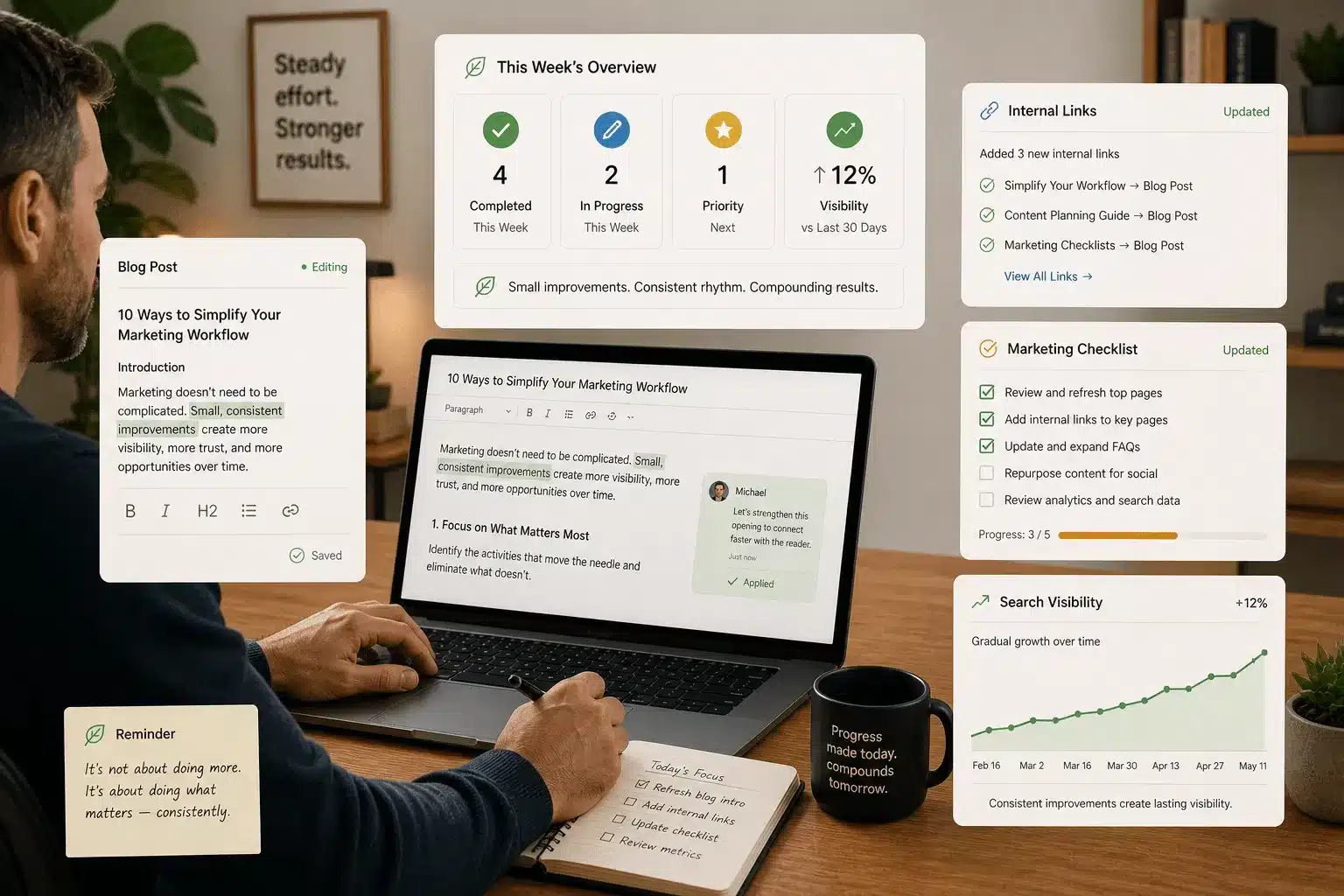
Most service business owners treat their website like a digital brochure. They spend months on a beautiful redesign, launch it, and then let it sit. Over time, that site starts to feel heavy. It becomes a static object that does not actually help people find you or trust you. If you care about search visibility support for small business, that gap becomes a real business problem.
Without proactive search visibility support, your website can slowly lose ground in search results. This is not just about chasing page-one rankings for broad terms. It is about ensuring that when a potential client has a specific need, your site clearly shows you can help. Strong search visibility support for small business means being understandable, useful, and easy to trust.
At InteniThrive Consulting, we see this friction all the time. Small service businesses often have real expertise but struggle with the follow-through required to show it online. They do not always need a total overhaul. They usually need a steady rhythm of useful updates that keep the site clear, active, and easier to find.
That is the shift this guide is built around. Stop treating the website like a one-time project. Start treating it like an operating asset that needs regular attention. The practical steps below will show how small, consistent improvements strengthen search visibility support for small business over time.
Key Takeaways
- Clarity over Cleverness: Service pages should be literal, specific, and easy to understand.
- FAQs Build Trust: Real customer questions help you create content that supports search and conversion.
- Internal Linking Supports Navigation: Strategic links help people and search engines move through your site.
- AI Readiness Still Starts with Humans: Structured, useful content improves both traditional search and AI visibility.
- Consistency Wins: Small weekly updates usually outperform occasional major redesigns.
- Search Visibility Is Operational: Better search visibility support for small business comes from clear ownership, useful updates, and regular follow-through.
Service Page Optimization for Search Visibility Support for Small Business
The biggest mistake service businesses make is trying to sound more clever than clear. A page title like “Strategic Solutions for Future-Proofed Growth” may sound polished, but it does not match how people actually search. When a busy prospect lands there, they should not have to decode what you do.
Effective service page optimization starts with being literal. If you offer bookkeeping services in Austin, say “Bookkeeping Services in Austin.” That level of clarity reduces friction for the visitor and strengthens search visibility for small businesses because the page matches real search behavior.
Each service page needs to function as a standalone entry point. You cannot assume someone has seen your homepage. Each page must answer three basic questions within seconds:
- What do you do?
- Who do you do it for?
- What should the visitor do next?
That sounds simple because it is simple. But simple is usually where websites get messy. Businesses over-explain, under-explain, or hide the useful part behind vague language. If your goal is search visibility support for small business, plain language will usually do more work than clever branding.
Beyond the headlines, website content optimization means looking at how the information is organized. Use bulleted lists to break up long sections. Use H2 and H3 headers to separate key topics. This helps search engines understand the page and makes it easier for people to scan. Better structure is a quiet but important part of search visibility support for small business.
We often find that service businesses bury their best information at the bottom of the page. Move your testimonials, process steps, and clear calls to action (CTAs) higher up. Every week, a small tweak to a service page, like adding a more descriptive header or updating a testimonial, contributes to a larger sense of momentum. This is the core of weekly website improvements.
A good service page should also include practical trust signals:
- Specific outcomes or deliverables
- Areas served
- Typical client fit
- Real FAQs
- A next step that does not make people hunt
Those details help visitors make decisions faster. They also support search visibility support for small business because they add context that search engines can understand. Clear pages tend to rank better and convert better. Ranking without clarity is like putting up a road sign that points to a locked door.
The FAQ Strategy: Turning Buyer Questions into Search Authority
Your inbox is a goldmine for search visibility support. Every time a prospect asks a question via email, form, or call, they are giving you the language real buyers use. Most businesses answer those questions once and then let them disappear.
Turning those questions into an FAQ section or individual blog posts is a practical way to improve website content. When you answer a specific question like “How long does a commercial roof inspection take?” you are targeting long-tail search queries. These phrases often have lower volume but higher intent. Semrush has repeatedly noted that long-tail searches tend to convert better because they reflect more specific needs, which makes them valuable for search visibility support for small business.
Answering FAQs also builds trust quickly. It shows you understand your clients’ common concerns. It positions you as a helpful partner rather than another generic provider. This is one of the cleaner ways to improve search visibility support for small business without stuffing pages with awkward SEO language.
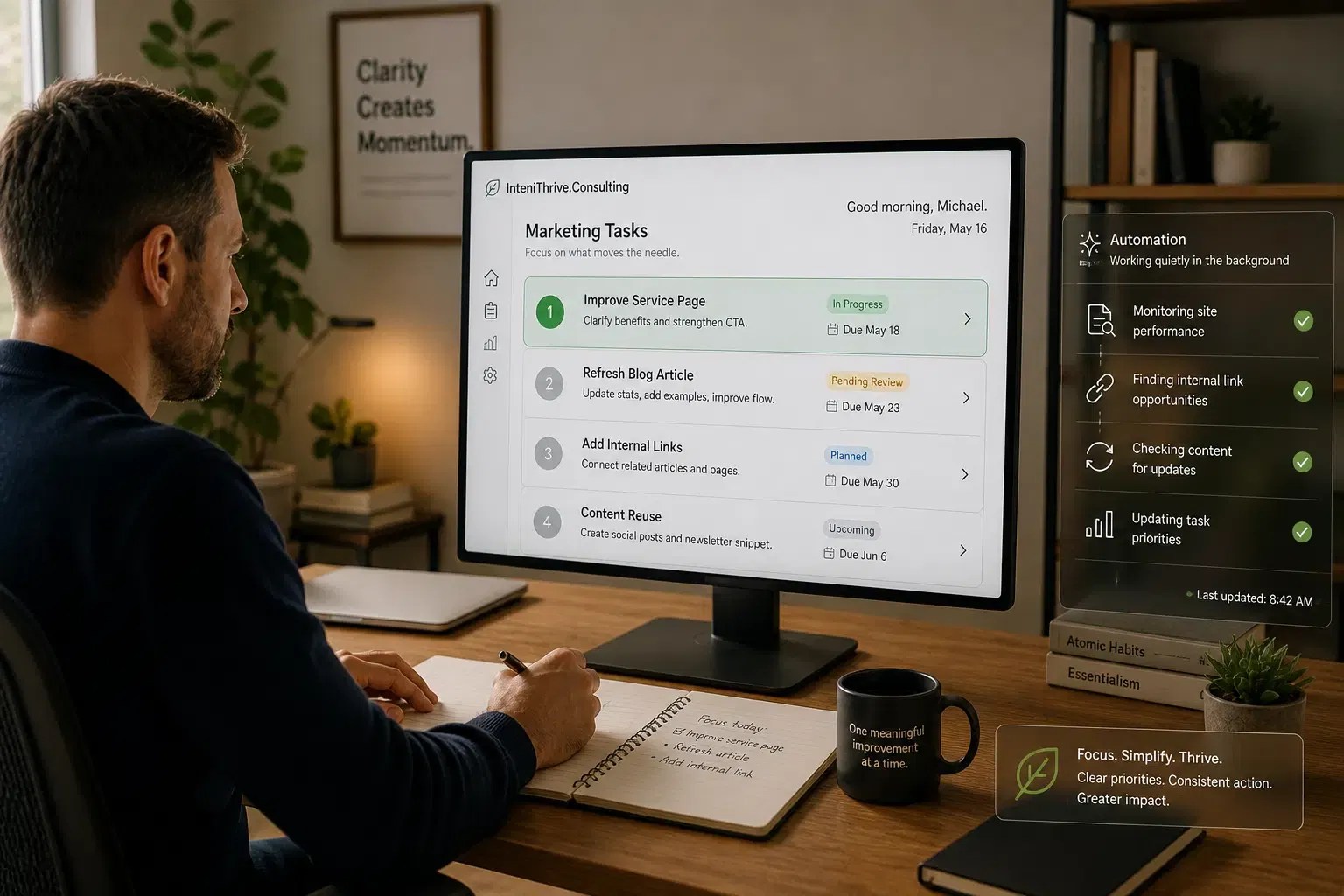
From a technical perspective, FAQs allow you to naturally include more relevant keywords without forcing them into your main service descriptions. Each FAQ is an opportunity to link back to your core services, creating a web of helpful information. This is where marketing follow-through support becomes essential. It’s about taking those insights from your daily work and ensuring they actually make it onto the website.
FAQ content also helps with how people search now. They type full questions. They use voice search. They ask AI tools the same things they ask friends. If your website clearly answers those questions, you improve search visibility support for small business in both traditional search and AI-assisted search environments.
If you aren’t sure where to start, look at your “frequently asked questions” literally. What are the five things people ask you during every sales call? Write those down, answer them clearly, and put them on your site this week. That simple act of ownership moves the needle more than a dozen brainstorming sessions.
A practical FAQ workflow looks like this:
- Pull questions from calls, emails, and forms
- Group similar questions together
- Answer them in plain English
- Link each answer to a relevant service page
- Revisit the section each month
It is not glamorous. It is useful. And what is useful is usually what strengthens search visibility support for small business over time.
Internal Linking Services: Building the “Roads” of Your Website
Think of your website like a city. Your pages are the buildings, and internal links are the roads that connect them. If you have a great building but no road leading to it, no one will visit. Internal linking services ensure that both your visitors and search engine crawlers can find every important piece of content you’ve created.
A common issue on service business websites is orphan pages. These pages exist, but nothing on the site links to them. Over time, they lose visibility because search engines assume they are not important. That is bad for usability, and it weakens search visibility support for small business.
Strategic internal linking follows a few basic rules:
- Link from high-traffic pages to high-value pages. If your homepage gets the most traffic, make sure it links directly to your most profitable services.
- Use descriptive anchor text. Instead of “click here,” use “read our guide on search visibility support.” This tells search engines exactly what the destination page is about.
- Keep it natural. Don’t link just for the sake of linking. Every link should provide a logical “next step” for the reader.
When you link a blog post about a specific problem back to a service page that solves it, you create a clearer conversion path. You guide the visitor from “I have a problem” to “I may need help.” You also strengthen search visibility support for small business by showing how your topics connect.
Google’s own guidance has long reinforced the value of helpful site structure and crawlable links. That matters because search engines are trying to understand which pages are important, how topics relate, and where users should go next. Internal links provide those signals without needing a giant technical project.
Setting up a regular rhythm to check for new linking opportunities is one of the most underrated weekly website improvements. As you add new content, you should always look back at your existing pages to see where a new link would be helpful. This prevents your site from becoming a collection of silos and turns it into a cohesive ecosystem.
A simple internal linking review can happen each week:
- Add links from new posts to service pages
- Add links from older posts to newer resources
- Check that the anchor text is descriptive
- Fix broken or outdated destinations
- Make sure key pages are no more than a few clicks deep
This is not busywork. It is maintenance that supports search visibility support for small business and keeps the site easier to navigate for real people.
The Future of Search: Optimizing for AI Visibility and LLMs
The way people find information is changing rapidly. With the rise of Search Generative Experience (SGE) and Large Language Models (LLMs) like ChatGPT, search is becoming more conversational. People aren’t just looking for a list of links; they are looking for direct answers. This makes AI visibility support a critical part of your long-term strategy.
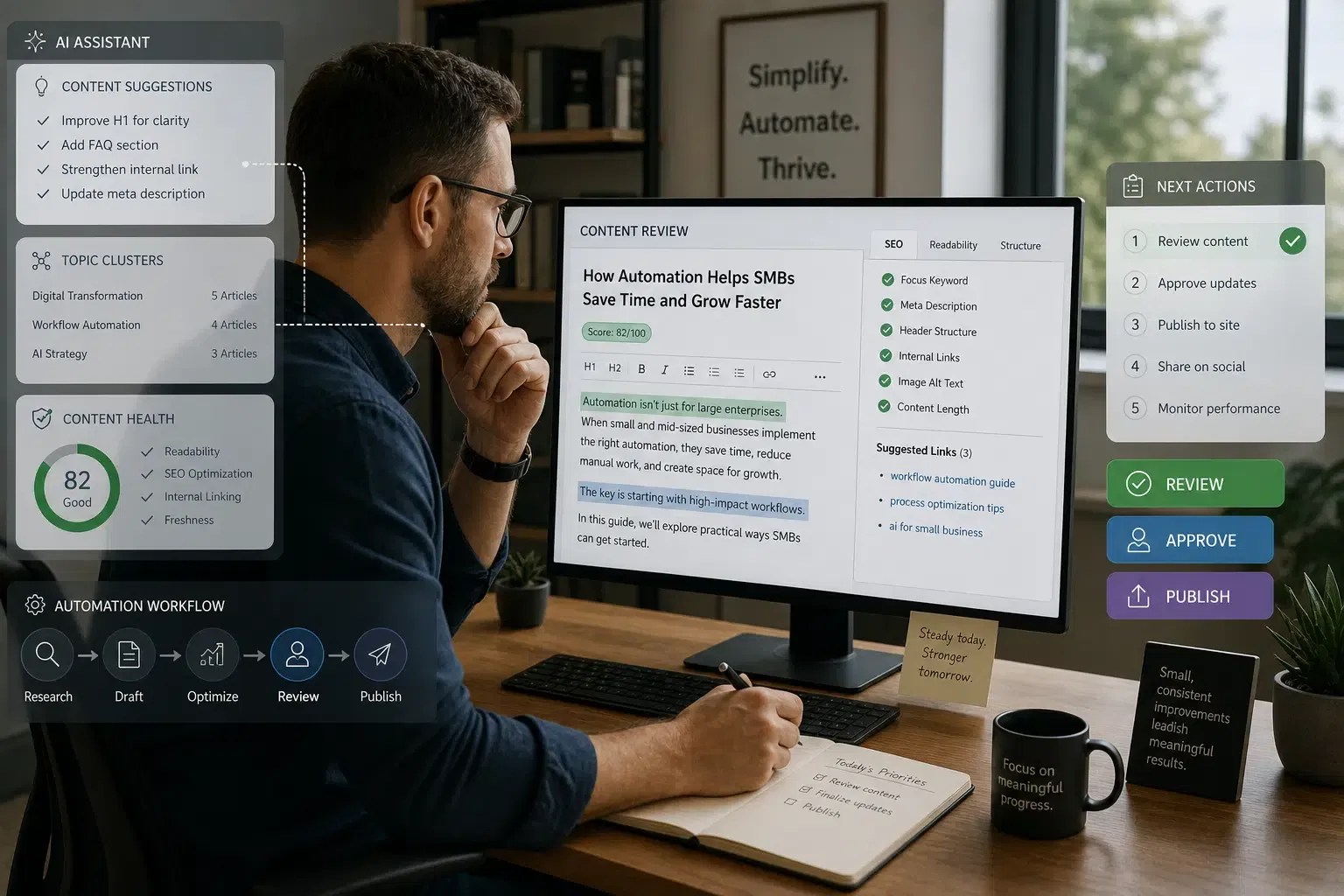
AI models prioritize content that is authoritative, structured, and clearly written. They look for identifiable concepts, people, services, and relationships they can synthesize into an answer. To stay visible in this environment, your website needs clearer signals, not more noise. That matters for search visibility support for small business.
One way to improve your AI visibility is by using structured data (schema markup). This is a bit of behind-the-scenes code that tells search engines exactly what a piece of information is: a price, an address, a review, or a specific service. While this sounds technical, it’s really just another form of clarity. You are making it easier for machines to understand your business.
However, the most important part of AI visibility support is still the human element. AI systems are trained on human-created material. If your site is filled with generic, empty copy, you lose the edge that comes from real expertise. You need useful examples, clear judgment, and practical detail that a generic tool cannot fake. That is still true for search visibility support for small business. Helpful beats hollow.
At InteniThrive, we focus on helping you document your “IP”: the unique way you solve problems. By consistently publishing your expertise, you create a footprint that AI models will recognize as a primary source of authority in your niche.
There is also a practical point here. AI tools tend to pull from content that is easy to quote, summarize, and trust. So give them that. Use direct headings. Answer obvious questions. State who the content is for. Add examples. Keep paragraphs readable. Google’s helpful content guidance continues to emphasize creating content for people first, not just rankings. That approach also supports search visibility support for small business in an AI-shaped search environment.
Why Consistency Beats Redesigns: The Power of Weekly Website Improvements
The traditional “big redesign” model of web development is broken for service businesses. It’s expensive, it’s stressful, and it usually results in a site that starts degrading the moment it launches. The modern alternative is a strategy of continuous, weekly website improvements.
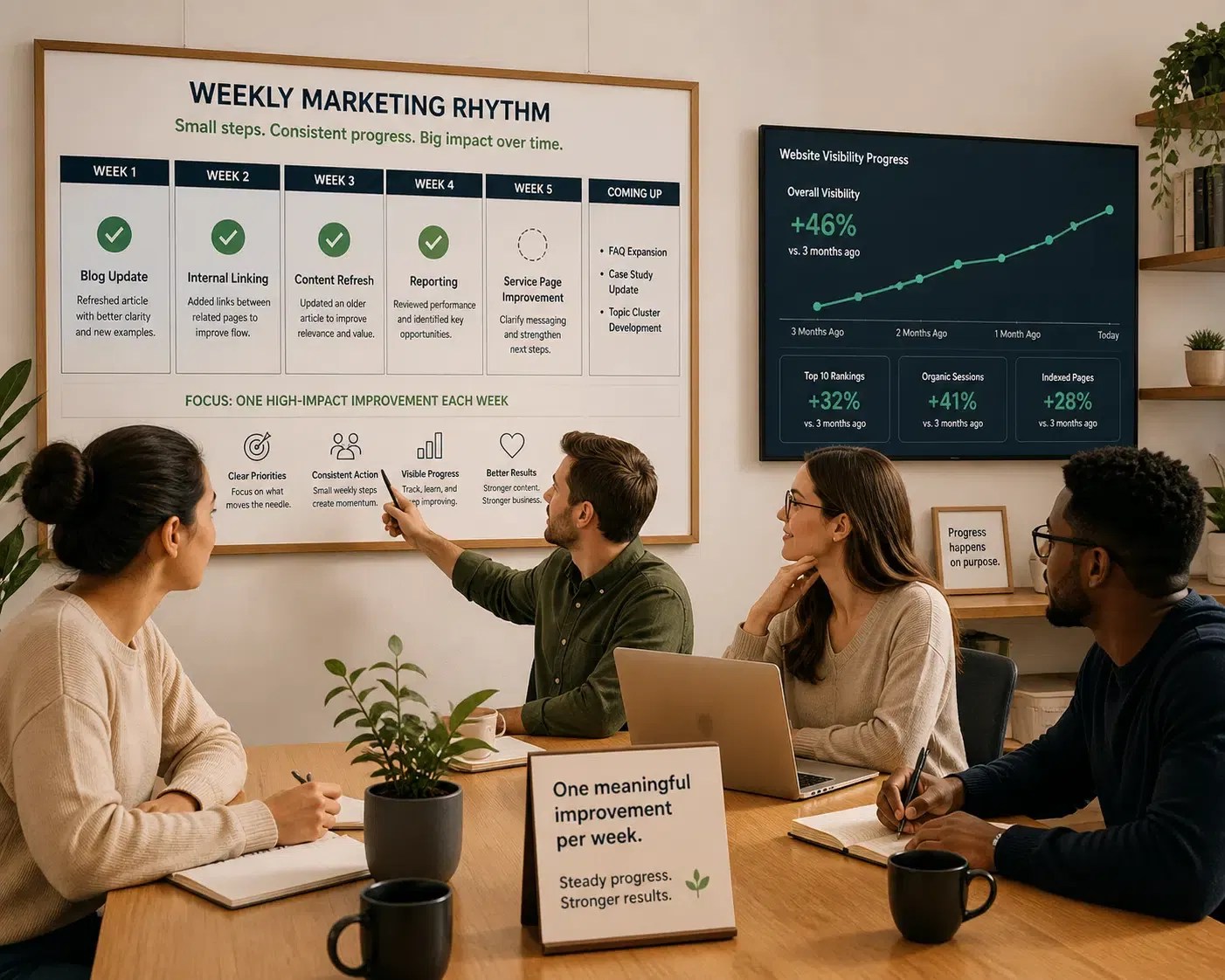
When you focus on small, manageable tasks each week, you avoid the overwhelm that can stall your marketing work. One week, you might improve a service page. The next, you might add a few internal links. The week after, you might refresh an older article with better examples or updated facts. Those steady actions usually improve search visibility support for small business more reliably than a large redesign every few years.
This approach, which we call the Rhythm Marketing Engine, builds predictable momentum. Over six months, twenty-four small improvements add up to a much more significant impact than a single redesign. You are constantly testing, learning, and refining based on what is actually working.
Consistent follow-through also ensures that your site never feels “dated.” It keeps your search rankings stable because search engines favor sites that are frequently updated with useful information. HubSpot’s marketing research has repeatedly shown that businesses that consistently publish and update useful content tend to generate more traffic over time. Most importantly, it lowers the coordination burden on you as the founder. You don’t have to manage a massive three-month project; you just have to ensure the engine is moving.
There is also a practical psychology benefit here. Small weekly tasks are easier to assign, finish, and review. They create visible progress. They reduce the drag caused by unfinished marketing work. And because they are repeatable, they are easier to sustain. That matters for search visibility support for small businesses, because visibility is rarely built through a single big push. It is built through rhythm.
If you find that your marketing work is constantly slipping to the bottom of your to-do list, you don’t need more ideas. You need marketing follow-through support. You need a system that ensures the essential work: the linking, the refreshing, the optimizing, happens every single week without fail.
Each week, ask:
- What page needs clearer language?
- What article needs a fresh example?
- What service page needs a better internal link?
- What question should be answered on the site?
- What is the next practical fix?
That kind of routine is not flashy. It is exactly why search visibility support for small businesses becomes more durable over time.
Conclusion: Getting Your Website to Work for You
Your website should be doing useful work for your business every day. It should answer questions, reduce doubt, and help the right people find you. But it can only do that when it is clear. Strong search visibility support for small business starts there.
Clarity is not a one-time achievement. It needs ongoing attention. When you focus on literal service pages, helpful FAQs, and a strong internal structure, you remove the friction that keeps buyers from finding you. Over time, that is what durably improves search visibility support for small businesses.
Do not wait for a future slow period to fix your website. Those periods rarely arrive in a neat, useful way. Instead, start a rhythm now. Make one practical improvement this week. Then repeat it next week. That is how a more visible, trustworthy site gets built.
If you are ready to break the all-or-nothing cycle and build a steadier marketing momentum, InteniThrive Consulting can help. Our focus is simple: clear ownership, useful updates, and dependable execution that supports search visibility support for small business without turning your week into an SEO side job.

Frequently Asked Questions
What is the most important part of search visibility support for a service business?
The most important part is making sure your core service pages are clear, literal, and aligned with buyer intent. Search engines and people both need to understand what you do, who you help, and what the next step is. That foundation is the backbone of search visibility support for small business.
How often should I be making weekly website improvements?
As the name suggests, a weekly rhythm is ideal. This could be as little as 30 to 60 minutes spent on a specific task, such as adding internal links or updating a service description. The goal is consistency over intensity. Small, frequent updates keep your site fresh and signal to search engines that your business is active.
Do I really need internal linking services if my site is small?
Yes. Even a five-page website benefits from internal linking. It helps define your site’s hierarchy and ensures users don’t hit a “dead end.” As your site grows, internal linking becomes even more vital for distributing authority from your popular pages to your newer or more specific content.
What does search visibility support for small business actually mean?
It means your business is easier to find when people search for the services you offer, the problems you solve, and the questions your buyers ask. It also means your website is clear enough to build trust once they arrive. Good search visibility support for small business is not just about traffic. It is relevant traffic.
How does AI visibility support differ from traditional SEO?
Traditional SEO focuses on keywords and rankings in a list of links. AI visibility support focuses on structure, authority, and providing direct answers. It involves using technical tools like schema markup and creating “entity-based” content that AI models can easily parse and synthesize for users in conversational search environments.
Why is marketing follow-through support necessary for small businesses?
Most small business owners have plenty of good marketing ideas but lack the time or bandwidth to execute them consistently. Marketing follow-through support provides the accountability and labor needed to keep the “engine” running. It prevents important tasks, such as content refreshes and site updates, from being postponed indefinitely.

Leave a Reply