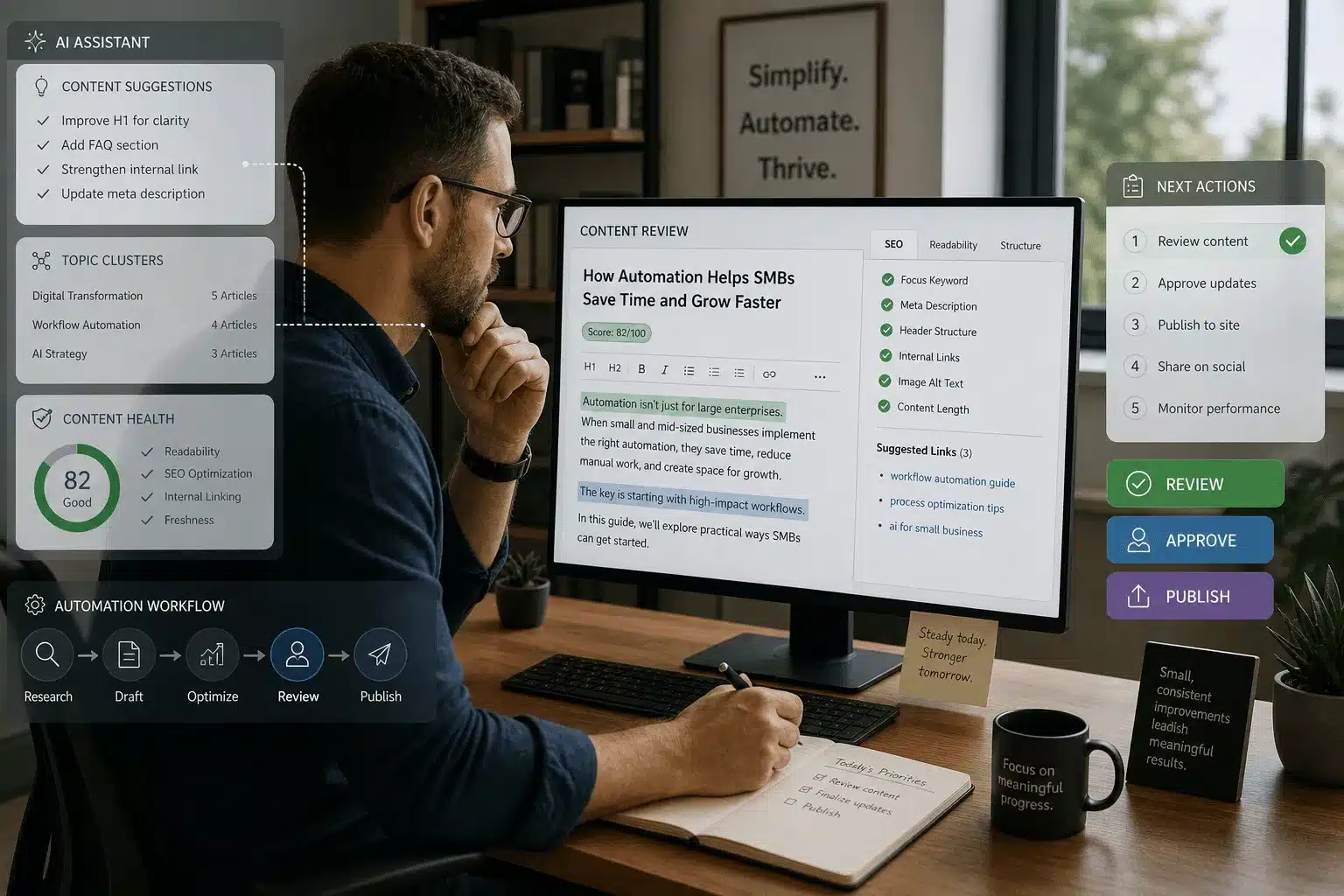
For years, the goal of a website was simple: rank on page one and get a click. But in 2026, the landscape has shifted toward AI visibility support to ensure your business isn’t just found but actually selected and cited by the generative engines your clients use. Search is no longer just a list of blue links; it is a conversation where AI models summarize who you are and what you do. For a small service business, this means your online presence needs to be clearer and more authoritative than ever before to stay relevant.
This change can feel overwhelming, but it is actually an opportunity to double down on what works: clarity, consistency, and useful answers. When your website provides high-quality information in a way that machines can easily parse, you move from being a “search result” to being a “trusted recommendation.” This guide explores how you can use AI visibility support to bridge the gap between your existing content and the new way people find professional services. Good AI visibility support is less about chasing trends and more about making your expertise easier to find, verify, and trust.
Key Takeaways
- Shift to Answers: AI search traffic has surged over 500% year-over-year, moving the focus from clicks to being cited in AI Overviews.
- Clarity Wins: AI visibility support prioritizes clear, structured content that machines can summarize and users can trust.
- Multi-Source Presence: Generative engines pull from an average of 9 to 16 sources, making cross-platform consistency essential.
- Continuous Improvement: Steady, weekly marketing movement through the Rhythm Marketing Engine ensures your site evolves with AI trends.
- Practical Fundamentals: Success in 2026 comes from structured data, FAQ expansion, and a grounded approach to website clarity.
Understanding AI Visibility Support in 2026
What exactly is AI visibility support? In short, it is the process of making your website’s information easy for AI models to understand, summarize, and recommend. Traditional SEO was about keywords and backlinks. While those still matter, modern visibility focuses on “Answer Engine Optimization” (AEO). You want to be the answer that Google’s AI Overview or a specialized tool like Perplexity gives to a potential client.
For a service business, this means your website needs to function as a data source for these engines. If a prospect asks, “Who is the best marketing operations partner for a scaling agency?” your site shouldn’t just exist; it should provide the specific evidence needed for an AI to cite you. This is why AI visibility support is a core component of a healthy marketing rhythm. It ensures your service page’s clarity is high enough for both a machine and a human to understand your value in seconds.
The goal isn’t to “trick” the algorithm. In 2026, the models are too smart for that. Instead, the focus is on search visibility support that reinforces your authority. We do this by organizing your expertise into formats that AI loves: comparative guides, detailed service descriptions, and structured FAQs. Strong AI visibility support turns scattered information into a more reliable signal. When your marketing work is consistent, these improvements add up, creating a footprint that AI can’t ignore.
Why Service Businesses Need to Pivot Now
The data tells a clear story about why waiting is no longer an option. Recent 2026 search trends show that AI search traffic surged 527% year-over-year. This isn’t a minor shift; it is a fundamental change in consumer behavior. People are increasingly using AI to narrow down their choices before they ever click through to a website.
Interestingly, while usage is high, trust is still being built. Research shows that only 14% of users fully trust AI answers, while 27% “trust but verify” by checking the cited sources. This is where your website clarity becomes your greatest sales tool. If an AI recommends you, but the user clicks through to a confusing, outdated homepage, the trust is broken. You need AI visibility support to ensure the AI summary matches the professional experience on your site.
Service businesses are particularly vulnerable to this shift. Unlike e-commerce products with clear specs, professional services are often abstract. Suppose your website doesn’t clearly define your “how,” your “who,” and your “how much.” An AI will likely skip over you in favor of a competitor who has provided that data clearly. This is where AI visibility support becomes practical, not theoretical. Consistent marketing follow-through is the only way to keep your service pages up to date with the details these engines crave.
The Pillars of Website Clarity for AI
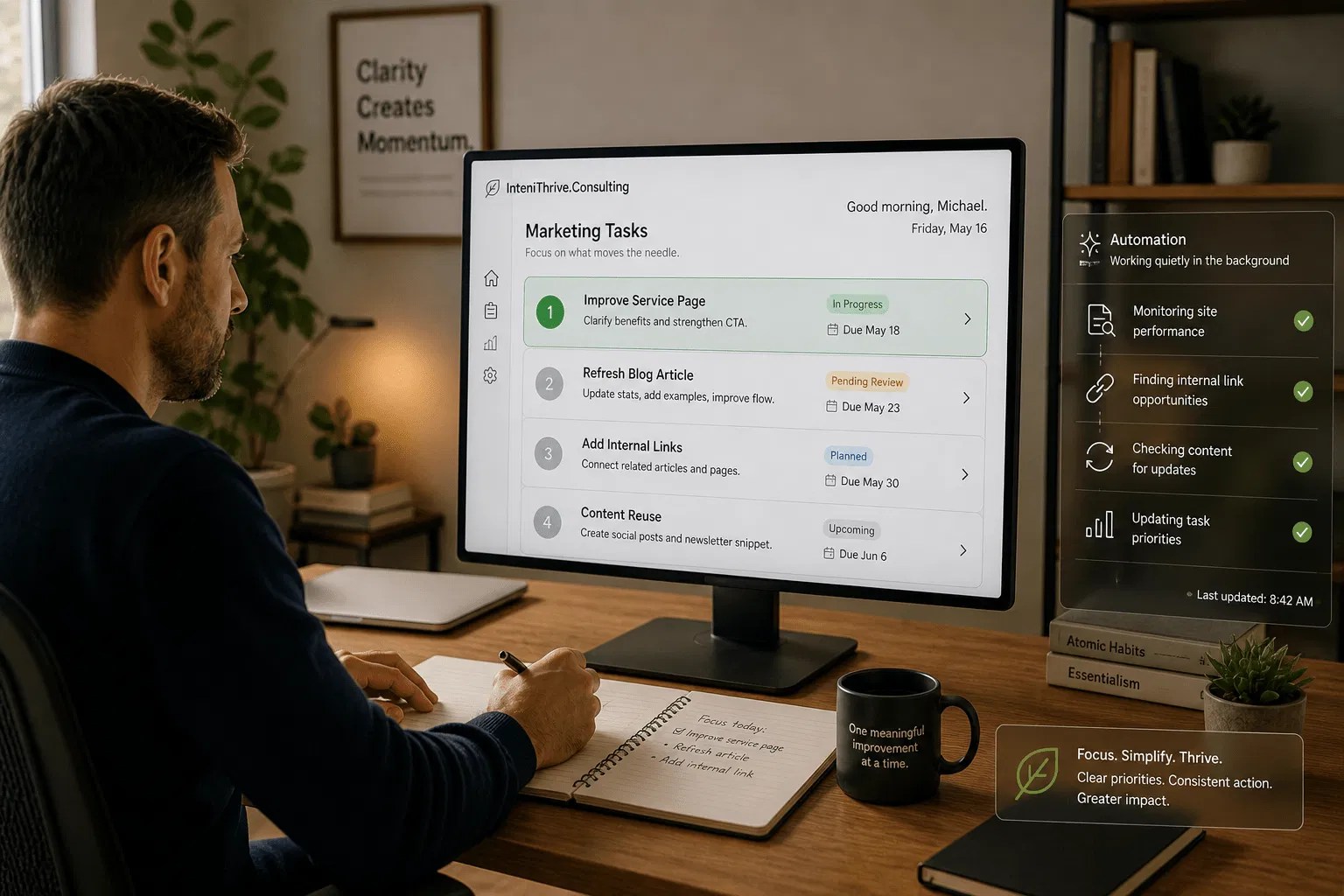
To win in the world of generative search, your site must be “readable” by machines. This goes beyond just having good copy; it involves the technical and structural aspects of how your information is presented. We call this website clarity. When a site is clear, an AI doesn’t have to “guess” what you do.
Structured Data and Schema
One of the most effective ways to provide AI with visibility support is through structured data (schema). This is a hidden layer of code that tells search engines exactly what a piece of information represents. For example:
- Service Schema: Clearly defines what you do, who it is for, and where you do it.
- Review Schema: Aggregates your social proof so AI can cite your “4.9-star rating.”
- Organization Schema: Connects your brand to your social profiles and physical locations.
Logical Information Hierarchy
AI models parse websites by examining headers (H1, H2, H3) to understand the relationships between ideas. If your service page is just one long block of text, the AI will struggle to extract specific answers. By breaking your content into logical sections with descriptive headers, you provide the “hooks” that AI needs to summarize your expertise accurately. In practice, AI visibility support often starts with simple structural fixes like this.
Consistent Messaging
AI pulls from multiple sources: often 9 to 16 different places: to form a single answer. If your website says you specialize in “B2B Lead Gen” but your LinkedIn says “Small Business Coaching,” the AI will detect the inconsistency and may lower your authority score. Practical search visibility support involves auditing these touchpoints to ensure your story is consistent across them. Good AI visibility support depends on that alignment. This marketing consistency is what builds machine-recognizable trust.
FAQ SEO Support: Answering the Right Questions
If you want to be cited in an AI Overview, you need to answer questions. Informational and comparative content make up nearly 70% of AI citations. This is why FAQ SEO support is no longer a “nice-to-have “: it is a core visibility strategy.
Think about the questions your clients actually ask during sales calls.
- “How long does it take to see results?”
- “What is the difference between [Service A] and [Service B]?”
- “Do I need [specific tool] to work with you?”
When you turn these questions into dedicated FAQ sections or blog posts, you are creating “snackable” content that AI can easily pull into an answer box. At InteniThrive, our AI visibility support process involves identifying these question gaps and filling them weekly. In our experience, this is one of the fastest ways to make AI visibility support tangible for a busy service business owner. This doesn’t require a 3,000-word manifesto; it requires a direct, clear answer of 50 to 100 words.
Using FAQ SEO support correctly also helps with “voice search” and “conversational search.” In 2026, people don’t just type “marketing consultant.” They ask their phone, “Find me a marketing consultant who works with law firms and uses a weekly subscription model.” If that specific answer is clearly available on your site, you are much more likely to be the top recommendation.
Content Discoverability in a Multi-Source World
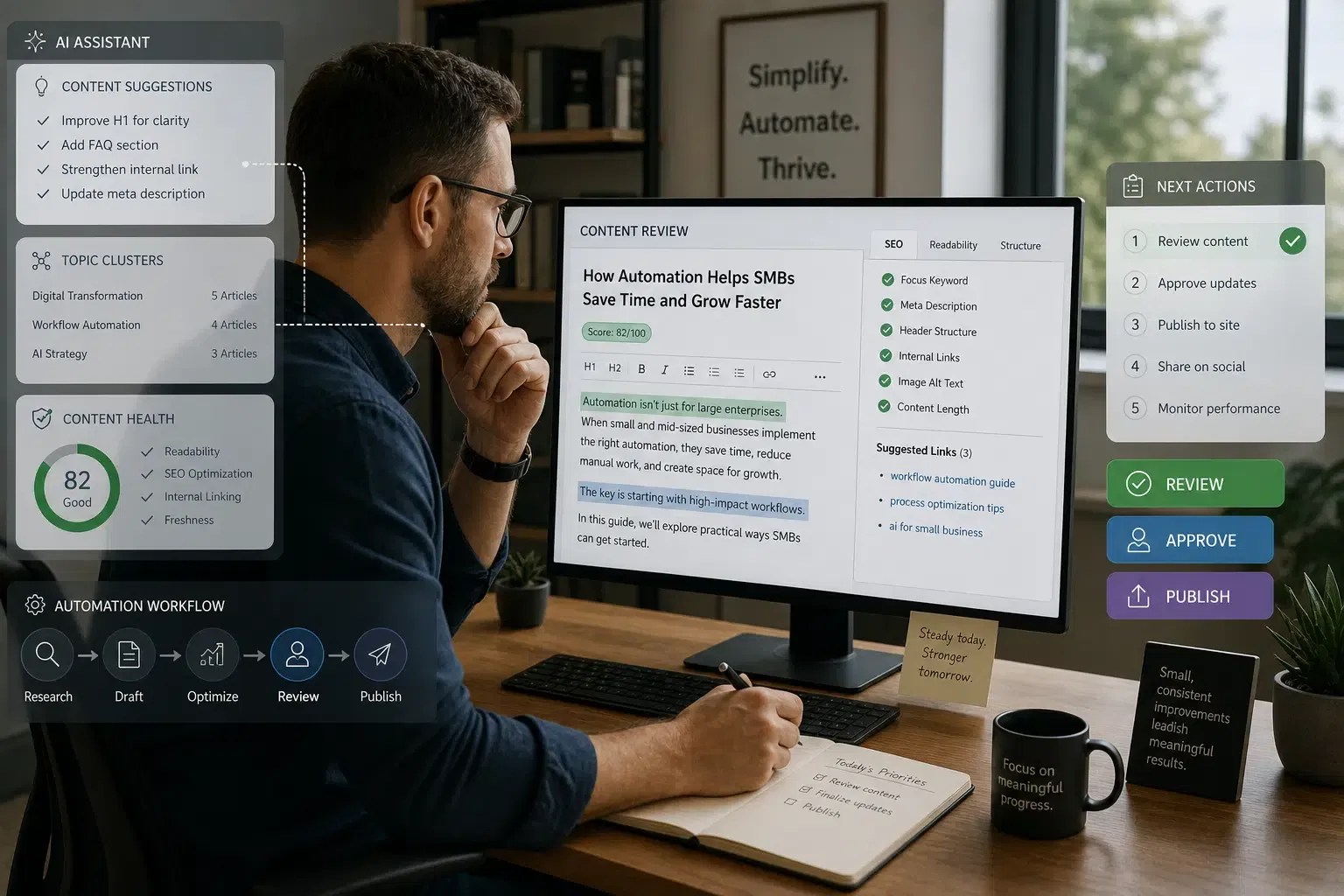
We have established that AI search engines draw on an average of 9 to 16 sources. This means your content discoverability depends on more than just your blog. To stay visible, your useful content needs to live in multiple places in multiple formats.
In the Rhythm Marketing Engine, we focus on “content reuse.” This isn’t about making more noise; it’s about making sure your best ideas are discoverable across the platforms AI monitors.
- The Core Article: Your deep-dive expertise lives on your site.
- The Social Excerpt: A LinkedIn post summarizes a key point from the article.
- The Business Profile Update: A Google Business Profile post mentions the same topic.
- The Newsletter Snippet: Your existing audience gets a “quick tip” from the piece.
By distributing your content this way, you create more “signals” for the AI to find. If the engine sees the same consistent message on your site, LinkedIn, and review platforms, it gains the confidence to recommend you. This level of AI visibility support ensures that your brand isn’t just a single point of failure but a connected web of authority. Effective AI visibility support also reduces the risk that a single weak page or an outdated profile defines your whole business. Improving these signals each week is how you build long-term momentum.
How the Rhythm Marketing Engine Supports AI Visibility
The biggest challenge with AI visibility support is that it is never “done.” Search engines update, AI models change their weights, and competitors improve their own clarity. Ongoing AI visibility support requires steady maintenance, not one big sprint. For a busy service business owner, keeping up with this can feel like a second full-time job.
This is why we built the Rhythm Marketing Engine. Instead of a one-time “SEO project” that goes stale in six months, we provide steady, weekly movement. This approach builds on the prior planning work covered in Segmentation, Targeting, and Positioning (STP). This includes:
- Weekly Website Improvements: Small tweaks to service pages that make them easier for AI to read.
- Content Refreshes: Updating older posts with new data and FAQ sections to maintain search visibility support.
- Internal Linking: Connecting your pages so both humans and bots can find relevant information easily.
- Priority Site Fixes: Removing the technical “noise” that can confuse search engines.
Our approach is grounded and low-pressure. We aren’t chasing the latest “hack” or trying to go viral. We focus on the fundamentals of content discoverability and website clarity. That is what makes AI visibility support sustainable for lean teams. Over time, these small, consistent steps lead to a website that is a powerhouse for AI recommendations. You don’t need a massive team to stay visible; you just need a reliable rhythm.
Practical Steps to Improve Your AI Visibility Today
You don’t have to wait for a consultant to start improving your visibility. Here are three practical steps you can take this week to ground your site in the reality of 2026 search:
- Audit Your Top 5 Services: Look at your main service pages. Are the headers descriptive? Does it say “Our Services” (bad) or “B2B Content Marketing for SaaS Companies” (good)? Clarity is the first step toward AI visibility support. Better page labeling improves AI visibility support quickly.
- Add a FAQ Section: Find three questions you were asked this week and add them to your site with direct, one-paragraph answers. This is the fastest way to improve your FAQ SEO support.
- Check Your “NAP”: Ensure your Name, Address, and Phone number are identical across your website, LinkedIn, and Google. Consistency is a massive trust signal for generative engines.
If you find that these tasks keep slipping through the cracks, it might be time to look for a marketing operations partner who can handle the execution for you. The goal is to keep the right work moving, so you can stay focused on your clients.
Conclusion: Steady Progress in a Changing World
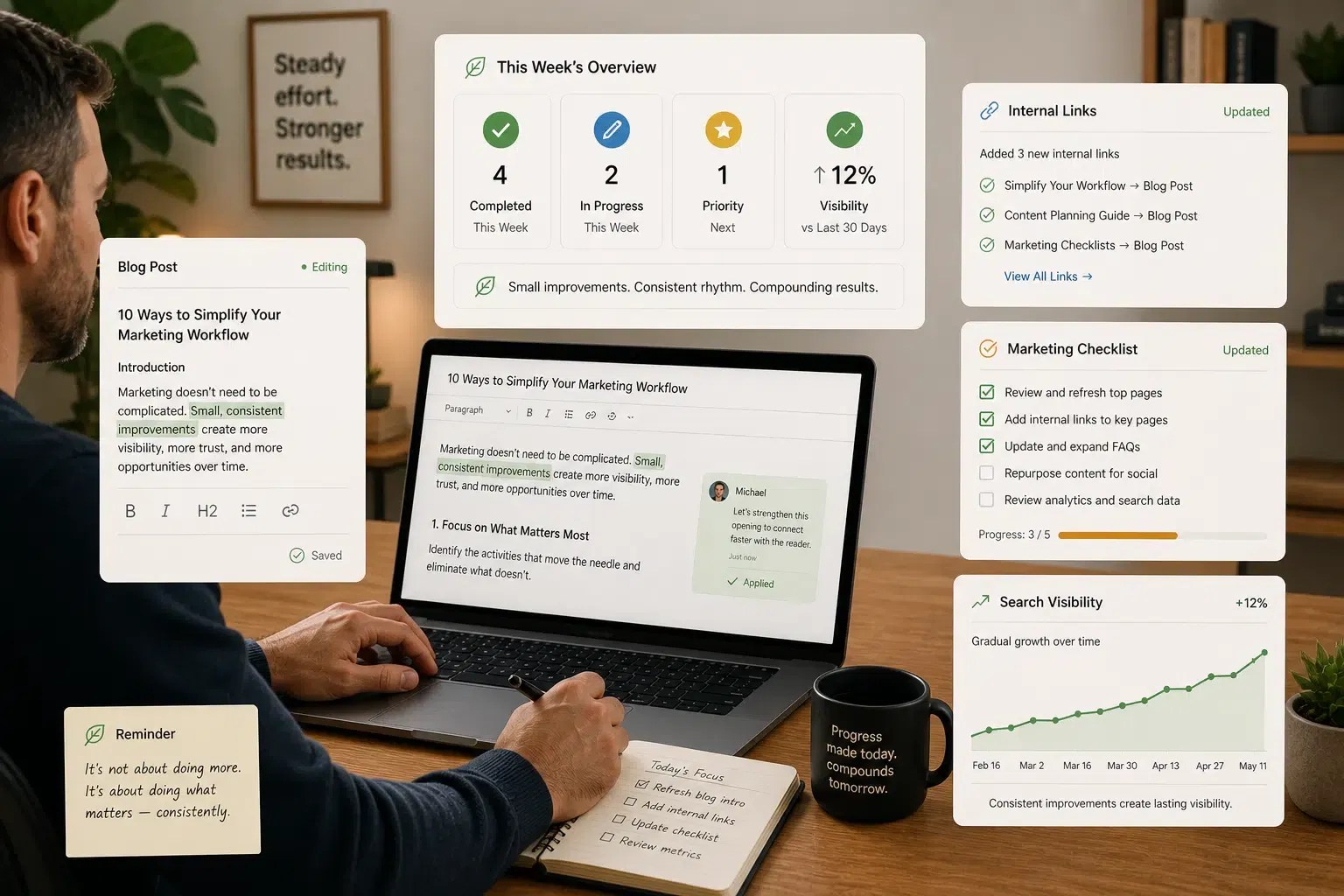
The rise of AI search is not something to fear, but it is something to prepare for. By focusing on AI visibility support, you are essentially future-proofing your business. You are moving away from the “treadmill” of constant content creation and toward a model of high-clarity, high-authority information.
Success in 2026 is about being the most useful and readable answer in your niche. Whether it is through expanding your FAQ SEO support, refining your website clarity, or ensuring consistent search visibility support, the key is to keep moving. Strong AI visibility support comes from those steady improvements. Small, weekly improvements through a system like the Rhythm Marketing Engine will always outperform a frantic, once-a-year marketing push.
Focus on the fundamentals. Keep your messaging clear. Answer your clients’ questions. Consistent AI visibility support helps compound that useful work over time. To see how this visibility work fits into a larger system, explore our final pillar guide on Sustainable Marketing Operations. When you do the work consistently, the machines and the clients will find you.
FAQ on AI Visibility Support
What is the difference between SEO and AI visibility support?
Traditional SEO focuses on ranking for specific keywords to get clicks. AI visibility support (or AEO) focuses on providing clear, structured answers that AI models can summarize and cite directly within an AI Overview or a generative chat response.
How do I know if my site is visible to AI?
You can test this by asking tools like ChatGPT or Perplexity specific questions about your services or industry. If the AI doesn’t mention you or provides incorrect information, your site likely needs clearer website content and stronger AI visibility support signals.
Does AI visibility support require a lot of new content?
No. In fact, it often involves improving what you already have. Refreshing existing articles, adding FAQ sections, and clarifying service descriptions are often more effective for content discoverability than creating a high volume of new, thin content. In many cases, AI visibility support is more about refinement than volume.
Is structured data (Schema) mandatory for AI search?
While not “mandatory,” it is highly recommended. Schema acts as a translation layer between your human-readable content and the machine-readable data AI needs. It significantly increases the likelihood that your business will be accurately cited in search summaries.
How long does it take to see results from AI visibility work?
Visibility is a cumulative process. While some technical fixes can have an impact in weeks, building the kind of machine-recognizable authority that gets consistent AI citations usually takes 3 to 6 months of steady, weekly website improvements.

Leave a Reply