
Most service businesses do not have a traffic problem first. They have a clarity problem. A visitor lands on a service page, scans for ten seconds, and still cannot tell what is included, who it is for, what happens next, or why they should trust the business behind it. That is where service page optimization matters most.
For founder-led businesses, this is not a small website detail. It affects lead quality, search visibility, sales conversations, and the amount of back-and-forth required to move someone from interested to ready. A weak service page creates friction. A clear one reduces it.
Service page optimization is the process of improving a service page so it clearly matches buyer intent, builds trust, supports search visibility, and makes the next step easy to take. It is not about tricks. It is about making useful information easier to find, understand, and act on.
In our experience, most service pages do not need a full rebuild. They need sharper messaging, better structure, stronger proof, and a more consistent review rhythm. That is good news. It means progress can happen one useful update at a time.
Key Takeaways
- Start with intent: A service page should match what the visitor is trying to solve, not just describe what your business does.
- Make the page easy to trust: Specific testimonials, process details, transparent expectations, and recent examples usually do more than polished claims.
- Use structure to reduce friction: Clear headlines, scannable sections, FAQs, and one obvious CTA help both humans and search systems understand the page.
- Support EEAT with real evidence: First-hand experience, service details, authoritativeness, and trust signals matter more than generic optimization language.
- Improve pages in a steady rhythm: Each week, one practical update can strengthen visibility, clarity, and conversion without creating a big coordination burden.
Why Service Pages Are Your Most Important Digital Assets
Many small business owners still treat the homepage like the star of the site. The homepage matters, but the service page often does the harder job. It is where a prospect decides whether you understand their problem, whether your offer fits, and whether it feels safe to contact you.
That is why service page optimization has such a direct effect on lead generation. People often skip your homepage entirely. They arrive from Google, a referral, a local listing, an internal link, or even an AI-generated summary that points them to one specific page. If that page is thin, vague, or outdated, the opportunity slips away.
A strong service page also gives your business better operational leverage. It answers repeated questions. It sets expectations before the sales call. It improves lead quality because people understand what you do before they reach out to you. Over time, that reduces friction for both the buyer and your team.
Search engines have also become better at recognizing depth, usefulness, and credibility. Google’s guidance on creating helpful, reliable, people-first content keeps pointing in the same direction: write for real users first, show a clear purpose, and demonstrate experience and trust. That lines up well with how service businesses actually win business.
If you offer several distinct services, separate pages usually work better than one crowded “Services” page. They let you:
- Match a specific search intent
- Speak to a specific buyer problem
- Explain a specific process
- Add specific proof and FAQs
- Link related supporting content more naturally
That level of relevance helps with SEO, but more importantly, it helps people make decisions. A useful page does not just attract visits. It supports action.
The Anatomy of an Optimized Service Page
Most pages do not fail because they are ugly. They fail because they make people work too hard. The structure is unclear. The proof is weak. The CTA is buried. The wording sounds polished, but says very little.
An optimized service page is a page that helps the right visitor understand the offer, trust the provider, and take the next step with minimal friction. That is the standard.
Below are the sections that usually matter most.
1. The hero section: clarity first
The top of the page should answer three questions fast:
- What is this service?
- Who is it for?
- What should I do next?
If the headline is vague, the rest of the page has to work harder than it should.
A stronger setup usually includes:
- A specific H1: Name the service plainly. If location matters, include it naturally.
- A direct subheading: Explain the outcome or relief the client gets.
- One clear CTA: “Request a Quote,” “Book a Call,” or “Get an Estimate” usually works better than “Learn More.”
For example, “Commercial Cleaning Services for Medical Offices in Austin” is stronger than “Professional Cleaning Solutions.” It is clearer for the reader and easier for search systems to classify.
2. Service description: outcomes over internal language
Service businesses often write from the inside out. They describe methods, tools, and internal terminology. Buyers care about those things later. First, they want to know if you solve the problem they have right now.
That is why good service page optimization usually shifts the page from “what we do” language to “what this helps you achieve” language.
A practical structure looks like this:
- The problem: Name the situation or friction the client is dealing with.
- The service: Explain what you do in plain terms.
- What is included: List deliverables, scope, or steps.
- What happens next: Explain the next action or consultation process.
If you are an accountant, the real value is not bookkeeping entries. It is cleaner records, fewer surprises, and more confidence when tax deadlines show up. If you are a landscaper, the service is not just weekly maintenance. It is a property that looks cared for without the owner having to manage another vendor problem.
3. Process section: reduce uncertainty
A simple process section often drives more conversions than a longer sales pitch.
Why? Because uncertainty slows decisions.
A visitor wants to know:
- How do we get started?
- What happens after I contact you?
- How long does this take?
- What do you need from me?
Even a short three-step format can help:
- Initial conversation
- Assessment or quote
- Delivery and follow-up
This is one of the easiest places to demonstrate EEAT. Clear process detail signals experience. It shows you have done this before and can guide the work in a calm, structured way.
4. Offer details: say the useful thing plainly
A common mistake is trying to sound premium by staying abstract. In practice, abstraction hurts trust.
A stronger service page often answers practical questions directly:
- Who this service is best for
- What is included
- What is not included
- Timeline expectations
- Pricing approach
- Whether there is a minimum commitment
- What results are realistic
That kind of detail helps users and supports GEO as well. AI systems summarize pages more accurately when the pages themselves are specific.
This is also where a slightly contrarian point matters: more copy is not always better. More clarity is better. Some service pages need 700 words. Some need 1,400. The right length is the length required to answer real buying questions without padding.

Building Trust with Social Proof and EEAT
Trust is the real job of a service page.
A visitor is not just asking, “Do you offer this?” They are also asking, “Can I rely on you?” That is where EEAT becomes practical rather than theoretical.
EEAT stands for Experience, Expertise, Authority, and Trustworthiness. On a service page, that usually shows up through specific proof, transparent details, and signals that a real business with real experience is behind the offer.
Reviews and testimonials
Short, generic praise rarely moves the needle. Specificity does.
A stronger testimonial usually mentions at least one of these:
- The problem the client had
- The quality of communication
- The speed or reliability of delivery
- The outcome or improvement they noticed
- Why would they recommend you
For local businesses, context helps. A name, company, service type, or location makes the testimonial more believable. That aligns with broader research on web credibility, which shows that design, usability, and real-world cues strongly influence trust judgments. The Stanford credibility studies published through ACM remain useful reminders that people assess trust quickly and often visually, not just rationally.
Mini-case stories
Mini-case stories are often more useful than long case studies.
A simple pattern works well:
- Challenge: What was going wrong?
- Action: What did you do?
- Result: What improved?
For example:
- Challenge: A local service provider had separate service pages, but none explained the process or addressed common pre-sale questions.
- Action: We rewrote the page structure, added FAQ coverage, clarified the CTA, and improved internal links from related articles.
- Result: The pages became easier to understand, and sales conversations started with better-informed leads.
In our experience, this kind of proof helps because it sounds like real work. It shows judgment, not just claims.
Operational trust signals people actually notice
Trust is also built through smaller signals that many businesses overlook:
- Recent and accurate page updates
- Real staff names or ownership visibility
- Clear contact options
- Matching offers across the site
- Clear service areas
- Honest scope and expectation setting
- Fast, mobile-friendly page performance
Google’s documentation on page experience and Core Web Vitals is helpful here. Performance is not the whole story of ranking, but it does affect usability. If a page is slow, jumpy, or frustrating on mobile, trust drops before the copy even gets a fair chance.
For more on building that trust from the top of the site down, our guide on the service business homepage connects homepage clarity to stronger service-page performance.
The Strategic Role of FAQs in Service Page Optimization
FAQ sections are often treated like filler. They should not be.
A service page FAQ is a structured set of real buyer questions answered clearly to reduce hesitation, improve search relevance, and support the next step. When the questions come from actual client conversations, they do three jobs at once.
First, they lower resistance. People want answers before they reach out. If the page explains timing, pricing approach, fit, service area, and what to expect, the sales conversation starts in a better place.
Second, FAQs support SEO and GEO. People search in question form. They also ask AI tools questions. Pages that answer those questions directly are easier to summarize, cite, and recommend.
Third, they create a practical maintenance rhythm. Instead of waiting for a big redesign, you can improve a page by adding one useful answer at a time.
Good FAQ questions often include:
- How much does this service cost?
- What is included?
- How long does it take?
- Do you serve my area?
- Is this right for my type of business?
- What happens after I contact you?
- Do I need to prepare anything first?
One of the best tips for service business websites is to treat FAQs as living sales support, not as static page decoration.
Each week, notice what prospects are asking. Each month, update the service pages that keep coming up in sales conversations. Over time, that simple habit strengthens service page optimization without adding a heavy burden of coordination.
If you want a related example of keeping existing assets useful rather than constantly starting from scratch, our post on maximizing existing content fits well here.
Local SEO and Search Intent
For many service businesses, local visibility is the difference between steady inquiries and long, quiet stretches.
That does not mean stuffing city names into every paragraph. It means helping search engines and people understand where you work and what kind of problem the page solves.
A practical local setup usually includes:
- A clear service plus location pattern in the title or H1, where appropriate
- Natural references to cities, neighborhoods, or service regions in the body copy
- An “Areas We Serve” section if geography matters
- Location-consistent contact details across the site
- Internal links from related local or service content
Search intent matters just as much as location.
Someone searching “emergency plumber near me” has a very different need from someone searching “how to fix low water pressure.” One is ready to hire. The other may still be researching. Your service page should clearly and calmly serve high-intent visitors.
That usually means emphasizing:
- Availability
- Process
- Reliability
- Response time
- Booking clarity
- Scope and fit
Strong service page optimization is really an intent-matching exercise. The closer the page aligns with the reason someone searched, the easier it is for them to move forward.
For businesses working on broader search visibility across existing pages, our article on website content optimization for search visibility is a useful companion.
Technical Hygiene: Speed, Mobile, and Accessibility
A good message still needs a usable page.
If the page loads slowly, shifts while someone is reading, or hides the CTA on mobile, performance problems turn into conversion problems.
The basics matter:
- Page speed: Compress images, reduce unnecessary scripts, and keep the page lean.
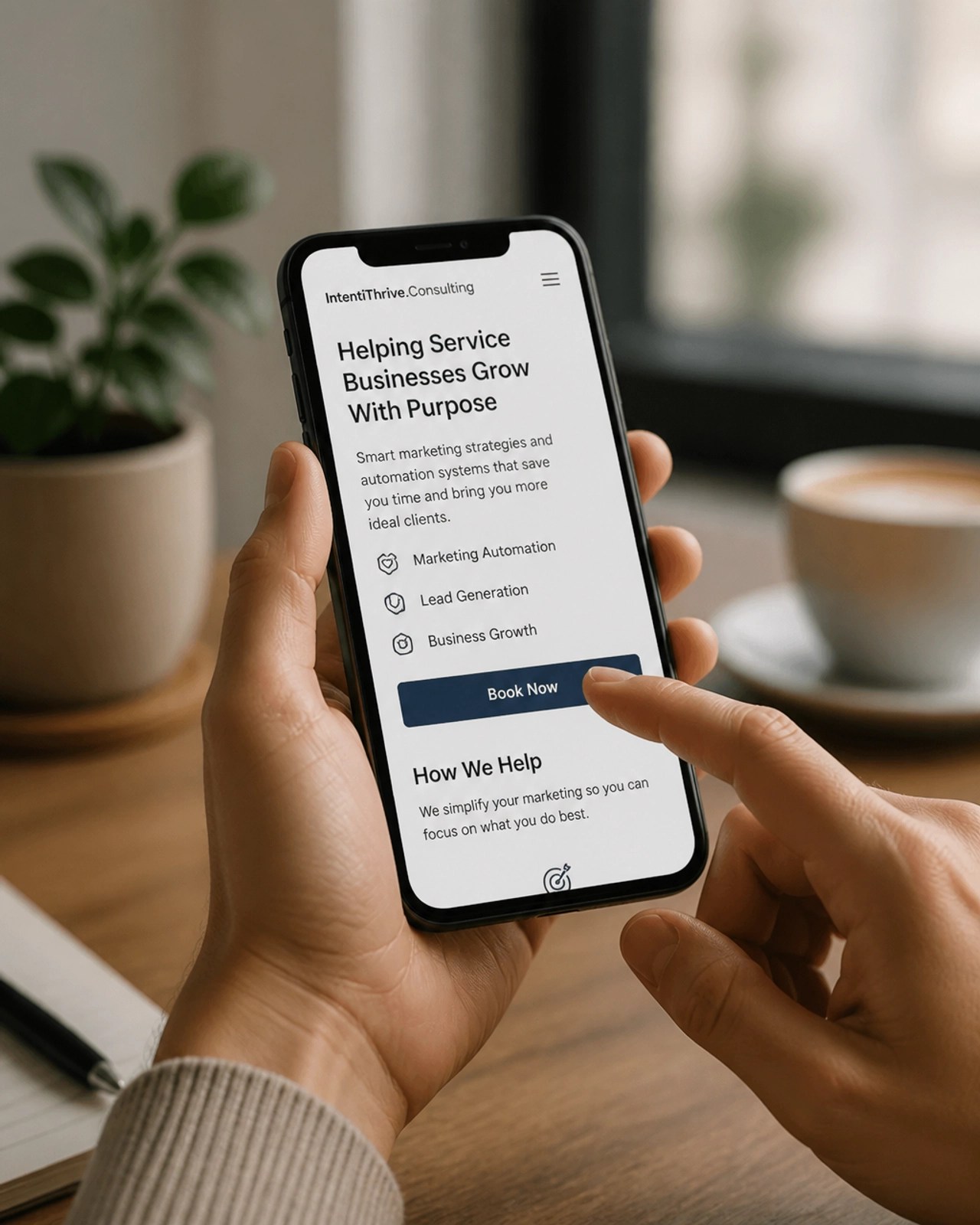
- Mobile usability: Use readable text, tap-friendly buttons, and layouts that hold up on smaller screens.
- Accessibility: Clear headings, logical structure, descriptive links, and readable contrast help more users complete the task.
- Navigation: Make it easy to move from an article to a service page, and from a service page to contact or booking.
Google’s Core Web Vitals documentation points to three widely used performance signals:
- LCP for loading
- INP for responsiveness
- CLS for visual stability
Those metrics should support decision-making, not distract from it. The goal is not a perfect score. The goal is a page that works reliably for real visitors.
Internal linking matters here, too. When blog posts link to relevant service pages, visitors have a clearer path forward, and search engines gain better context about page relationships. That is one reason we often recommend reviewing internal links as part of a monthly maintenance cycle.
If internal links are messy or inconsistent, our post on internal linking mistakes can help tighten that up.
Sustaining Growth with the Rhythm Marketing Engine
The hardest part for most small service businesses is not identifying what needs improvement. It is keeping the work moving once client delivery gets busy.
That is where a steady operating rhythm matters more than another burst of ideas.
At InteniThrive Consulting, we have seen the same pattern again and again. A business knows its service pages need attention. The fixes are not mysterious. But the updates keep slipping because no one owns the weekly follow-through. Then a quarter passes, pages go stale, and the website stops reflecting the quality of the actual business.
Our Rhythm Marketing Engine is built around a simpler approach: two useful improvements at a time, every week.
That might look like:
- Rewriting a weak service-page headline
- Adding two new FAQs from recent calls
- Refreshing outdated proof points
- Tightening internal links between articles and services
- Updating service-area references
- Improving one CTA section that is underperforming
This approach may sound less exciting than a full relaunch. That is partly the point.
A practical contrarian view here: the businesses that win often are not the ones making dramatic website changes. They are the ones steadily reducing friction, keeping core pages current, and making their expertise easier to trust.
That is also why marketing consistency for your service business matters so much. Each week, a useful improvement moves. Each month, the backlog gets clearer. Over time, the website becomes a more effective working asset rather than a neglected brochure.

Practical Steps to Start Optimizing Today
If the full project feels too big, do not start with all pages. Start with one important page and one useful improvement.
Use this checklist:
Audit the headline
Does the H1 clearly say what the service is, who it helps, and where it applies if location matters?Check the first screen
Can a visitor quickly understand the offer, the benefit, and the next step without having to scroll?Tighten the CTA
Is there one primary call to action that is visible near the top and repeated near the bottom?Add specific proof
Insert one relevant testimonial or mini-case story tied to that exact service.Expand the FAQ
Add one real question that came up in a recent sales conversation.Review internal links
Link to the page from one relevant article and one nearby site page if that path is missing.Check mobile experience
Open the page on your phone. If the CTA is awkward, the text is cramped, or the page feels slow, fix that next.
These are small changes. They are also meaningful changes.
This is the same idea behind growing through weekly website improvements. Steady service page optimization keeps core revenue pages current, useful, and easier to trust.
Conclusion: Clarity Is the Best Marketing Strategy
Service page optimization works best when it stays simple. Match the page to buyer intent. Make the offer clear. Show real proof. Remove avoidable friction. Give the visitor an easy next step.
That approach supports SEO, GEO, and conversion simultaneously because it is built around usefulness. It also aligns with how people actually evaluate service providers online. They look for clarity, trust, and evidence that the business is competent and up to date.
Small service businesses do not need more noise here. They need pages that accurately represent their work and a practical rhythm for improving them over time. When service pages get clearer, sales conversations get easier. When they stay current, visibility compounds. When someone owns the follow-through, the website starts pulling its weight again.
That is the real value of steady improvement. Not hype. Not endless rewrites. Just useful progress that keeps moving.

FAQ: Common Questions About Service Page Optimization
1. How many service pages should my website have?
Usually, one page for each core service is the best starting point. If several services are closely related, begin with a stronger category page and expand later as needed.
2. How long should a service page be?
Long enough to answer real buying questions. Many pages land somewhere between 700 and 1,500 words, but clarity matters more than word count.
3. Should I include pricing on my service pages?
If you can, yes. Exact pricing is not always possible, but even a starting point or clear explanation of pricing factors helps reduce uncertainty and improve lead quality.
4. How often should I update my service pages?
Review them quarterly at a minimum. Better yet, make small updates each month or each week when you have new proof, better answers, or outdated details to fix.
5. Can I use the same testimonials on every service page?
You can, but it is better to use service-specific proof. A testimonial tied to the exact service usually feels more relevant and more convincing.
6. Does service page optimization help AI search results, too?
Yes. Clear structure, direct answers, trustworthy details, and specific service information make pages easier for AI systems to interpret and summarize accurately.
7. What is the fastest improvement I can make today?
Rewrite the headline and top section of one key service page so a visitor immediately understands the offer, the benefit, and the next step.

Leave a Reply