
Many small service business owners feel like they are shouting into a void. You post on LinkedIn, send out a monthly newsletter, and hope the “right” person sees it. This “spray and pray” approach is exhausting. It leads to marketing burnout because you expend a lot of energy for unpredictable results.
Learning segmentation targeting and positioning does not have to be complicated, yet it is the single most effective way to reclaim your time and budget. When you stop trying to be everything to everyone, your marketing starts to feel like a conversation rather than a broadcast. This transition from generalist to specialist is where sustainable growth actually begins for founder-led firms.
In our experience at InteniThrive Consulting, we often see businesses stall not because they lack expertise, but because they lack a clear filter for their activity. They treat marketing like a checklist of chores rather than a strategic tool to attract specific buyers. By implementing a solid STP framework, you move away from busywork and toward a steady marketing effort that actually builds a pipeline of qualified leads.
That is where segmentation targeting and positioning marketing becomes useful. STP helps you stop broadcasting to everyone and start shaping your message around the clients most likely to value your expertise. It is the process of finding your most profitable “corner” of the market and owning it through clear, consistent communication.
Segmentation targeting and positioning is a marketing framework used to divide a broad market into manageable groups (segmentation), select the most viable groups to serve (targeting), and establish a clear, differentiated brand identity for those groups (positioning).
This matters because buyers are already doing more research before they talk to a seller. Demand Gen Report found that B2B buyers are nearly 70% of the way through their purchasing process before engaging with sellers, and that buyers initiate first contact 80% of the time. (Demand Gen Report) In other words, your positioning needs to work before the sales conversation happens.
Key Takeaways
- Segmentation: Divide your market into meaningful groups based on needs, behaviors, pain points, and fit.
- Targeting: Choose the segment where your strengths and buyer needs overlap.
- Positioning: Explain why your service is the logical choice for that specific buyer.
- STP marketing strategy: Use segmentation, targeting, and positioning to focus your website, content, offers, and outreach.
- Execution: Keep your positioning alive through a steady weekly marketing rhythm.
What Is Segmentation Targeting and Positioning?
The definition of segmentation targeting and positioning is simple: STP is a marketing framework that helps you divide your market, choose the best-fit audience, and position your offer so that the audience sees you as the right choice.
The meaning of segmentation targeting and positioning is even more practical: know who you serve, decide who matters most, then explain why your service fits their situation. It is the opposite of a generic “we do everything” pitch that leaves buyers confused about your true value.
Adobe describes STP as a three-step formula that helps businesses segment their audience, target the right buyers, and position their products to make the strongest impact. (Adobe) For a founder-led service business, that clarity changes everything. Instead of competing on price or generic “quality,” you compete on relevance.
Instead of saying, “We help small businesses with marketing,” you might say, “We help founder-led service businesses keep practical marketing improvements moving each week.” That second message is easier to understand. It names the buyer, the problem, and the kind of progress they want.
Research supports this direction. Epsilon found that 80% of consumers are more likely to do business with a company that offers personalized experiences. The same study found that 90% of respondents found personalization appealing. (Epsilon)
McKinsey also found that 71% of consumers expect personalized interactions, while 76% become frustrated when they do not occur. Its research has also connected personalization with meaningful revenue lift when companies execute it well. (McKinsey & Company) For small service firms, personalization does not require complex software; it starts with a sharper STP marketing strategy.
Why Generic Marketing Costs More Than You Think

Generic marketing feels safe because it avoids choosing. You do not have to name a specific buyer. You do not have to say who your service is best for. You do not have to risk turning anyone away. But that safety is expensive. It leads to “message dilution,” where your value proposition is so thin that no one feels like it was written specifically for them.
When your message is broad, your website has to work harder. Your content has to explain more. Your sales calls start with more confusion. Your referrals weaken because people cannot easily replicate what you do. If a friend asks, “Who is a good accountant?” and you are just “an accountant,” you are harder to remember than the “accountant for high-growth tech startups.”
Generic marketing also creates internal drag. Every new post, page, or email becomes a fresh decision because there is no clear positioning to guide it. You find yourself staring at a blank screen, wondering what to write about today. When you have a clear target, your topics are already decided by your audience’s specific needs.
A practical STP marketing strategy reduces that drag. It gives you a filter for what to say, who to say it to, and which opportunities deserve your attention. That is especially important for founder-led service businesses. Time is limited. Marketing cannot become another full-time job. It needs to become a focused rhythm that supports the business rather than drains it.
Segmentation Targeting and Positioning: The 5-Step Process

The traditional segmentation targeting and positioning model has three broad parts: segment the market, target the right group, and position your offer. For small service businesses, it helps to break that into five practical steps that prioritize execution over theory.
Step 1: Market Segmentation
Segmentation starts by grouping potential customers based on shared characteristics. Do not stop at age, location, or company size. Those details may be useful, but they rarely explain why someone buys. Look at practical factors:
- What problem is the buyer trying to solve right now?
- What have they already tried (and why did it fail)?
- How urgent is the issue to their bottom line?
- What kind of support do they value (do-it-for-me vs. guidance)?
- What budget range is realistic for their stage of growth?
For example, “small business owners” is too broad. “Founder-led service businesses with inconsistent marketing follow-through” is more useful. That segment tells you something about the buyer’s situation. It also points toward the kind of message that might matter.
Step 2: Segment Evaluation
Not every segment is worth pursuing. Some groups are easy to name but hard to reach. Some need your services but cannot afford them. Segment evaluation helps you avoid chasing the “ghost market”, people who look like customers but never actually sign a contract.
Ask four questions:
- Size: Is this group large enough to support your revenue goals?
- Reachability: Can you reach them through content, referrals, search, or outreach?
- Alignment: Do they value the way you deliver your service?
- Pain: Do they have a problem they are actively willing to pay to solve?
Small business reality check: A segment that cannot pay your rates will create pressure, not momentum. It is better to have a small, high-value segment than a large, low-value one.
Step 3: Target Selection
Targeting is where you choose. Pick the one or two segments where your strengths and buyer needs clearly overlap. Your target should be specific enough to guide your website, offers, content, and sales conversations.
Choosing a target does not mean refusing every other opportunity. It means your public message becomes focused enough to attract better-fit buyers. In practice, a clear target makes your business easier to understand, remember, and refer to. It builds a “moat” around your business because generalist competitors cannot match your specialized depth.
Step 4: Positioning Strategy
Positioning answers the buyer’s question: “Why should I choose you?” Good positioning connects the buyer’s current problem, your specific way of helping, and the outcome the buyer wants.
Weak positioning often sounds like this: “We provide high-quality marketing services for small businesses.” Stronger positioning sounds like this: “We help founder-led service businesses keep practical marketing improvements moving each week, so their online presence reflects the quality of their work.”
Small business reality check: If your positioning sounds like three competitors, it is not positioning. It is noise. Real positioning should feel slightly polarizing; it should make the right people say “Yes!” and the wrong people say “Not for me.”
Step 5: Marketing Mix Implementation
Strategy only matters when it changes what buyers see. Your homepage, service pages, Google Business Profile, and LinkedIn posts should all reinforce the same position. This is the stage in the weekly website improvements process that turns a strategy document into a business asset.
Most founder-led businesses do not need more marketing ideas. They need a clearer rhythm for implementing the right ones based on their STP findings.
Step 1 And 2: Finding The Right Customers
Understanding segmentation targeting and positioning marketing starts with the work many service businesses skip. They jump straight to messaging without knowing who they are trying to reach. Then they wonder why the message does not land. Segmentation and targeting solve that problem together.
Segmentation is the act of dividing a broad market into smaller groups with shared needs, problems, behaviors, or buying conditions. Targeting is the act of choosing which group your business will prioritize.
Move Beyond Demographics
“Small business owners, ages 35-55” is not a useful segment. It is only a description. Better segmentation looks at what people worry about at 2:00 AM. For service businesses, strong segments often form around pain, urgency, and buying behavior.
Examples include:
- Founder-led firms with inconsistent marketing follow-through.
- Professional services firms with low website conversion rates.
- Local service businesses are relying too heavily on referrals.
- Consultants with strong expertise but unclear offers.
Each group may need marketing support, but each group needs a different message. By narrowing the focus, you increase the “perceived expertise” of your business.
Ideal Customer Profile Vs. Profitable Customer Segment
Your Ideal Customer Profile (ICP) describes the type of client for whom you do your best work. A profitable customer segment is a large, reachable group that can support growth. You want both to overlap.
A useful segment should help you make decisions. It should guide what you publish, what you emphasize, and which inquiries you prioritize. If you are targeting established service providers, you shouldn’t be writing “how to start a business” guides.
Step 3: Positioning Your Service As The Logical Choice
Once segmentation and targeting are clear, positioning turns strategy into buyer perception. Positioning is not a tagline; it is the mental “slot” you occupy in the buyer’s brain.
Positioning refers to the place your service occupies in the buyer’s mind compared with other available options.
Build A UVP Around Real Pain
A useful value proposition (UVP) connects directly to what your target segment already feels. Generic claims like “experienced team” or “quality service” rarely create a strong position.
For example, a marketing consultant targeting founder-led service businesses might say: “We keep practical marketing improvements moving each week, so your online presence catches up with your expertise.” That works because it names a real frustration: the feeling that the website is “behind” the actual quality of the work.
Use Human Judgment As A Positioning Signal
In an era of AI-generated noise, human judgment is becoming a premium positioning signal. Many service buyers have tried tools or cheap freelancers that required too much hand-holding. If your service includes thoughtful oversight, clear follow-through, and practical recommendations, say so directly.
Clear judgment and steady execution matter more to a busy founder than a list of 50 automated features. Positioning your business as a “partner in progress” rather than just a “vendor of tasks” can significantly increase your fees and client retention.
STP Marketing Model Guide And Examples
This STP marketing model guide and examples section shows how the framework works in practice for three different types of service providers.
Example 1: A Local Accounting Firm
- Segment: Small ecommerce businesses with a sustainability focus.
- Target: Eco-conscious ecommerce founders earning $150K-$800K annually.
- Position: “We handle the numbers behind purpose-driven ecommerce, so you can focus on the mission, not the spreadsheets.”
The website changes immediately. Service pages stop listing generic bookkeeping. Instead, they answer questions about multi-state sales tax for online stores and inventory costs for sustainable goods.
Example 2: A Marketing Operations Consultant
- Segment: Founder-led professional services firms.
- Target: Consultants and advisors with strong expertise but inconsistent marketing follow-through.
- Position: “We help you reduce marketing drift through a practical weekly rhythm.”
The website becomes focused on sustainable marketing operations. Service pages speak to consistency and visibility rather than “getting more leads.”
Example 3: A Web Designer
- Segment: Local service businesses with outdated websites.
- Target: Established trades and home service providers that rely heavily on referrals.
- Position: “We turn referral-dependent websites into clearer trust assets that help local buyers take the next step.”
The designer no longer sells “a new website.” They sell a clearer path from trust to inquiry. The content focuses on service page optimization and local SEO.
Turning STP Strategy Into A Weekly Rhythm
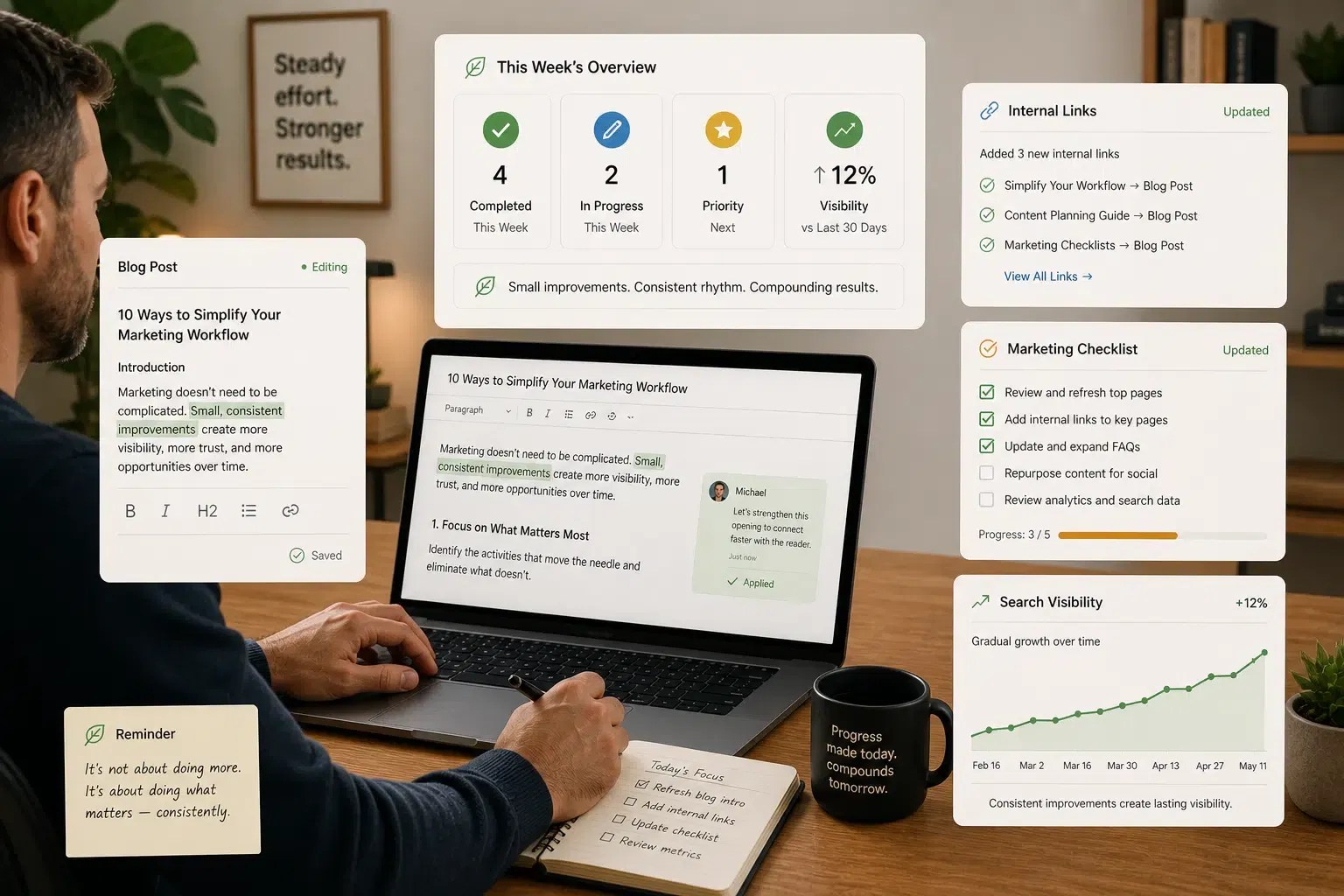
Strategy without follow-through is only planning. For founder-led service businesses, STP often breaks down because the daily “whirlwind” takes over. The strategy makes sense, but the website never actually changes. This is strategic drift.
The fix is not a major overhaul; it is a weekly rhythm of practical improvements. In our experience, the most successful businesses are those that make one small change every week that reinforces their positioning.
That might include:
- Updating one service page section to reflect a buyer’s question.
- Adding one real-world case study that speaks to your target segment.
- Improving your Google Business Profile to highlight a specific specialty.
- Rewrite a call to action to be more relevant to your niche.
InteniThrive Consulting supports founder-led service businesses with that rhythm, using human judgment and thoughtful automation to keep practical marketing improvements moving.
How To Check Whether Your STP Strategy Is Working
A useful STP strategy should make decisions easier. If you are still struggling to decide what to post or which clients to take on, your strategy isn’t sharp enough yet.
Track these simple signals:
- Lead Quality: Are the people contacting you actually in your target segment?
- Sales Cycle: Do prospects already understand your value before the first call?
- Content Ease: Is it getting easier to come up with blog topics and email content?
- Referral Clarity: Are your clients introducing you to more people just like them?
You do not need a complex dashboard. You need enough visibility to see whether your message is attracting the right people and repelling the wrong ones.
FAQ: Strategic Marketing For Service Businesses
What Is STP In Marketing For Small Businesses?
STP stands for segmentation targeting and positioning. It is a three-step process that helps you segment your market, select the best-fit clients, and define your unique value proposition for them. For small businesses, it reduces wasted effort and prevents marketing burnout.
What Is The Segmentation Targeting and Positioning Definition?
The definition of segmentation targeting and positioning is: segmentation divides the market, targeting selects the most attractive segment, and positioning explains why your offer is the right choice for that specific group.
What Is The Segmentation Targeting and Positioning Meaning In Plain English?
In plain English, it means: understand who is out there, pick who you want to work with, and explain why you are the best fit for their specific problem. It is about clarity before activity.
How Does Positioning Help A Website Convert?
Positioning transforms your website from a generic brochure into a specific solution. When visitors see that you understand their exact problem, trust builds faster, leading to more confident inquiries and higher conversion rates.
Why Is Targeting Important For Service Providers?
Service businesses have limited capacity. Targeting helps you focus your energy on the clients you are best equipped to serve profitably, improving efficiency and strengthening your reputation in a specific niche.
What Is An STP Marketing Strategy?
An STP marketing strategy is a focused plan for selecting the right market segment and positioning your service to meet their needs across all your digital channels, from your website to your social media profiles.

Leave a Reply