
Structured content distribution is a repeatable process for turning useful website content into platform-ready material for the channels your buyers already use.
It is not a daily posting. It is not trend chasing. It is not reactive social media management.
Structured content distribution refers to the planned reuse, adaptation, and sharing of useful content across relevant channels so that a single strong idea can support visibility, trust, and follow-up in multiple places.
Creating great content is often the biggest hurdle for small service businesses. But what happens after you hit "publish" matters just as much.
Many founders produce thoughtful blog posts, service explanations, FAQs, and case studies that only a small audience ever sees. The issue is not always content quality. Often, the issue is distribution.
Without structured content distribution, your best ideas can sit quietly on your website. They may help the few people who find them, but they do not consistently support LinkedIn, Google Business Profile, email, sales follow-up, or other buyer touchpoints.
That is where a better rhythm helps.
HubSpot reports that 48% of social media marketers share similar or repurposed content across platforms with minor adaptations, while 34% create unique content from scratch for each platform. That matters for small teams because repurposing lowers the pressure to constantly invent something new. (hubspot.com)
This guide explains how structured content distribution, multi-platform content distribution, content repurposing services, content atomization services, social content repurposing, and a practical cross-platform content strategy can help useful content work harder without creating another management burden.
Key Takeaways
- Structured content distribution: Moves marketing from random posting to a repeatable reuse system.
- Multi-platform content distribution: Helps one useful idea show up across relevant buyer channels.
- Content repurposing services: Turn existing content into practical platform-ready assets.
- Content atomization services: Break larger content into smaller reusable blocks.
- Social content repurposing: Helps website content support LinkedIn posts, Google Business Profile updates, newsletter snippets, and sales follow-up.
- Cross-platform content strategy: Keeps messaging consistent while adapting content for each channel.
Structured Content Distribution Vs. Social Media Management
There is a common misconception that distribution means social media management.
They are related, but they are not the same.
Social media management usually focuses on platform activity. It may include daily posting, inbox monitoring, comment moderation, engagement, trend response, and community management.
Structured content distribution focuses on making existing content useful across relevant channels.
Social media management manages platform activity. Structured content distribution moves useful content into the right places through a repeatable system.
For a small service business, this distinction matters.
Your goal is not to become a full-time content creator. Your goal is to help the right buyers understand what you do, why it matters, and whether you are the right fit.
A structured system starts with your website and core expertise. It takes one useful article, FAQ, guide, service page, or case study and turns it into smaller pieces for practical use.
That might include:
- A LinkedIn post
- A Google Business Profile update
- A newsletter snippet
- A sales follow-up excerpt
- A short Threads or X post
- A Pinterest-ready excerpt
- A carousel outline
- A buyer-question post
This is content reuse and structured distribution. It is not platform chaos.
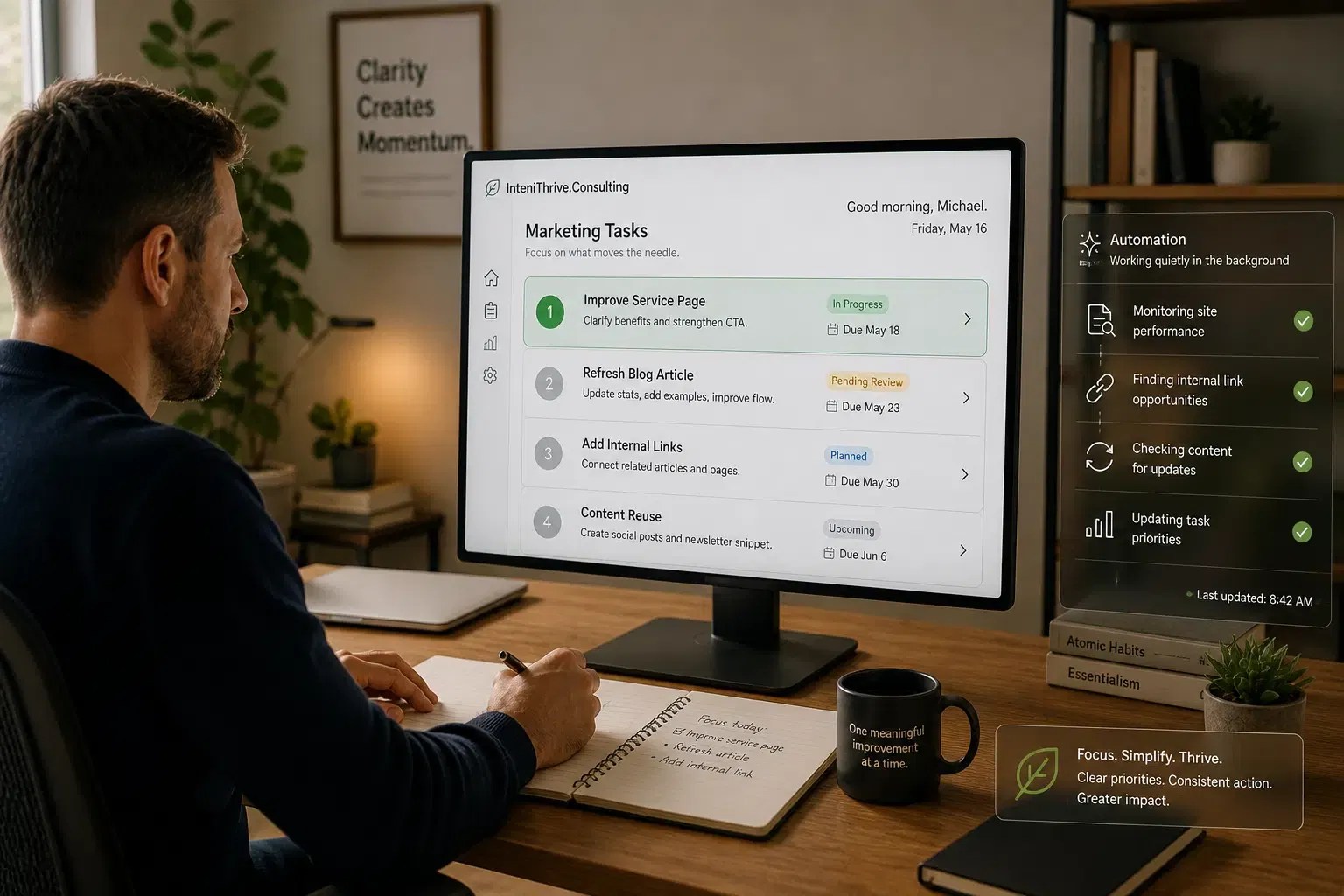
Why Distribution Structure Matters For Trust And Visibility
Visibility is not just about being seen once. It is about being remembered over time.
A single blog post rarely turns a stranger into a client. Trust builds through repeated, useful interactions. A buyer might first see a practical LinkedIn post, later notice a Google Business Profile update, then receive a related newsletter, and finally visit the full article before booking a call.
That sequence works better when the message is consistent.
When distribution is unstructured, useful content appears once and disappears. The business may publish a good article, share it once, then move on. Six months later, the same buyer question appears again in a sales conversation.
Structured content distribution prevents that waste.
Pew Research Center’s 2025 survey of 5,022 U.S. adults found that 84% use YouTube and 71% use Facebook. Its report also notes that platform use varies across age, gender, race, ethnicity, education, and other demographic groups. That fragmentation makes cross-platform planning more practical than relying on one channel. (pewresearch.org)
For service businesses, this does not mean being everywhere.
It means choosing relevant channels and giving each useful content asset more than one job.
What Multi-Platform Content Distribution Means
Multi-platform content distribution is the practice of adapting one useful idea for more than one relevant channel.
It does not mean copying the same post everywhere. It means adjusting the format, length, angle, and call to action for each place the content appears.
For example, one article about service-page clarity could become:
- LinkedIn: A short post about why unclear service pages slow buyer decisions.
- Google Business Profile: A practical update explaining one service improvement.
- Email: A short note linking service clarity to better sales conversations.
- Sales follow-up: A helpful excerpt sent after a discovery call.
- FAQ: A direct answer has been added to the website.
- Pinterest: A clear excerpt from the article, formatted for saving and discovery.
The core idea stays consistent. The delivery changes.
That is the difference between copying content and distributing content well.
Why Content Often Gets Stuck
Most small service businesses do not have a content problem first. They have a follow-through problem.
They may already have:
- Useful blog posts
- Strong service explanations
- Customer questions
- Proposal language
- Sales email explanations
- Case studies
- Newsletter archives
- Internal notes
- FAQ drafts
The problem is that this material stays trapped.
It does not become social-ready. It does not become newsletter-ready. It does not support sales follow-up. It does not strengthen related service pages. It does not keep moving.
Content Marketing Institute’s 2025 B2B research found that marketers expected increased investment in video at 61%, thought leadership content at 52%, AI for content optimization and performance at 40%, and AI for content creation at 39%. Yet small teams often do not need more formats first. They need a simpler operating rhythm for using what already exists. (contentmarketinginstitute.com)
The better question is not always, “What should we create next?”
Often, it is, “What useful content already exists, and where else should it show up?”
Content Repurposing Services: What They Do
Content repurposing services help turn existing content into new formats for new contexts.
A service page might become a LinkedIn post. A blog post might become a newsletter. A FAQ might become a sales follow-up excerpt. A case study might be condensed into a short carousel outline.
Content repurposing is the process of adapting existing content into new formats so that the same idea can serve multiple purposes.
Good repurposing keeps the source idea intact. It does not flatten the message into generic social copy.
For a service business, content repurposing services should preserve:
- The buyer’s real question
- The service context
- The practical lesson
- The business point of view
- The next step
- The human judgment behind the claim
This is where many businesses struggle. They do not need more vague posts. They need useful content adapted carefully.
Content Atomization Services: Breaking One Asset Into Useful Blocks
Content atomization services go one level deeper than repurposing.
Content atomization is the process of breaking a larger content asset into smaller, reusable parts. Each part can stand alone or support another channel.
For example, a 2,000-word article might contain:
- One strong problem statement
- Three practical tips
- Two buyer questions
- One short definition
- One client example
- One common mistake
- One comparison section
- One next-step recommendation
Each of those pieces can become a useful distribution asset.

Content atomization is the practice of turning one large content asset into smaller, reusable blocks that can support social, email, search, sales, and follow-up.
This matters because atomization reduces blank-page work.
Instead of asking, “What should we post today?” you ask, “Which useful block should we adapt next?”
That is a better operating question.
Social Content Repurposing Without Daily Posting
Social content repurposing is the process of adapting existing website, email, sales, or educational content into useful social-ready posts.
It should not require daily posting to be valuable.
For many small service businesses, a steady weekly rhythm is more sustainable than a high-frequency publishing plan. A practical rhythm might include:
- One LinkedIn post from a recent or older article
- One Google Business Profile update from a service page
- One short post from an FAQ
- One newsletter snippet from a useful guide
- One sales follow-up excerpt from a buyer-question section
That is enough to create visible movement.
Sprout Social’s 2025 Index is based on surveys of more than 4,000 consumers, 900 social practitioners, and 300 marketing leaders. The scale of that research reflects a simple reality: social platforms remain important, but marketers need better ways to build memorable brands rather than merely producing activity. (sproutsocial.com)
For small service businesses, the useful question is not, “How do we post more?”
The better question is, “How do we make useful content show up consistently where buyers already pay attention?”
Building A Cross-Platform Content Strategy
A cross-platform content strategy is a simple plan for how useful ideas move across relevant channels.
It should answer five questions:
- Source: Which website page, article, FAQ, case study, or sales explanation will we reuse?
- Audience: Who needs this idea, and what do they care about?
- Channel: Where should this idea appear?
- Format: What version fits that channel?
- Next step: Where should the reader go next?
For example, a small consulting business might choose one strong article each week. From that article, it can be prepared
- A LinkedIn post for professional visibility
- A Google Business Profile update for local trust signals
- A newsletter snippet for existing contacts
- A sales follow-up excerpt for active prospects
- A short FAQ update for the website
That is, in practical terms, a cross-platform content strategy.
It does not need to be complicated. It needs to be repeatable.
Specific Channel Strategies For Service Businesses
Not every platform deserves the same attention.
For many service businesses, the strongest starting channels are LinkedIn, Google Business Profile, email, and sales follow-up. Other platforms can be useful when they fit the audience and content type.
LinkedIn Content Repurposing
LinkedIn is useful for professional service businesses because it supports expertise, trust, and relationship-based visibility.
But simply sharing a blog link is rarely enough.
A better LinkedIn content repurposing process pulls one useful point from the article and makes it native to the feed. That might be:
- A practical mistake buyers make
- A short framework
- A before-and-after clarity example
- A buyer’s question
- A simple definition
- A short lesson from client work
The article can still be linked where appropriate. But the post itself should provide value without requiring a click.
Google Business Profile Updates
Small service businesses often underuse Google Business Profile updates.
A useful update can come from existing content. For example:
- A service-page excerpt
- A customer question
- A seasonal service reminder
- A short explanation of a common problem
- A link to a relevant article
- A brief update about what the business helps with
This is not about high-volume posting. It is about demonstrating activity, relevance, and clarity when people are already evaluating the business.
Newsletter Content Reuse
Email remains valuable because it is more direct than social platforms.
Newsletter content reuse helps you send useful notes without having to write from scratch every week. A newsletter can reuse:
- One article section
- One buyer’s question
- One practical tip
- One short case example
- One definition
- One “what to improve next” recommendation
This keeps your email rhythm aligned with your website and social content.
Sales Follow-Up Excerpts
Sales follow-up is one of the most practical distribution channels.
If a prospect asks a question during a call, your existing content should help answer it afterward. A useful article section can be condensed into a short follow-up excerpt that reinforces the conversation.
This makes content directly useful in the sales process.
It also reduces repeated explanations.
How Rhythm Marketing Engine Supports Structured Distribution
At InteniThrive, Rhythm Marketing Engine supports structured content distribution as part of ongoing marketing operations.
The work starts with what already exists.
That may include service pages, articles, FAQs, case studies, newsletters, sales explanations, or useful internal notes. The goal is to identify which material can be refreshed, reused, connected, distributed, or atomized.
This may include:
- LinkedIn posts
- Google Business Profile updates
- Threads or X snippets
- Pinterest-ready excerpts
- Social-ready post drafts
- Carousel outlines
- FAQ-based short posts
- Newsletter snippets
- Sales follow-up excerpts
This is content reuse and structured distribution.
It is not community management, inbox management, comment moderation, influencer outreach, paid social management, or daily platform-native social media operations.
Overcoming The Friction Of Execution
The hardest part of structured content distribution is not usually the idea.
It is the rhythm.
The work can stall because:
- No one owns the next step
- Source content is hard to find
- Review expectations are unclear
- Platform formatting takes time
- Content needs light editing first
- The founder is busy with client work
- Posting depends on memory or motivation

A marketing operations partner helps reduce that friction.
The role is not to create more marketing noise. The role is to help useful material keep moving through a clear, manageable system.
That might mean selecting the next content asset, pulling the strongest excerpts, preparing channel-ready drafts, improving internal links, and keeping the review process simple.
A Simple Structured Content Distribution Workflow
A practical workflow can stay simple.
1. Choose One Source Asset
Start with one useful page, article, FAQ, guide, case study, or sales explanation.
Choose content that already answers a buyer’s question or clearly explains an important service.
2. Identify The Reusable Blocks
Look for sections that can stand alone.
Good blocks include:
- Definitions
- Common mistakes
- Short examples
- Buyer questions
- Practical steps
- Service explanations
- Strong comparisons
- Clear next-step guidance
3. Match Blocks To Channels
Do not force every idea onto every platform.
Match the content to the channel where it makes sense.
A practical tip may fit LinkedIn. A local service reminder may fit Google Business Profile. A deeper explanation may be better suited to an email. A direct answer may be appropriate for a sales follow-up.
4. Adapt The Format
Each channel needs a slightly different shape.
LinkedIn may need a stronger opening. Google Business Profile may need a local or service-specific angle. The email may need a warmer introduction. Sales follow-up may need a direct connection to the conversation.
5. Link Back To The Useful Source
When appropriate, point readers back to the full website article, service page, or FAQ.
This keeps the website central.
It also helps content support search visibility, buyer education, and sales conversations.
6. Track What Was Used
Keep a simple record of what was distributed, where it appeared, and what source content it came from.
This prevents repeated guessing.
It also makes future reuse easier.
What To Improve First
If your content is sitting still, start with the most useful source material.
Look for content that meets at least one of these conditions:
- It explains a priority service
- It answers a frequent buyer question
- It supports a common sales conversation
- It has useful search visibility already
- It is evergreen but underused
- It could become several smaller posts
- It helps clarify who the business is for
Do not start with every channel.
Start with one strong source asset and two or three relevant distribution paths.
That is enough to begin.
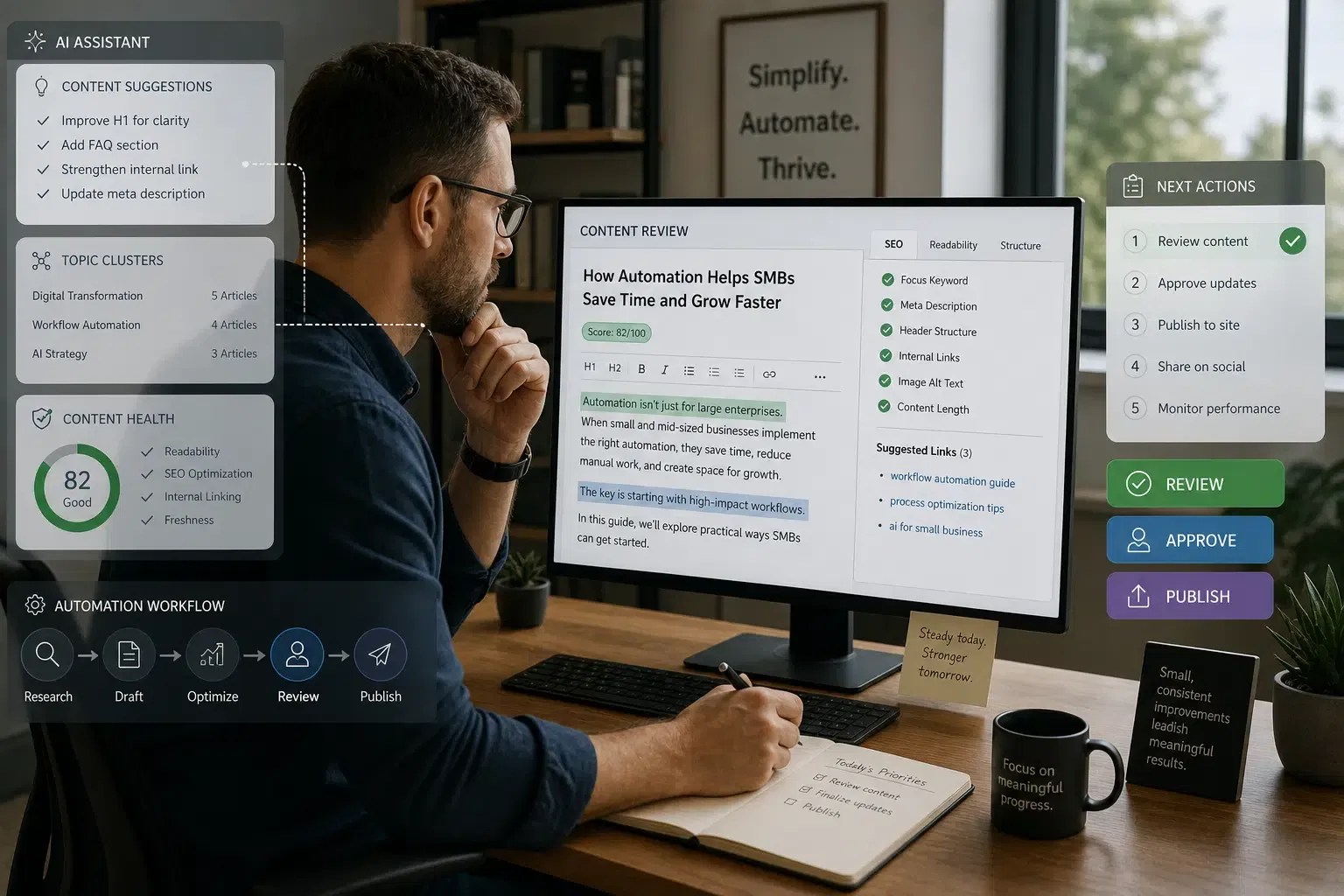
When To Get Help
You may benefit from content repurposing services or content atomization services if your business already has useful content, but it is not moving consistently.
This is especially true when:
- Articles are published but rarely reused
- Service pages answer good questions but stay hidden
- LinkedIn posting depends on last-minute effort
- Google Business Profile updates happen irregularly
- Newsletters feel hard to maintain
- Sales follow-up repeats the same explanations
- Existing content could support more channels
- No one owns the weekly distribution rhythm
A marketing operations partner can help create the system, prepare the assets, and keep the work moving.
At Intenithrive, the Baseline Setup identifies which content should be refreshed, reused, connected, distributed, or atomized first. Monthly Rhythm Marketing Engine support keeps practical improvements moving when the Baseline confirms a good fit.
Final Thought
Structured content distribution helps useful content work harder without asking the founder to become a full-time publisher.
It gives one strong idea for more than one job.
The goal is not more marketing activity. The goal is steady, useful marketing movement across the places where buyers already look, learn, compare, and decide.
FAQs About Structured Content Distribution
What is structured content distribution?
Structured content distribution is a repeatable process for adapting and sharing useful content across relevant channels. It helps website content support social posts, newsletters, sales follow-up, Google Business Profile updates, and other buyer touchpoints.
How is structured content distribution different from social media management?
Social media management usually focuses on platform activity, including posting, engagement, comments, inboxes, and trends. Structured content distribution focuses on reusing useful content across relevant channels without turning marketing into daily platform management.
What is multi-platform content distribution?
Multi-platform content distribution means adapting a single useful idea across several relevant channels. The message stays consistent, but the format varies across LinkedIn, email, Google Business Profile, sales follow-up, and other platforms.
What do content repurposing services include?
Content repurposing services may include turning articles, service pages, FAQs, newsletters, case studies, or sales explanations into new formats. These formats may include LinkedIn posts, newsletter snippets, FAQ sections, carousel outlines, or sales follow-up excerpts.
What are content atomization services?
Content atomization services break larger content assets into smaller, reusable blocks. One article might become several short posts, email sections, FAQ answers, and sales-support snippets.
What is social content repurposing?
Social content repurposing is the process of adapting existing content into social-ready posts. It helps businesses show up more consistently without having to create every post from scratch.
Why does a cross-platform content strategy matter?
A cross-platform content strategy helps the same useful idea reach buyers in different places. It keeps messaging consistent while adapting the format for each channel.
How often should a small service business distribute content?
A small service business should choose a rhythm it can sustain. For many teams, one useful content source per week can support several lightweight distribution assets without creating unnecessary pressure.
Can old content be used for structured content distribution?
Yes. Older evergreen content is often one of the best places to start. It may need a light refresh first, but existing content can often support social posts, newsletters, FAQs, and sales follow-up.
Does InteniThrive provide structured content distribution?
Yes. Rhythm Marketing Engine may include structured content distribution, content reuse, content atomization, LinkedIn posts, Google Business Profile updates, newsletter snippets, and sales follow-up excerpts when the Baseline confirms a good fit.

Leave a Reply