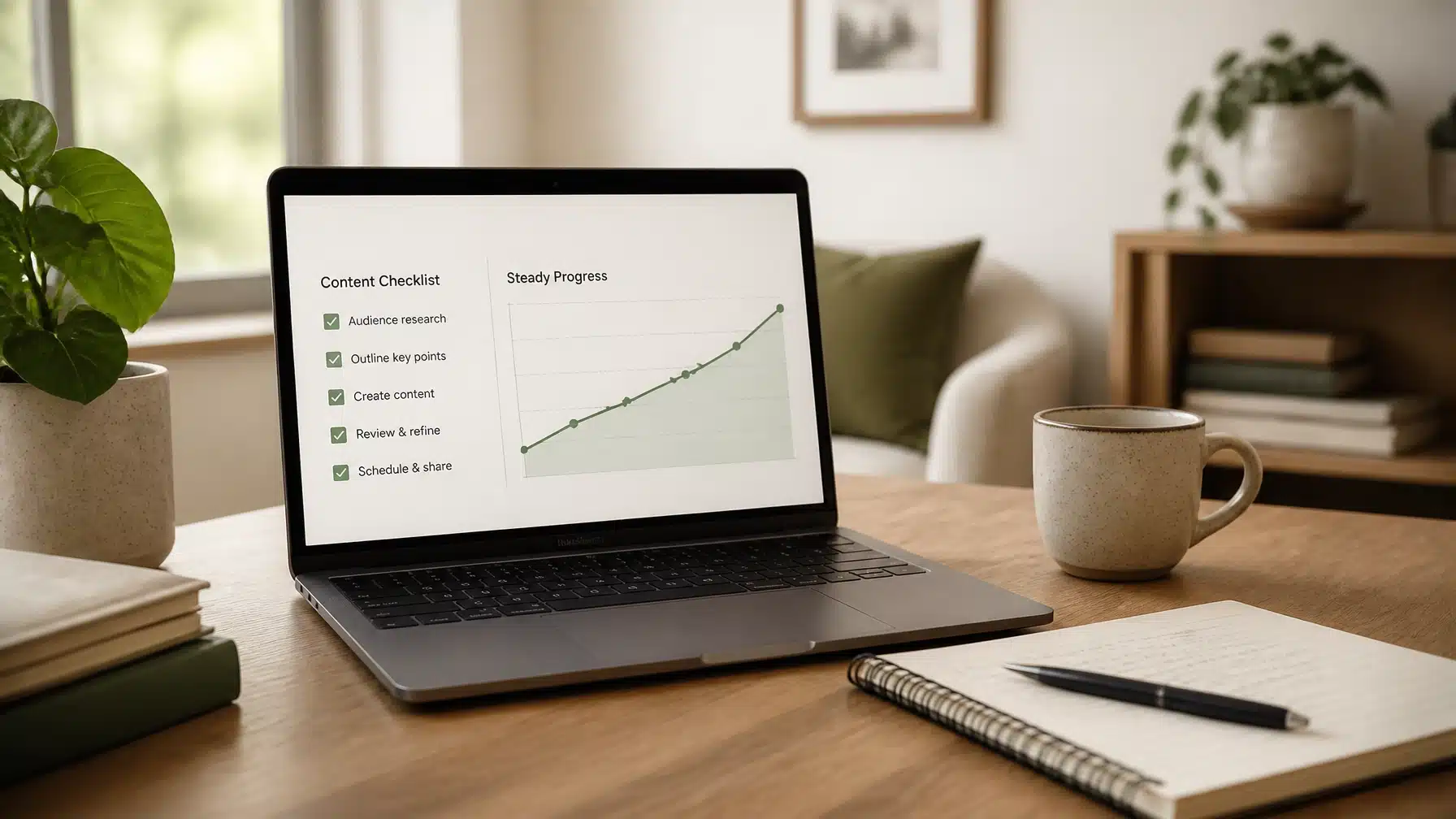
Most service business owners find themselves on a content treadmill that leads nowhere. You may feel pressured to publish something new every week: a fresh blog post, a new case study, or another “thought leadership” piece, just to prove your business is active.
However, behind the scenes, your older and more valuable pages may be quietly losing their edge.
The reality of modern marketing is simple: more content is not always better content. When you focus solely on volume, your website can become cluttered with low-impact posts that search engines eventually overlook.
Meanwhile, the pages that genuinely support leads, sales conversations, and client trust are left to decay. They may have outdated statistics, weak calls to action, broken internal links, missing FAQs, or examples that no longer align with how your business operates.
At InteniThrive Consulting, we recommend a steadier approach. Instead of pursuing the next big content idea, focus on weekly website content improvements that protect your existing assets and make your site easier to trust, use, and find.
This approach is not about publishing more for the sake of publishing more: it’s about steady progress, useful maintenance, and practical search visibility support.
Key Takeaways
- Stop the bloat: Ahrefs found that 90.63% of pages get no organic traffic from Google in its study of more than one billion pages. (Ahrefs)
- Refresh what already exists: HubSpot reported a 106% average increase in monthly organic search views after optimizing older posts. (HubSpot Blog)
- Search engines reward usefulness: Google says its ranking systems are designed to prioritize helpful, reliable, people-first content. (Google for Developers)
- Consistency matters: Weekly website content improvements help service businesses maintain visibility without relying on rushed content production.
- Maintenance is a strategy: The right search visibility support services protect the pages, links, and messages your business already depends on.
Table of Contents
The Trap Of New Content Vanity
A specific kind of anxiety accompanies seeing a “Last Updated: 2023” date on your website. To fix it, many business owners immediately think, “We need a new post.”
That response feels productive: you create a title, write something quickly, publish it, and move on.
But publishing is not the same as progress.
If the new post does not serve a clear buyer question, support a service page, or strengthen your website structure, it may become digital clutter. It adds more work to maintain later without improving search visibility today.
Ahrefs has shown how common this problem is. In its keyword research guide, Ahrefs cites a study of more than 1 billion pages and notes that 90.63% of pages receive no traffic from Google. (Ahrefs)
That does not mean content marketing is dead. It means unfocused content creation is expensive.
Content debt is real. Every article, landing page, service page, and resource eventually needs maintenance. Statistics age. Links break. Offers change. Screenshots become outdated. Client questions shift.
Without a plan for search visibility support, your website can become a graveyard of old claims, weak links, and half-useful content.
For small service businesses, this creates a quiet problem. Your website may still look active from the outside, but the underlying structure no longer supports your current business.

Why Search Engines Prefer A Refreshed Site
Search engines do not only look for new things. They look for useful things.
A refreshed article with updated data, clearer examples, stronger internal links, and better answers can be more valuable than a brand-new post with no history.
Google’s own guidance emphasizes helpful, reliable, people-first content: this means your pages should answer real questions, show useful experience, and help visitors accomplish their goals. (Google for Developers)
When you make weekly website content improvements, you signal that your site is actively maintained.
That signal matters because search visibility is not only about keywords: it is also about relevance, clarity, structure, and trust.
A neglected page can slowly lose performance as the surrounding market changes. Competitors improve their pages. Search intent shifts. New terminology emerges. Buyers ask sharper questions, and AI answer engines start summarizing information directly inside search results.
In that environment, a stale page has less to offer.
A refreshed page can stay useful longer because it keeps pace with real buyer needs. It can also preserve the value of an existing URL, especially when that page already has backlinks, search history, or internal importance.
HubSpot’s existing content refreshes work is a useful example. The company reported that updating older posts helped increase monthly organic search views by an average of 106%. HubSpot also noted that optimized older posts more than doubled monthly leads. (HubSpot Blog)
That does not mean every refresh will produce the same result, but it does clearly demonstrate the principle.
Improving what already exists can be more practical than constantly starting over.
Why This Matters More For Service Businesses
Marketing consistency for service businesses is harder than most marketing advice admits.
Service businesses do not always have a large marketing team, a dedicated search visibility specialist, a marketing operations role, or a weekly creative rhythm. In many cases, the owner, operations lead, or small internal team handles marketing between client delivery, sales conversations, hiring, and admin work.
That is why broad advice like “publish more content” often breaks down.
It creates more tasks without solving the actual problem: follow-through.
Most service businesses already have useful material somewhere. It may live in proposals, sales calls, client emails, onboarding notes, FAQs, case studies, workshop slides, or past blog posts.
The issue is not always a lack of ideas. The issue is that useful knowledge does not consistently become visible website content.
This is where website content improvements become useful. They turn scattered knowledge into stronger pages, clearer answers, and better internal pathways.
Instead of asking, “What new thing should we publish this week?” ask a better question:
“What existing page could become more useful this week?”
That question lowers the pressure and leads to more sustainable marketing work.
5 Specific Weekly Website Content Improvements
You do not need a massive improvement backlog to improve search visibility: you need a repeatable rhythm that keeps the right work moving.
These five weekly website improvements can help your existing website become clearer, more useful, and easier to find.
1. Update Statistics And Facts
Nothing weakens authority faster than outdated data.
A service page that cites a 2019 study may still be accurate in spirit, but it can feel neglected. A blog post referencing old tools, old pricing, old platform names, or outdated search behavior can create doubt.
Each week, choose one important page and review its facts.
Look for:
- Old statistics
- Outdated year references
- Broken source links
- Old screenshots
- Removed tools or platforms
- Claims that need stronger evidence
- Examples that no longer match your offer
This is one of the simplest website content improvements because it does not require a blank page. You are improving an existing asset.
It also strengthens trust. Readers notice when content feels current. Search systems notice when pages better match the present search environment.
2. Strengthen Internal Linking
Internal links are the roads through your website.
They help visitors find related pages. They help search engines understand how your content fits together. They also help important pages receive more attention from supporting articles and resources.
Many websites have a simple problem: new content gets published, but nobody goes back to connect it.
That leaves useful pages isolated.
Each week, review one article or service page and ask: What related page should this link to?, What page should link back here?, Is there a natural next step for the reader?, Are we linking to the most current service page?, and Are old links still pointing to outdated offers?
Internal linking supports search visibility by clarifying relationships between pages. It also supports conversion by allowing readers to move from learning to taking action without hunting.
For service businesses, this matters because buyers rarely make decisions based on a single page. They move through questions, proof, services, process, pricing, and trust signals.
Your internal links should help that journey feel natural.
3. Refresh Calls To Action
Your calls to action should match what your business actually wants next.
That sounds obvious, but many websites quietly drift. A page may still invite visitors to download an old guide, book an outdated service, or contact someone who no longer owns that process.
A CTA that made sense two years ago may not support your current business.
Each week, check one high-value page and review the next step.
Ask:
- Is this CTA still relevant?
- Does it match the reader’s likely stage of awareness?
- Does it point to the right offer?
- Is the language clear and low-pressure?
- Does the CTA help the visitor decide what to do next?
For service businesses, the best CTA is not always “book a call.” Sometimes the better next step is to read a related service page, review a process, check fit, or submit a short inquiry.
Good marketing operations support helps keep these details aligned.
That alignment improves the buyer experience and reduces friction for your internal team.
4. Optimize Images And Add Descriptive Alt Text
Images often get ignored after publishing.
That creates two problems.
First, large image files can slow down the website. Second, missing or vague alt text can undermine accessibility and reduce the page’s usefulness.
A weekly image review is a practical website maintenance task with several benefits.
Check for:
- Oversized image files
- Missing alt text
- Generic alt text like “image” or “photo.”
- Images that no longer match the page
- Broken image links
- Screenshots that show outdated tools
- Visuals that could support the article more clearly
Descriptive alt text should explain the image in a useful way. It should not be stuffed with keywords.
For example, “Business owner reviewing website progress and marketing dashboards” is more helpful than “generic website graphic.”
This kind of maintenance supports usability, accessibility, and search clarity. It also keeps your website from feeling abandoned.
5. Add Or Improve FAQ Sections
Your buyers are already telling you what content your website needs.
They ask questions in sales calls. They raise concerns during onboarding. They hesitate around pricing, timing, scope, ownership, and outcomes.
Those questions should not live only in your memory or inbox.
Each week, choose one real buyer question and add it to a relevant service page, blog post, or FAQ section.
Useful FAQ topics often include:
- Who the service is for
- Who the service is not for
- What happens first
- How pricing works
- What the client needs to provide
- How long the process takes
- What results are realistic
- What happens if priorities change
FAQ sections help human readers make decisions. They also help search engines and AI answer systems understand the specific questions your page answers.
This is especially useful for local service providers, consultants, agencies, and small firms where trust depends on clarity.
A good FAQ does not need to be clever. It needs to be direct, honest, and specific.

How This Leads To Better Visibility Without Burnout
Marketing consistency for service businesses does not come from working harder. It comes from building a rhythm that makes the right work easier to repeat.
Content Marketing Institute and MarketingProfs found that only 22% of B2B marketers rated their content marketing as extremely or very successful in their 2025 benchmark research. The same report found that 45% lacked a scalable model for content creation. (MX)
That gap matters.
Many teams produce content, but few have a sustainable system to keep it useful over time.
When you shift your focus to weekly website content improvements, the pressure to be “creative” on demand vanishes.
You are not staring at a blank page every Monday morning: you are working from a practical list of improvements that already need attention.
That work may include updating a statistic, improving a CTA, adding a buyer question, strengthening internal links, or refreshing an old introduction.
These are not glamorous tasks. They are useful tasks.
They also compound.
One improvement may feel small. Fifty improvements across a year can make a website noticeably clearer, stronger, and more aligned with the business.
This is the practical value of search visibility support services. They keep your content from decaying after publication, protect your existing search visibility, and reduce the need for reactive cleanup later.
The Rhythm Marketing Engine Solution
Most founder-led service businesses do not need more marketing ideas: they need steadier follow-through.
The Rhythm Marketing Engine was built for that reality.
It keeps one useful website or content improvement moving each week, so your marketing fundamentals do not stall when client delivery gets busy.
Each week, we identify the next most useful website content improvement, whether it is a content refresh, an internal link update, a service page clarification, a FAQ addition, or a search visibility tweak.
Then we move it forward.
No bursts. No stalls. No content treadmill.
Just steady, visible progress.
The goal is not to replace your judgment. Your business still needs human ownership, clear priorities, and final review. The goal is to reduce the recurring friction that keeps useful improvements from happening.
That is what good marketing operations support should do.
It should make the work clearer, lighter, and easier to own.
What To Improve First
Start with your highest-leverage pages.
For most service businesses, that means:
- Your homepage
- Core service pages
- Top-performing blog posts
- Contact page
- About page
- Case studies
- Pages already getting search impressions
- Pages used in sales conversations
Do not begin with the lowest-value page just because it is easy.
Start where clarity matters most.
If a page helps a buyer understand your service, compare options, trust your process, or take the next step, it deserves maintenance.
A simple first pass can answer three questions:
- Is this page still accurate?
- Is the next step clear?
- Does this page connect to related content?
That is enough to begin.
A Better Way To Keep Marketing Moving
The content treadmill tells you to keep producing.
A better rhythm tells you to keep improving.
That shift matters because your website is not just a publishing channel: it is a business asset. It supports trust, sales conversations, search visibility, referrals, and decision-making.
When your site receives steady maintenance, it becomes more useful over time. When it gets ignored, even strong content can lose value.
Weekly website content improvements help protect what you already built.
They also give your business a sustainable path forward: one useful improvement, one week at a time.
Simplify. Maintain. Thrive.
FAQ
Is It Better To Update An Old Post Or Write A New One?
In many cases, updating an old post with search history, backlinks, or useful buyer relevance can produce faster value than starting from scratch. New content still has a place, but refreshes often protect assets your business already owns.
How Often Should I Refresh My Website Content?
A weekly rhythm works well for small service businesses. One useful improvement per week prevents content decay without requiring a large annual audit or a heavy content production cycle.
Will Refreshing Content Really Help SEO?
Yes, when the refresh improves usefulness, accuracy, structure, and relevance. Google prioritizes helpful, reliable, people-first content, and HubSpot has reported strong gains from historical optimization. (Google for Developers)
What If My Old Content Is No Longer Relevant?
If the page no longer serves a useful purpose, you can redirect it, merge it with a stronger page, or rebuild it around a more relevant buyer question. The right choice depends on the page’s traffic, backlinks, and business value.
What Are The Most Important Weekly Website Content Improvements To Start With?
Start with your top five most-visited or most commercially important pages. Check the links, update the facts, clarify the CTA, improve the internal links, and add missing buyer questions.
Leave a Reply