
For many small business owners, marketing feels like a treadmill that only moves when they sprint.
You get a burst of energy, publish a few posts, update a service page, and feel like you finally gained ground. Then the client’s work gets busy. Marketing stalls. The blog sits untouched. Service pages age quietly. Helpful ideas stay buried in a folder.
That cycle is tiring because it turns marketing into another source of guilt.
Marketing operations for founders helps replace that stop-start cycle with a steadier way to keep useful work moving.
Marketing operations for founders is the practical system that helps founder-led businesses prioritize, complete, review, and track recurring marketing work without relying on heroic effort.
The goal is not to sprint harder. The goal is to create a steady marketing movement through clear ownership, useful workflows, and realistic review rhythms.
Key Takeaways
- Marketing operations for founders reduces dependency on memory: Marketing stops living only in the founder’s head.
- Founder-led business marketing support keeps improvements moving: The owner still provides judgment, but the process carries more coordination.
- Marketing consistency for service businesses compounds: Small weekly improvements strengthen clarity, visibility, and sales usefulness over time.
- Entrepreneurial burnout prevention requires better systems: Burnout risk rises when one person carries strategy, sales, delivery, operations, and marketing.
- Marketing follow-through support closes the execution gap: a clear backlog, a review rhythm, and a progress summary make marketing easier to sustain.
Marketing Operations For Founders Starts With The Real Problem
Most founder-led businesses do not lack marketing ideas.
They lack marketing continuity.
The founder usually knows what should improve. The service page needs clearer language. The FAQ is too thin. Older articles need refreshing. Useful explanations from sales calls should be repurposed as website content, LinkedIn posts, Google Business Profile updates, newsletter snippets, or sales follow-up excerpts.
But knowing what should happen is not the same as keeping it moving.
That is where the execution gap begins.
Marketing follow-through support refers to the structure, ownership, and recurring help that keeps marketing improvements moving after the initial idea appears.
Without that support, marketing depends on personal bandwidth. If the founder is tired, marketing stops. If client work spikes, marketing stops. If delivery issues need attention, marketing stops.
This is why the marketing problem often becomes a burnout problem.
A 2025 BMC Public Health study found that 22.1% of SME workers met the criteria for burnout, and more than 54% reported at least one mental health challenge. For founders, that pressure often grows because strategy, sales, client delivery, operations, and marketing all compete for the same attention.

The Cost Of The Heroic Effort Trap
Heroic effort feels productive in the moment.
You block a weekend, update a few pages, write a batch of posts, and feel temporarily caught up. But the system has not changed. The next time marketing needs attention, the same pressure returns.
That pattern creates three kinds of friction:
- Mental friction: You keep remembering what should be done.
- Operational friction: You restart the process every time marketing resumes.
- Growth friction: Website, content, and visibility improvements do not compound.
This is where entrepreneurial burnout prevention becomes practical. It is not only about rest, although rest matters. It is also about reducing recurring work that relies on a single person’s memory.
Entrepreneurial burnout prevention is the practice of reducing chronic overload, decision fatigue, and unsustainable responsibility patterns before they damage the founder or the business.
Gallup’s 2024 State of the Global Workplace report found that 41% of employees globally experienced daily stress. Founders often carry an added layer: the business risk, client expectations, team decisions, and unfinished marketing work.
That is why marketing operations for founders should not be treated as a luxury. It is a practical infrastructure for keeping useful work from becoming another private burden.
What Founder-Led Business Marketing Support Actually Means
Founder-led business marketing support is not the same as handing off judgment.
It means the founder is no longer the only person responsible for remembering, sequencing, preparing, and tracking every marketing improvement.
Founder-led business marketing support is structured help that keeps marketing work moving while preserving the founder’s role in decisions, approvals, and business context.
That distinction matters.
A founder should still own:
- Strategic judgment.
- Service claims.
- Sensitive examples.
- Final approvals.
- Relationship context.
- Business priorities.
But the founder should not need to carry every recurring marketing task personally.
With the right marketing operations for founders, the work shifts from remembering to reviewing.
From Remembering To Reviewing
The biggest shift is simple.
The founder moves from “I need to remember this” to “I need to review this.”
When marketing depends on remembering, the founder carries a constant background list:
- Check which article needs updating.
- Find the old service page.
- Decide what to improve next.
- Write the first draft.
- Add internal links.
- Turn the content into social-ready posts.
- Check whether anything was published.
- Repeat next month, if there is energy.
That is not a marketing system. That is a memory tax.
With marketing follow-through support, the rhythm changes:
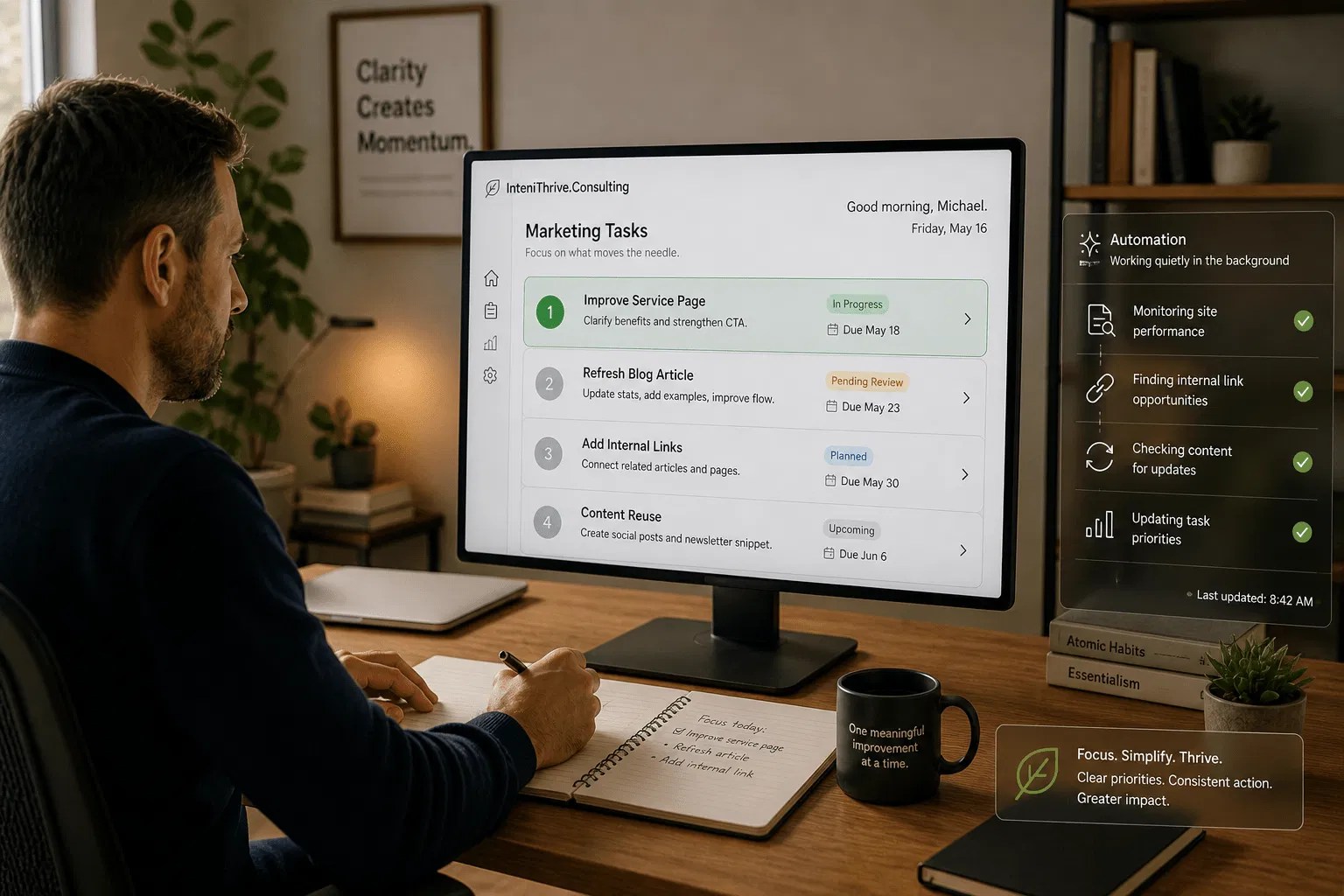
- The backlog holds the priorities: The next useful improvements are already listed.
- The system sequences the work: The next step is clear before the week begins.
- Support prepares the improvement: The founder is not starting from a blank page.
- The founder reviews: Their judgment improves accuracy, tone, and fit.
- Progress gets documented: The next step stays visible.
This creates marketing consistency for service businesses because progress no longer depends on bursts of available energy.

How Marketing Consistency For Service Businesses Reduces Pressure
Marketing consistency for service businesses means useful improvements happen at a sustainable pace.
It does not mean posting every day. It does not mean chasing every platform. It does not mean producing content for the sake of volume.
Marketing consistency for service businesses is the repeatable movement of practical website, content, visibility, and distribution improvements over time.
For a service business, consistency may look like:
- Refreshing one older article.
- Clarifying one service page.
- Improving internal links.
- Expanding one FAQ section.
- Preparing one LinkedIn post from existing content.
- Creating a Google Business Profile update.
- Turning one sales explanation into reusable website content.
Small improvements matter because they compound.
CoSchedule’s marketing research found that organized marketers were 674% more likely to report success than their peers. Constant Contact’s 2025 Small Business Now report also found that fewer than one in five small businesses felt very confident about the impact of their marketing.
That confidence gap makes sense. If marketing happens inconsistently, it becomes hard to connect effort to progress.
Marketing becomes easier to trust when progress is visible.
How A Steady Rhythm Supports Entrepreneurial Burnout Prevention
A steady rhythm lowers the emotional stakes of marketing.
Instead of waiting until everything feels urgent, the business moves one useful improvement at a time. That makes the work easier to start, review, and sustain.
1. It Protects The Founder During Busy Delivery Cycles
Client work will get busy. That is normal.
The problem is that every busy delivery cycle causes marketing to disappear. Marketing operations for founders help protect continuity during those moments.
The founder may still review short updates, answer questions, or approve changes. But they are not restarting the entire process on their own.
2. It Reduces Decision Fatigue
One of the most exhausting parts of marketing is deciding what to do next.
A useful rhythm answers that question before the week begins. The priority is already selected. The reason is documented. The next review point is clear.
This supports entrepreneurial burnout prevention because fewer small decisions are carried in the mind.
3. It Makes Progress Visible
Invisible effort creates stress.
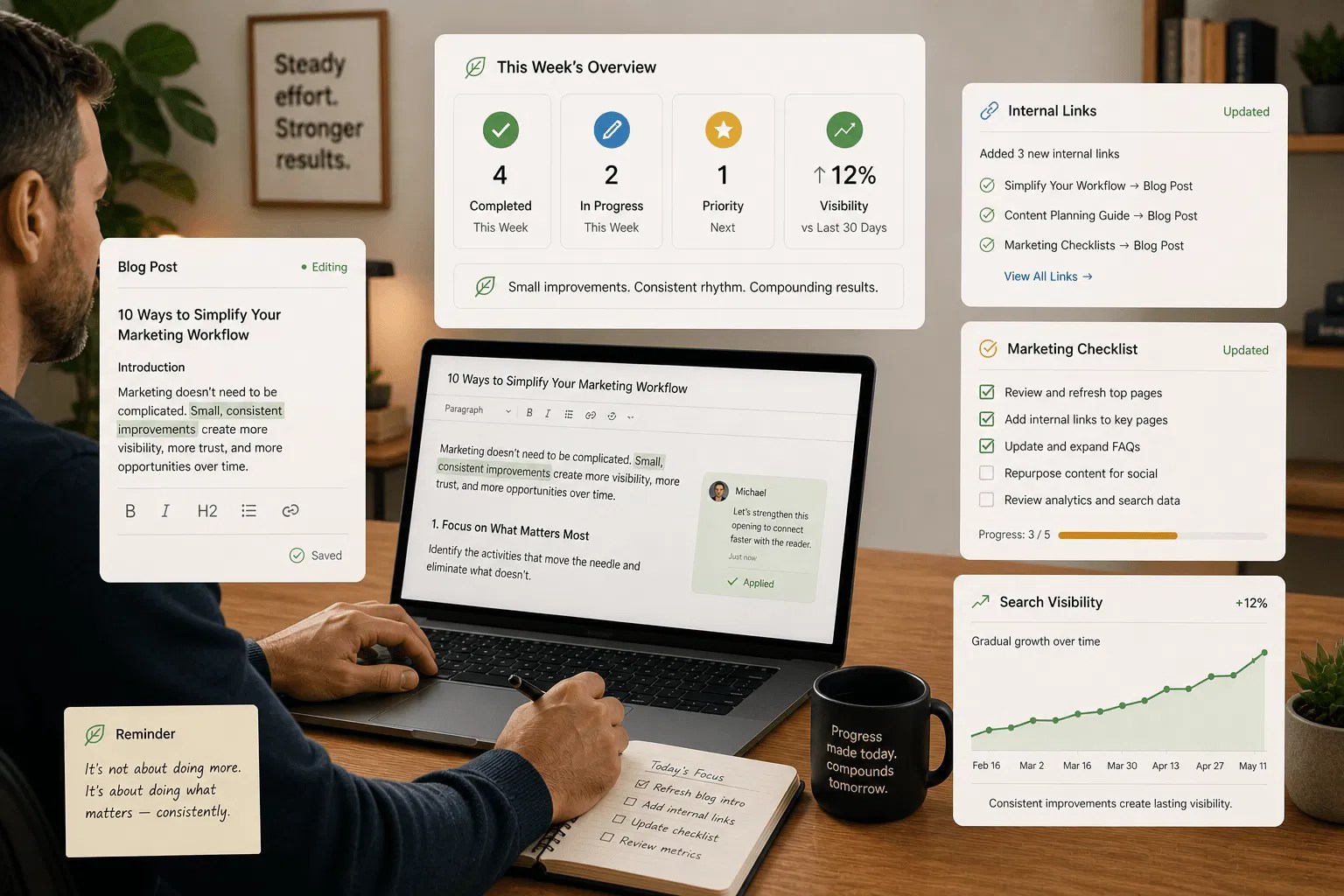
A simple weekly update can show:
- What changed.
- Why it mattered.
- Where to review it.
- What needs approval.
- What moves next.
That kind of progress visibility helps the founder feel less behind, even when the backlog still contains more work.
4. It Keeps Human Judgment In The Right Place
Automation and AI can support drafting, organizing, formatting, and reusing. But they should not replace business judgment.
A healthy system uses automation to reduce recurring effort. The founder still owns final review, sensitive claims, and strategic direction.
That balance protects quality and reduces overload.
The Rhythm Marketing Engine Approach
At InteniThrive Consulting, the Rhythm Marketing Engine is built for founder-led service businesses that have a working website, useful content, and inconsistent follow-through.
It provides marketing operations for founders who do not need more random ideas. They need a steadier way to keep the right improvements moving.
The work may include:
- Service-page improvements.
- Existing content refreshes.
- Internal linking.
- FAQ and buyer-question coverage.
- Search and AI visibility support.
- Content reuse.
- Structured content distribution.
- Newsletter snippets.
- Sales follow-up excerpts.
- Simple monthly progress summaries.
The goal is not more marketing activity.
The goal is a steady marketing movement.
Start With The Baseline Setup
Rhythm Marketing Engine begins with the Baseline Setup.
The Baseline Setup is a one-time starting phase priced at $1,499. It shows what is already working, what is unclear or outdated, what should improve first, and whether monthly support makes sense.
The Baseline reviews:
- Website structure.
- Priority service pages.
- Existing content.
- Internal links.
- Search visibility signals.
- FAQ opportunities.
- Content reuse and distribution opportunities.
- Site clarity issues.
This prevents monthly support from starting on a guess.
If the Baseline confirms a good fit, monthly Rhythm Marketing Engine support is $1,499. The monthly rhythm keeps practical website, content, visibility, and distribution improvements moving each week.
What Marketing Follow-Through Support Changes
Good marketing follow-through support does not remove the founder from the marketing process.
It makes the founder’s role more focused.
Instead of carrying every task, the founder can focus on:
- Reviewing short updates.
- Confirming factual accuracy.
- Clarifying business priorities.
- Approving sensitive claims.
- Sharing context when something changes.
- Making final decisions.
That is a healthier use of founder energy.
The business also gains a clearer operating rhythm:
- The improvement backlog stays visible.
- Weekly priorities are easier to understand.
- Existing content gets reused more often.
- Service pages become clearer.
- Internal links improve.
- Buyer questions get answered.
- Marketing consistency becomes normal.
Over time, the website becomes more useful, better connected, and easier to maintain.
Reclaiming Mental Bandwidth
Marketing should not feel like a second job that the founder waits for after client work ends.
It should feel like a practical support system around the business.
That is the point of marketing operations for founders. It helps move useful marketing work out of private memory and into a visible rhythm.
The founder still leads. The founder still decides. The founder still protects the quality of the message.
But the founder no longer has to be the entire engine.
Ready To Build A Better Rhythm?
Stop remembering every marketing task alone.
Start with a Baseline Setup, clarify what should improve first, and build a practical rhythm for steady marketing movement.
Schedule a fit call with InteniThrive Consulting today.
Frequently Asked Questions
What Is Marketing Operations For Founders?
Marketing operations for founders is the practical system that helps founder-led businesses prioritize, complete, review, and track recurring marketing work. It reduces dependency on heroic effort and helps keep improvements moving.
What Is Founder-Led Business Marketing Support?
Founder-led business marketing support is structured help that keeps marketing work moving while preserving the founder’s judgment. The founder still approves important decisions, but the process carries more coordination.
Why Does Marketing Consistency For Service Businesses Matter?
Marketing consistency for service businesses matters because small improvements compound. Clearer pages, refreshed content, stronger internal links, and better FAQs can support visibility, trust, and sales conversations.
How Does Marketing Follow-Through Support Prevent Burnout?
Marketing follow-through support reduces the number of recurring tasks the founder must remember and restart. It creates a backlog, rhythm, review process, and progress summary, making marketing easier to carry out.
What Is Entrepreneurial Burnout Prevention?
Entrepreneurial burnout prevention is the practice of reducing chronic overload before it damages the founder or business. In marketing, that means replacing last-minute effort with systems, ownership, and sustainable rhythms.
What Is Steady Marketing Movement?
A steady marketing movement is the consistent completion of useful website, content, visibility, and distribution improvements over time. It focuses on practical progress, not bursts of activity.
Is Rhythm Marketing Engine A Full-Service Marketing Agency?
No. Rhythm Marketing Engine is not a full-service marketing agency, paid ads provider, or bulk content production service. It is practical marketing operations support for founder-led service businesses.
What Happens First?
The first step is the Baseline Setup. It identifies what is working, what is unclear, what should improve first, what can wait, and whether monthly Rhythm Marketing Engine support makes sense.

Leave a ReplyCancel reply