
Stop the start-stop cycle. Build steadier marketing follow-through with a clear improvement rhythm.
Most service business owners treat marketing like a New Year’s resolution. You start with a burst of energy. You write three blog posts, post daily on LinkedIn, update your services page, and promise yourself the rhythm will continue.
Then the client’s work gets busy. Operations need attention. A proposal needs review. A team question needs an answer. Marketing quietly slips again.
That pattern is common because time is the real constraint. Constant Contact reported that fewer than one in five small businesses feel very confident about their marketing impact, even as effort has increased. Salesforce also found that 88% of SMB leaders feel overwhelmed by the number of business tools they use. The issue is rarely an effort alone. It is usually unclear ownership, scattered tools, and no reliable improvement rhythm. (Constant Contact)
This is the start-stop cycle. It creates extra coordination, weakens confidence, and makes practical marketing work harder to restart.
Marketing consistency for service businesses is not about doing everything at once. It is about keeping the right improvements moving at a steady pace. Emphasizing marketing follow-through ensures that your efforts are not wasted and progress is continuous.
Table of Contents
The Hidden Cost of Stop-Start Marketing
When you market in fits and starts, you pay a momentum tax.
Every restart creates extra work. You have to remember what changed, find the right files, check old assumptions, and rebuild confidence. That burden gets heavier when the website, content, reporting, and approvals all live in different places.
The cost is not only time. Stop-start marketing also makes decision-making harder.
When updates happen irregularly, every task feels like a fresh strategy conversation. Should this service page be rewritten? Should this older article be refreshed? Should the FAQ be expanded? Should LinkedIn get attention first? These are useful questions, but they become draining when they restart from zero each month.
Search visibility can suffer, too. Google Search Central emphasizes helpful, reliable, people-first content. Useful pages should stay accurate, clear, and genuinely helpful, not sit as old posts no one revisits. (Google Search Central)
Marketing follow-through changes the pattern. It turns marketing from a stressful catch-up effort into a manageable operating rhythm.
Why Your Marketing Stops
Most service founders blame willpower. They think they need to be more disciplined.
The system is usually the problem. Many marketing plans assume a larger team, clearer ownership, and more available time than a small service business actually has.
For a lean service business, marketing often stops because:
- The plan is too complex: Five channels sound good until client delivery gets busy.
- Ownership is unclear: If everyone owns the website, no one owns the next improvement.
- New work gets overvalued: Older service pages, articles, and FAQs often need refreshes before new content.
- Reporting is too noisy: Metrics matter less when no one knows what to do next.
- Approvals are too vague: Progress slows when no one knows who can say yes.
The Content Marketing Institute and MarketingProfs 2025 B2B research found that 56% of B2B marketers struggle to attribute content ROI and track customer journeys. The same research found that 45% lack a scalable content-creation model. That is a follow-through problem, not just a creativity problem. (The MX Group)
The practical lesson is simple. Marketing stops when the next step is unclear, too large, or too dependent on memory.

Step 1: Start with a Baseline Setup
You cannot build a useful rhythm on a messy starting point.
Before you commit to weekly marketing activity, you need to know where the website stands. At InteniThrive Consulting, we call this a Baseline Setup.
A useful Baseline asks practical questions:
- What is already working?
- Which service pages are unclear or outdated?
- Which older articles could be refreshed or reused?
- Where are internal links missing?
- Which buyer questions should be answered before a call?
- What should improve first?
- What can wait?
This keeps monthly support from starting on a guess. It also protects the owner from trying to fix everything at once.
A Baseline is not a long technical audit. It should not bury the owner in a 40-page report that creates more work than clarity. The point is to identify the next useful improvements and put them in a sensible order.
A good Baseline also separates urgent work from useful work. Some issues need attention now because they block trust, visibility, or next-step confidence. Other issues can wait because they are secondary, cosmetic, or not tied to a current business priority.
Simplify first. Then improve.
Step 2: Build a Rhythm, Not a Campaign
The word campaign implies an end date. Most service businesses need something steadier.
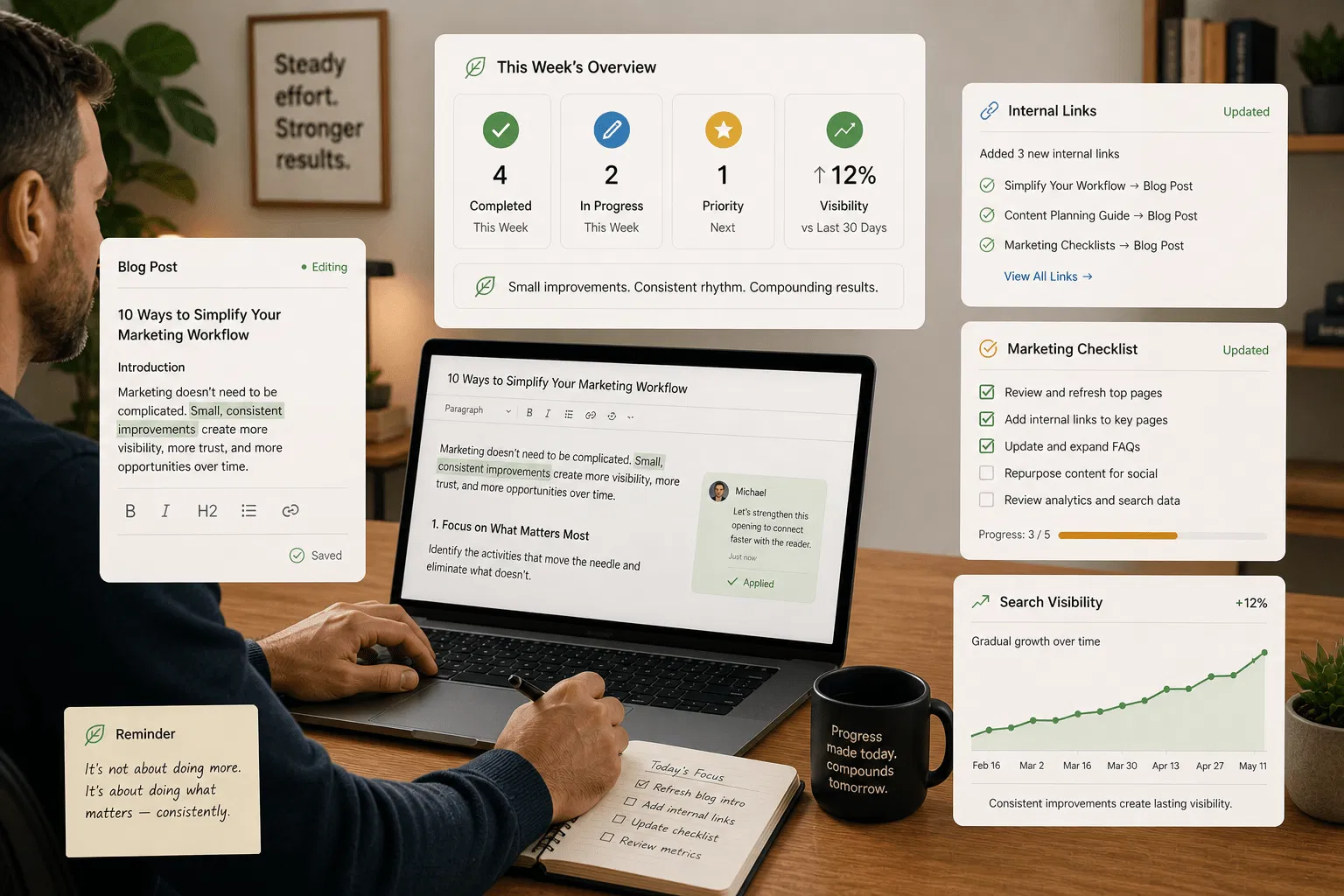
The Rhythm Marketing Engine is built around weekly movement. Instead of saving marketing for one overloaded “marketing day,” one useful improvement moves forward each week.
A simple month might look like this:
- Week 1: Clarify one priority service page.
- Week 2: Refresh one useful older article.
- Week 3: Improve internal links between related pages.
- Week 4: Review what changed and choose the next priority.
That rhythm matches how small teams actually work. It keeps the work small enough to continue, but useful enough to matter.
Weekly movement also reduces decision fatigue. You no longer need to ask, “What should we do with marketing?” every time attention returns. The improvement backlog already holds the next practical step.
This matters because service businesses rarely lack ideas. They usually have too many ideas competing for limited attention. A rhythm helps choose one useful improvement, move it forward, and document what changed.
The value is not volume. The value is continuity.
Step 3: Refresh Before You Create More
One of the biggest obstacles to marketing follow-through is the pressure to create something new.
Most service businesses already have useful information buried in service pages, articles, FAQs, proposals, and sales conversations. The better first move is often to improve what already exists.
A content refresh can include:
- Updating outdated details.
- Adding current examples or proof.
- Improving headings and structure.
- Adding internal links.
- Expanding thin FAQ answers.
- Adding a clearer call to action.
- Removing duplicated or confusing wording.
- Connecting the page to a related service or article.
Ahrefs recommends refreshing and republishing older content as a practical way to improve organic performance. Its guidance focuses on finding pages with existing potential and improving relevance, accuracy, and usefulness rather than starting from scratch. (Ahrefs)
Refreshing also respects the reality of small teams. New content requires ideation, drafting, review, publishing, and promotion. Existing content already has a topic, a URL, and some business context. That makes it a more practical starting point.
Content reuse lowers the burden further. One useful article can become a LinkedIn post, a carousel outline, a short thread, an FAQ section, or a sales follow-up snippet.
The point is not to squeeze every piece of content dry. The point is to stop letting useful material sit untouched.
Step 4: Use Data Without Creating More Noise
You cannot improve marketing follow-through if you never look at what changed.
But most reports create more noise than clarity. You do not need 20 metrics if no one knows what action to take from them.
You need simple reporting that answers three questions:
- What did we do?
- What changed?
- What moves next?
This is where Google Search Console, site analytics, and a simple improvement backlog come into play. The goal is not perfect attribution. The goal is visible progress and better decisions.
Salesforce’s SMB research highlights the role of technology and data in helping small businesses move faster and serve customers better. But the same research also shows tool overwhelm is real. The answer is not more dashboards. It is fewer, clearer signals. (Salesforce)
Simple reporting should show what improved, why it mattered, and what still needs attention. It should also show where client input is needed. That keeps progress visible without making the owner manage another marketing function.
For example, a useful monthly summary might say:
- One service page was clarified to answer buyer questions better.
- Two older articles were refreshed and linked to related services.
- Three missing internal links were added between priority pages.
- One FAQ section now answers a common pre-sales question.
- Next month should focus on the highest-priority service page.
That kind of reporting creates movement. It does not just describe activity.

Reduce the Friction of Coordination
The biggest reason marketing fails in service businesses is the coordination burden.
This is the time spent deciding what to do, finding the right files, chasing approvals, checking old claims, and reopening the same conversations. It feels small in the moment, but it quietly drains follow-through.
To reduce that friction:
- Standardize templates: Do not reinvent every update.
- Keep a visible backlog: Make the next improvement easy to find.
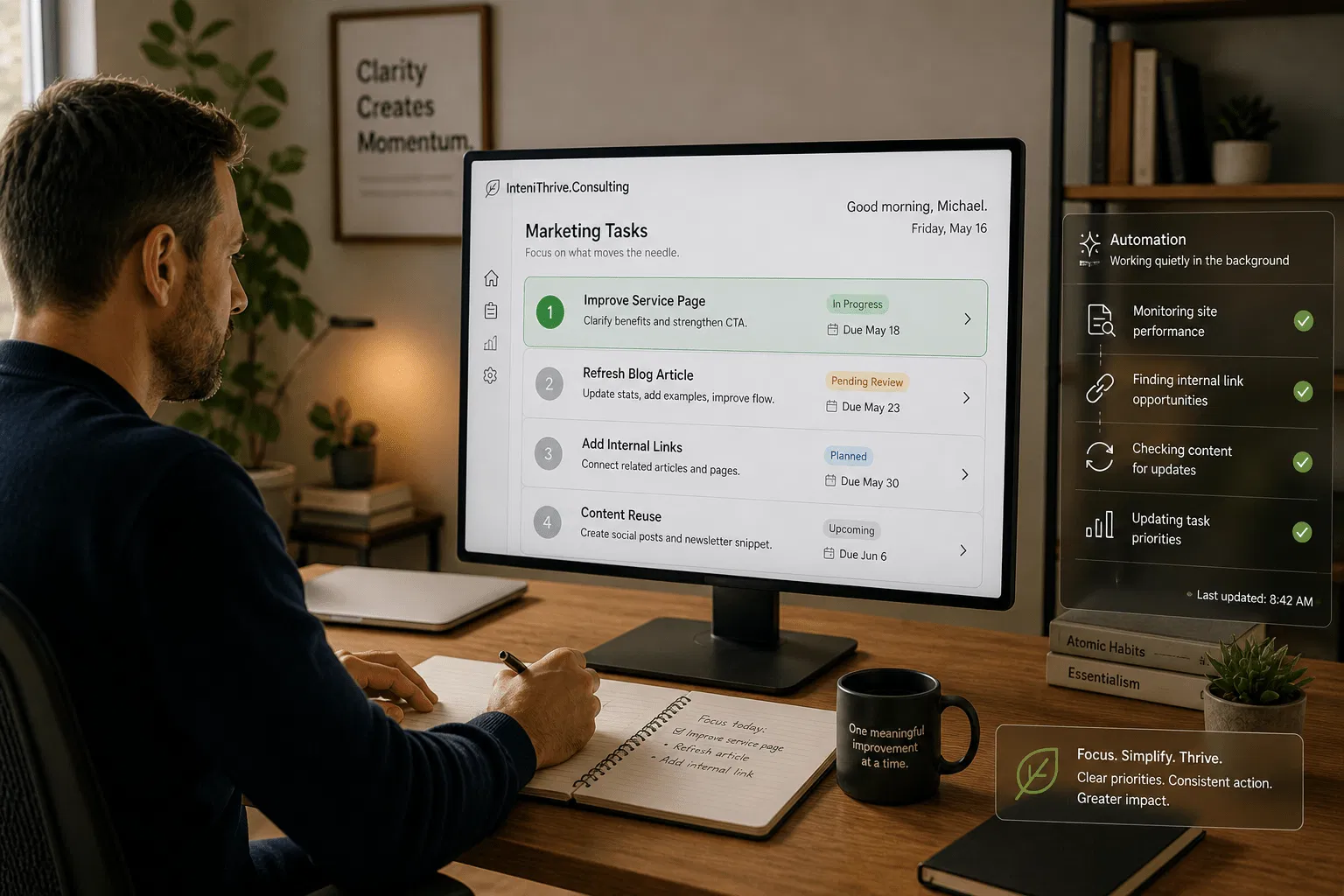
- Use automation carefully: Let tools flag broken links, stale pages, and reporting changes.
- Keep review ownership clear: One person should approve short updates.
- Protect human judgment: AI can support drafting, reuse, and analysis, but final business claims need review.
This fits InteniThrive’s sustainable ownership standard. Progress should be clear enough to understand, small enough to keep moving, useful enough to matter, and visible enough to trust.
Automation helps when it removes recurring effort that should not depend on memory. It causes problems when it hides accountability or pushes work forward without review.
That distinction matters. AI can help draft FAQ answers, identify content reuse opportunities, summarize updates, and prepare reporting notes. It should not replace strategic judgment, final claims review, or sensitive client communication.
Marketing follow-through gets stronger when automation supports ownership. It gets weaker when automation becomes another system no one owns.
What Steady Progress Looks Like Over Time
The first month usually creates relief. The website is moving again. The next improvement is clearer. The owner no longer has to restart the same marketing conversation from scratch.
After 90 days, the benefits become easier to see. Several pages are clearer. Older content has been refreshed or reused. Internal links are stronger. FAQ coverage is better. Search visibility signals have more support.
After six months, the website can feel noticeably more useful. Service pages explain value more clearly. Articles connect to practical next steps. Reused content supports social, email, FAQs, and sales follow-up. Monthly reporting shows what changed and why it mattered.
This is not a dramatic transformation. It is a steady improvement.
That is the point.
Small improvements compound when they keep moving. A clearer service page helps buyers understand fit. A refreshed article becomes useful again. A stronger internal link helps visitors find the next step. A better FAQ can reduce the need for repeated explanations before a call.
Each improvement is modest by itself. Together, they make the website easier to trust, use, and maintain.
Is Rhythm Marketing Engine Right for You?
Marketing follow-through is not about being the loudest business in the room. It is about becoming more dependable.
Rhythm Marketing Engine is a strong fit if you already have:
- A working website.
- Service pages or useful written content.
- Older articles, FAQs, or resources are worth improving.
- Website updates that keep slipping.
- A need for steady progress, not a full campaign.
- One person who can review short updates each week.
It is not for businesses that need a first website, paid ads, full campaign execution, bulk content production, social media management, or guaranteed leads.
It is also not a fit if you want to hand off all marketing judgment. The work still needs a business context, review, and occasional correction. Human ownership stays part of the rhythm.
The point is simple: keep one useful website or content improvement moving each week. Over time, your website becomes clearer, better connected, easier to maintain, and more useful in sales conversations.
Final Thought: Momentum Is a System
The start-stop cycle is not a character flaw. It is usually a system design problem.
Improving marketing follow-through does not require a massive agency, a bigger content calendar, or a constant stream of new ideas. It requires a clear baseline, a simple improvement rhythm, and visible ownership.
Start with clarity. Build a rhythm. Keep the work moving.
If your website already exists, but useful updates keep slipping, let’s see if we’re a good fit.
One meaningful improvement at a time. That is how you thrive.
Key Takeaways
- Marketing inconsistency is often structural: Time, tool overwhelm, and unclear ownership cause more problems than motivation.
- A Baseline Setup prevents guessing: It shows what is working, what is unclear, and what should improve first.
- Weekly rhythm beats campaign bursts: Small, practical improvements are easier to sustain.
- Refreshing content is often smarter than creating from scratch: Older pages can become useful again with updates, links, examples, and stronger CTAs.
- Reporting should create movement: Track what changed, why it mattered, and what moves next.
- Human ownership still matters: Automation can reduce recurring effort, but strategy, review, and sensitive claims need human judgment.
Leave a Reply