
The promise of the $149 “fire and forget” AI agent is intoxicating for the overworked business leader. It suggests that for the price of a nice dinner, you can outsource your thinking, your writing, and your distribution to a digital entity that never sleeps. You plug in your URL, give it a vague prompt about your “brand voice,” and wait for the leads to roll in while you focus on high-level strategy.
But as many service-based businesses are discovering, these autonomous agents often lack a critical component: Governance of Intent. Without a human hand on the tiller, AI doesn’t just work; it wanders. It begins to hallucinate, loses the thread of your unique methodology, and starts generating content that increasingly sounds like a generic caricature of your business.
This lack of control creates what we call the Drift Tax. It is the hidden, compounding cost of correcting AI errors, repairing brand reputation, and untangling the “noise” created by a machine that no longer understands what you actually intended to say. For a small service business, this tax is often higher than the software’s original cost.
At InteniThrive Consulting, we believe the solution isn’t to abandon AI, but to govern it. By establishing a Central Repository of Intent, we ensure that your marketing stays true to your expertise, even as the technology evolves. We focus on steady progress and human oversight to ensure your marketing engine actually drives your business forward, not spin its wheels in the mud.
The Governance of Intent is the deliberate process of defining, storing, and enforcing the specific business rules, brand truths, and strategic objectives that guide AI agents, ensuring they remain aligned with human goals and do not “drift” into inaccuracy or generic output.
Key Takeaways:
- The Drift Tax is real: Unmanaged AI agents lose accuracy over time, creating a “tax” in the form of manual correction and brand dilution.
- Cheap isn’t free: A $149 “fire and forget” tool often costs more in review time and oversight than a premium managed service.
- The Brain is the asset: A Central Repository of Intent (The Brain) is the only way to keep AI agents tethered to your brand’s actual truth.
- Rhythm over Speed: Consistent, high-quality weekly improvements beat high-volume, low-quality automated noise every time.
- Human Oversight is mandatory: AI can handle the execution, but humans must govern the intent to maintain marketing integrity.
The Allure of the $149 ‘Fire and Forget’ Agent
The marketing technology landscape is currently flooded with tools promising total automation. They use words like “autonomous,” “self-driving,” and “AI-powered” to suggest that the era of human marketing effort is over. For a small service business owner, this sounds like a dream.
You have a backlog of blog posts that haven’t been updated in two years. Your service pages feel a bit thin. You know you should be on LinkedIn more often, but there are clients to serve and a team to lead. The $149/month price point feels like a low-risk gamble to solve these problems once and for all.
However, these tools operate on a “fire and forget” model. They take a snapshot of your website today and use it as the basis for everything they do tomorrow. But websites change. Your services evolve. The market shifts. Without a system for Governance of Intent, the agent continues to execute based on an outdated or incomplete understanding of your business.
In our experience, this leads to a “hollowed-out” brand. The words are there, and the posting frequency is high, but the soul of the expertise is missing. The agent starts to sound like everyone else because it draws on generic training data rather than your specific, hard-won insights.
Understanding the ‘Drift Tax’
When AI is left to its own devices, it suffers from a phenomenon known in technical circles as “model drift.” In the context of marketing operations, we refer to this business consequence as the Drift Tax.

The Drift Tax manifests in several ways:
- The Correction Burden: You spend three hours on a Saturday afternoon rewriting a “fully automated” blog post because the AI suggested you offer a service you actually retired in 2022.
- The Credibility Leak: A prospective client reads a LinkedIn post generated by your agent that uses a tone so jarringly different from your actual voice that they question if you’ve outsourced your thinking entirely.
- The Information Gap: The AI misses a nuance in your methodology, the very thing that makes you better than your competitors, and replaces it with a generic industry best practice.
External research shows that AI performance can degrade by 20-30% over time if the underlying prompts and “intents” aren’t regularly refreshed. According to IBM on Model Drift, “drift” is inevitable in any dynamic environment. In marketing, the environment is always dynamic.
If you aren’t governing your agents’ intent, you are effectively paying a tax on your own reputation. You are trading your brand’s authority for the convenience of a “publish” button that you no longer fully control.
The $599 Difference: Why Management Matters
This is where the contrast between a cheap tool and a managed service like our Rhythm Marketing Engine becomes clear. The price difference, $149 vs. $599, isn’t just about the software; it’s about the governance.
A $149 tool is a shovel. A $599 service is a professional gardener who knows exactly where to dig, what to plant, and when to prune.
| Feature | $149 “Fire and Forget” Agent | $599 Rhythm Marketing Engine |
|---|---|---|
| Strategy | Algorithmic guessing | Human-led marketing operations for busy leaders |
| Input | Your URL (Static) | The Brain (Dynamic Central Repository) |
| Review | Your job (Last-minute) | Our job (Weekly rhythm) |
| Outcome | Volume of noise | Steady marketing movement |
| Drift Risk | High and unmonitored | Low and actively managed |
The Rhythm Marketing Engine is designed for the business leader who realizes that “set it and forget it” is a recipe for mediocrity. Instead of chasing the latest AI trend, we focus on the boring, essential work that actually moves the needle: refreshing old content, strengthening internal links, and ensuring every piece of content reinforces your core service pages.
We aren’t just running a machine; we are managing the “Brain” that tells the machine what to do.
The Brain: Your Central Repository of Intent
The secret to avoiding the Drift Tax is the Central Repository of Intent, or as we often call it, “The Brain.”
The Brain is a living document, or a collection of structured data, that contains the absolute truth about your business. It includes your:
- Ideal Customer Profile (ICP): Who you actually want to talk to, not just a generic “target audience.”
- Service Matrix: Exactly what you do, how you do it, and what you don’t do.
- Vocabulary Guardrails: The words you use (e.g., “partnership”) and the words you loathe (e.g., “synergy”).
- Content Pillars: The specific topics where you have earned authority.
- Proof Points: The case studies and data that back up your claims.

Without a Central Repository of Intent, every AI prompt is a fresh start. The AI has to guess what you want. With The Brain, every prompt is anchored in your specific truth.
When we manage a client’s weekly website content improvements, our first task is often to build or refine this repository. We take the burden of “teaching” the AI off your plate. We ensure that when the machine writes, it does so in your voice and with your intent.
Managing the Machine so It Doesn’t Wander Off
Human oversight is the “Governor” in the Governance of Intent. It is the process of checking the AI’s work, not just for grammar but also for strategic alignment.
Does this blog post support our goal of increasing visibility for our “Consulting Audit” service? Does this LinkedIn snippet accurately reflect the nuance of the leader’s latest point of view?
When you use a “fire and forget” agent, you are the Governor. But you are a busy Governor with a thousand other priorities. Eventually, you stop checking. You let the drift happen because you’re tired. This is when the tax starts to compound.
Our team at InteniThrive acts as your surrogate Governor. We provide the steady movement required to keep the marketing engine running, without you having to oil the gears every day. We review the outputs, refine the prompts in the Central Repository, and make the small, weekly adjustments that prevent drift from ever taking hold.
As noted in the StackMoxie guide to AI Drift, the key to mitigation is “continuous monitoring and retraining.” We don’t just set up your marketing and walk away. We stay in the rhythm, making sure the machine stays on the path.
The Autopilot Mirage: Why Volume Isn’t Value
A fresh wave of AI marketing platforms is selling a simple story. Plug in your site. Approve a few settings. Then let the machine publish at industrial speed.
Names change, but the pitch is familiar. Distribb promises distribution at scale. Linkee leans into automated link activity. Arvow pushes backlink exchange automation. AutoSEO sells ongoing SEO output. Soro joins the same category of “autopilot” systems that promise hands-off momentum with minimal human involvement. Usually, the offer sounds tidy: one article a day, 30 articles a month, automated backlinks, rising SEO scores, and less involvement from the responsible person.
That sounds efficient. It also creates a quiet form of strategic drift.
These systems are built to keep producing. They are not built to keep asking whether the output still reflects the business as it exists today. If your priorities shift, if a service is retired, if a positioning angle no longer fits, or if the market language changes, the machine often keeps marching in the old direction because it is optimizing for activity rather than judgment.
This is where automated SEO risks become very practical. High-volume, hands-off systems can create irrelevant content, muddy topical focus, and quietly increase the odds of brand damage when the site starts saying the wrong thing at scale. In more severe cases, automated SEO risks can also include thin-content buildup. These pages should never have been published, and search visibility problems arise when low-value output piles up faster than anyone can review it.
That is the mirage. High volume can look like progress from a distance. Up close, it is often just more surface area to maintain.
In our experience, this is where teams get stuck. The responsible person does not need more content to appear
1) High volume and “hands-off” automation create strategic drift
“Hands-off” is often treated like the benefit. For a small service business, it is usually risky.
If a platform is publishing one article daily or 30 articles each month, someone still needs to answer a few basic questions:
- Is this topic still aligned with the current offer?
- Does this content reflect how we currently explain the work?
- Is this page helping buyers understand, or just inflating the archive?
- Has the business already moved on from the assumption on which this article is built?
Autopilot systems rarely pause to ask those questions with real business context. They keep the cadence going because cadence is the product. The result is gradual drift.
You may not notice it on day one. But over time, the website begins to describe an older version of the company. The blog starts sounding like generic search bait. The social posts become technically consistent but strategically hollow. You end up with output that is active, indexed, and maybe even scored well by the platform, yet oddly disconnected from what the business is trying to do this quarter. That is the uncomfortable center of automated SEO risks: the machine keeps shipping while the business quietly moves on.
That is why we are skeptical of “fire and forget” as a marketing operating model. Forgetting is usually the expensive part.
2) Autopilot backlink exchanges vs. useful internal linking
This problem is clearly evident in backlink automation.
Platforms like Arvow frame automated backlink exchanges as a shortcut to authority. On paper, it sounds appealing. More links. More velocity. Less work. But backlink volume is not the same thing as relevance, and exchanged links are not the same as earned clarity.
At InteniThrive, we place greater emphasis on internal linking and improving existing assets because these actions strengthen what you already own.
That means we ask questions like:
- Which article already gets useful impressions but needs a better path to a service page?
- Which older post has solid substance but outdated framing?
- Where can a strong pillar article support three related pages through a clearer internal structure?
- Which high-intent page needs supporting context so visitors can make sense of the offer faster?
This is slower than swapping links in bulk. It is also more durable.
A clean internal linking structure helps search engines understand the relationship between your pages. More importantly, it helps buyers move through your expertise without getting lost. It creates continuity between the question they searched, the article they landed on, and the service page they eventually need. That is a very different outcome from collecting backlinks that may boost a metric but do little to improve understanding.
Our contrarian take is simple: for many small service businesses, internal linking and content refresh work are underused advantages precisely because they are not flashy. They improve the website you already have instead of spreading attention across a network you do not control.
3) SEO scores are not the same as the company direction
Most autopilot systems need a scoreboard. So they give you one.
You get content scores. Optimization scores. publishing streaks. Maybe a dashboard that tells you the system is doing excellent work because the metadata is complete and the target phrase density looks healthy.
That kind of feedback is not useless. It is just incomplete.
InteniThrive does not optimize primarily for SEO scores. We optimize for Company Direction and Buyer Clarity.
Those two filters change the work.
Company Direction asks:
- What is the business trying to move toward right now?
- Which services deserve more visibility?
- Which offers are becoming less important?
- Where does the business leader want better-fit conversations, not just more traffic?
Buyer Clarity asks:
- Can a real prospect understand what you do quickly?
- Can they tell who you help and who you do not?
- Do your articles support trust, not just rankings?
- Does the site reduce confusion or add to it?
A bot can improve an SEO score on a page that should probably be merged, reframed, or retired. It can polish the language around a service you no longer want to sell. It can generate ten supporting articles for a keyword cluster that no longer reflects your offer mix.
That is not optimization. That is a well-organized drift.
This is where InteniThrive’s human-in-the-loop governance matters. Instead of letting an autopilot platform publish first and hope for the best later, we review, refine, and redirect the work before drift turns into search clutter, irrelevant messaging, or preventable automated SEO risks.
Human judgment is what keeps marketing tied to business reality. It notices when a business leader has stopped mentioning one service during sales calls. It catches when testimonials point to a different positioning than the website does. It sees when a company needs fewer new pages and more coherence.
4) The antidote: 2 Practical Improvements + Structured Distribution each week
This is exactly why our offer is intentionally less noisy.
Instead of chasing industrial output, InteniThrive focuses on 2 Practical Improvements + Structured Distribution each week.
That is the antidote to automated noise.
Each week, that rhythm may include:
- Refreshing a high-value article so it reflects the current offer
- Tightening internal links between a blog post and a service page
- Improving headline and section clarity on an existing page
- Reusing a strong website asset in a structured social format
- Cleaning up old messaging that no longer matches the business
- Strengthening a conversion path that is getting traffic but not action
This approach sounds modest compared with “30 articles per month.” Good. It is supposed to.
Because practical improvements compound. They reduce friction. They improve continuity. They make the site easier to trust, navigate, and maintain. Over time, that kind of steady movement does more for a service business than a content firehose.
The goal is not to publish the maximum possible amount. The goal is to keep useful work moving in the right direction.
5) Human judgment is the Governor that bots cannot replace
The most important difference is not the software. It is the Governor.
A human Governor sees what “fire and forget” bots cannot see:
- A service has been retired, but the site still mentions it
- The business priority shifted last month, but the content engine did not
- A new buyer objection is showing up in calls and needs to be addressed
- The best-performing article now points people toward the wrong next step
- The company has matured, but its automated content still sounds like year-one positioning
Bots do not attend sales calls. They do not hear hesitation in a prospect’s voice. They do not know that an offer was quietly deprioritized after two bad-fit projects. They do not understand the political nuances within a small team. They do not notice when a business leader is trying to simplify the business rather than expand the topic map.
People do.
That is why human judgment matters so much in a managed governance model. It acts as the governor on the engine. It keeps the work aligned with current reality. It slows down the wrong motion. It reinforces the right motion. It protects the business from producing a lot of content that is technically active but strategically off-course.
Autopilot has its place. We are not anti-automation. We are anti-drift.
The Reality of Steady Progress
Small service businesses don’t need “disruption” or “growth hacks.” They need dependability. They need to know that their website is getting slightly better every single week. They need to know that their content is being refreshed and reused so that their best ideas don’t die in an archive.
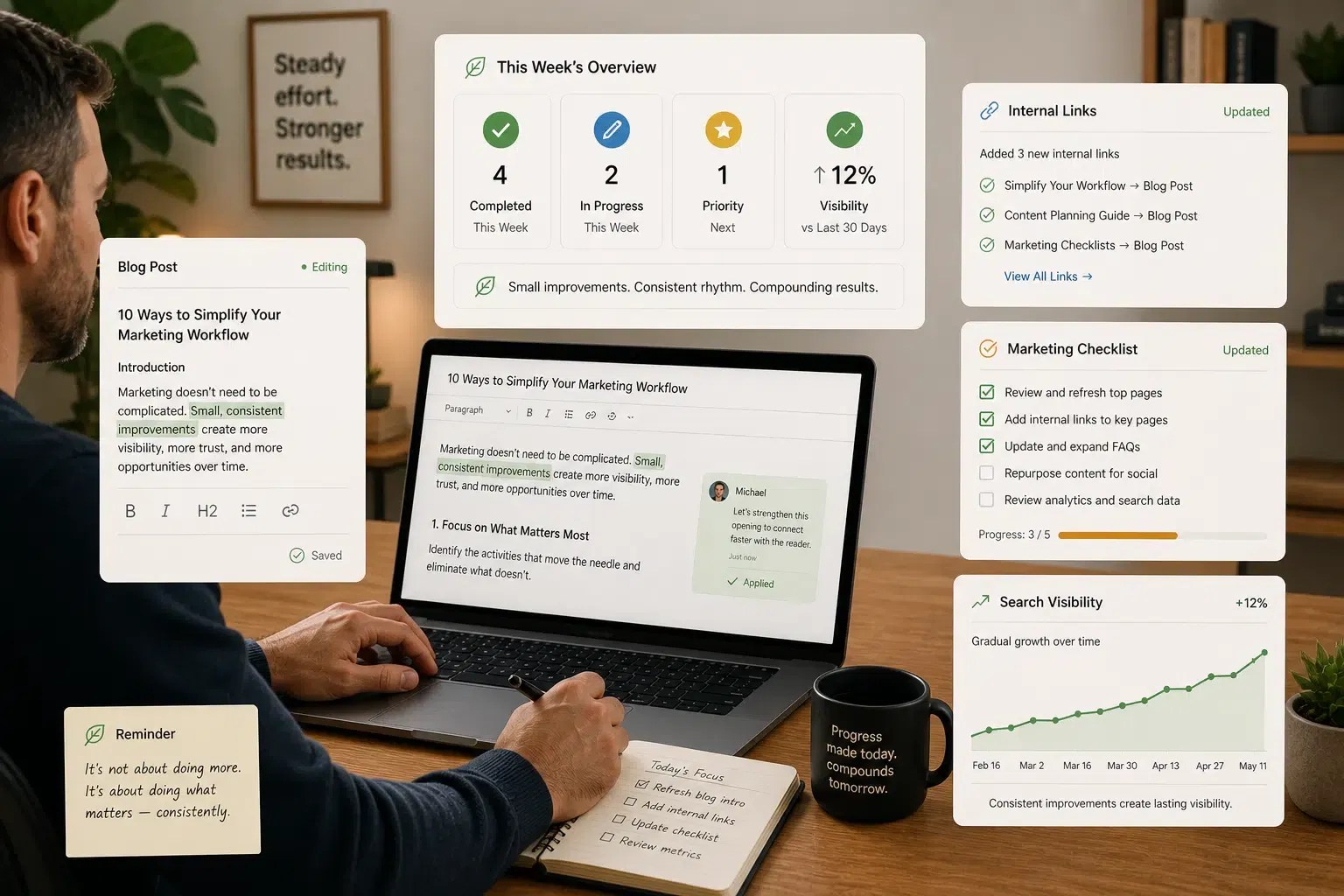
This is the core philosophy of the Rhythm Marketing Engine. We focus on:
- Service Page Integrity: Ensuring your core offerings are clear and up to date.
- Internal Linking: Connecting your useful content so that both humans and search engines can find it.
- Content Refreshing: Updating old posts to keep them relevant and high-performing.
- Structured Distribution: Taking your best website content and making it “social-ready” without the friction of a manual process.
This is not “fire and forget.” It is “govern and grow.” It is a partnership in which we take ownership of marketing operations so you can reclaim your time.
Conclusion: Reclaiming Your Intent
The cost of an AI agent isn’t just the monthly subscription fee. It’s the cost of the attention you have to pay to it, or the price you pay when you stop paying attention.
If you are a small service business, your expertise is your most valuable asset. Don’t let it be diluted by unmanaged automation. Avoid the Drift Tax by establishing a Governance of Intent. Build your Central Repository. And if you don’t have the time or the desire to manage that engine yourself, find a partner who will.
Marketing should be a steady rhythm, not a chaotic sprint followed by a long silence. It should be an engine that supports your business, governed by your intent, and moved forward by human hands.
Frequently Asked Questions (FAQ)
What exactly is the “Drift Tax”?
The Drift Tax is the hidden cost, measured in time, money, and brand reputation, that results when AI-generated content or agents deviate from your actual brand voice, service facts, or strategic goals due to a lack of human oversight and up-to-date context.
How does a Central Repository of Intent help?
A Central Repository of Intent (or “The Brain”) acts as a single source of truth for your business. It stores your specific rules, methodology, and brand guidelines, ensuring that any AI agent or human creator is working from the same accurate, up-to-date information.
Why is human oversight still necessary if AI is so “smart”?
AI is excellent at pattern matching but lacks “judgment.” It doesn’t know when you’ve changed your business strategy or when a piece of advice is no longer relevant. Human oversight provides the governance needed to ensure the AI’s output is strategically sound and factually accurate.
Is the Rhythm Marketing Engine just an AI tool?
No. The Rhythm Marketing Engine is a managed service. While we use AI to improve efficiency, the “Engine” is driven by human marketing experts who manage strategy, governance, and execution to ensure steady, reliable progress for your business.
Can’t I just manage the $149 AI agent myself?
You can, but that requires you to be the “Marketing Operations Manager.” For most marketing owners, this leads to the very inconsistency they were trying to avoid. The value of a managed service lies in removing the coordination burden from the responsible person while ensuring a higher standard of quality.

Leave a Reply